
Technical Support & Resources
Visit our FAQ
Contact Us
Toll Free Phone (USA and Canada Only): (888) 526-5351
Direct Phone: (734) 975-3888
Product Categories
Product Type
IGF2BP2 Long Isoform (human, recombinant)
Item No. 41533
Technical Information
- IGF2 mRNA-binding Protein 2
- Insulin-like Growth Factor 2 mRNA-binding Protein 2
- IMP-2
- VICKZ2
Shipping & Storage Information
Recommended Products
Certificates of Analysis & Batch Specific Data
Provide batch numbers separated by commas to download or request available product inserts, QC sheets, certificates of analysis, data packs, and GC-MS data.

Explore Obesity & Metabolic Disease Resources
Discover high-quality research tools to investigate GLP-1 mechanisms and next-generation metabolic targets.
OBESITY RESEARCH SOLUTIONSProduct Description
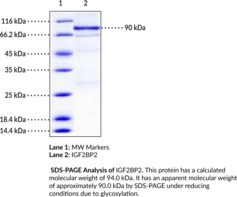
Insulin-like growth factor 2 mRNA-binding protein 2 (IGF2BP2) is an RNA-binding protein (RBP) and a member of the zipcode-binding protein (ZBP) family.1 It is composed of two N-terminal RNA recognition motifs (RRMs) and four C-terminal heterogeneous nuclear ribonucleoprotein (hnRNP) K-homology (KH) domains. IGF2BP2 is ubiquitously expressed during development and localizes to the cytoplasm.1,2 It exists as three isoforms: p58, which lacks an RRM motif, p62, which has a shortened linker region between KH2 and KH3, and the full-length isoform, p66.3 IGF2BP2 is involved in RNA processing through N6-methyladenosine (m6A) recognition, metabolism, neurogenesis, and embryonic development and interacts with several target transcripts, including IGF2, LAMB2, TRIM54, EIF4A1, and NTN4, as well as some mitochondrial genes.1,4,5 IGF2BP2 promotes or inhibits invasion and migration of cancer cells in vitro in a context-dependent manner.4,5 SNPs in IGF2BP2 are associated with an increased risk of type 2 diabetes.6 Cayman’s IGF2BP2 long isoform (human, recombinant) protein consists of 836 amino acids and has a calculated molecular weight of 94 kDa. By SDS-PAGE, under reducing conditions, the apparent molecular weight of the protein is 90 kDa.
WARNING This product is not for human or veterinary use.
References & Product Citations
1. The biological function of IGF2BPs and their role in tumorigenesis. Invest. New Drugs 39(6), 1682-1693 (2021).
2. Dynamic expression of m6A regulators during multiple human tissue development and cancers. Front. Cell Dev. Biol. 8, 629030 (2021).
3. Two isoforms of the mRNA binding protein IGF2BP2 are generated by alternative translational initiation. PLoS One 7(3), e33140 (2012).
4. The m6A reader IGF2BP2 promotes esophageal cell carcinoma progression by enhancing EIF4A1 translation. Cancer Cell Int. 24(1), 162 (2024).
5. IGF2BP2 inhibits invasion and migration of clear cell renal cell carcinoma via targeting netrin-
6. The diverse functions of IMP2/IGF2BP2 in metabolism. Trends in Endocrinol. Metab. 31(9), 679-679 (2020).
Contact Info
Cayman Chemical1180 East Ellsworth RoadAnn Arbor, Michigan 48108 USAToll Free: (800) 364-9897(USA and Canada only)Fax: (734) 971-3640


