
Technical Support & Resources
Visit our FAQ
Contact Us
Toll Free Phone (USA and Canada Only): (888) 526-5351
Direct Phone: (734) 975-3888
Product Categories
Product Type
Application
Technical Information
- BTC
Shipping & Storage Information
Recommended Products
Certificates of Analysis & Batch Specific Data
Provide batch numbers separated by commas to download or request available product inserts, QC sheets, certificates of analysis, data packs, and GC-MS data.

Explore Obesity & Metabolic Disease Resources
Discover high-quality research tools to investigate GLP-1 mechanisms and next-generation metabolic targets.
OBESITY RESEARCH SOLUTIONSProduct Description
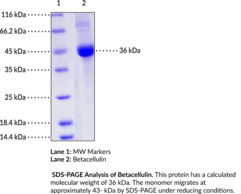
Betacellulin is a member of the EGF family of growth factors.1,2,3 It is composed of a signal peptide, an extracellular domain, which contains the EGF-like domain and a proteolytic cleavage site, a transmembrane domain, and a cytoplasmic domain.2,3 Betacellulin is ubiquitously expressed and undergoes shedding via cleavage by disintegrin and metalloproteinase domain-containing proteins (ADAMs) to release the soluble mature form. It acts as a ligand for homodimers of EGFR or HER4 and all possible heterodimers of EGFR, HER2, HER3, and HER4 to induce signaling through various pathways, including JNK, RAS/RAF/MEK/ERK, and Akt. Betacellulin has mitogenic activity toward pancreatic β-cells in vitro and improves glucose tolerance in vivo.1,2 It is also involved in reproduction, mammary gland and neonatal gastrointestinal tract development, and adult neurogenesis.2,3,4 Intratumoral levels of betacellulin are increased in patients with lung adenocarcinoma.5 Cayman’s Betacellulin (human, recombinant) protein can be used for cell-based assays. This protein is a disulfide-linked homodimer. The reduced monomer, composed of betacellulin (amino acids 32-111) fused to human IgG1 Fc at its C-terminus, consists of 321 amino acids, has a calculated molecular weight of 36 kDa, and a predicted N-terminus of Asp32 after signal peptide cleavage. The monomer migrates at approximately 43-46 kDa by SDS-PAGE under reducing conditions.
WARNING This product is not for human or veterinary use.
References & Product Citations
1. Betacellulin: A mitogen from pancreatic β cell tumors. Science 259, 1604-1607 (1993).
2. The ABC of BTC: Structural properties and biological roles of betacellulin. Semin. Cell Dev. Biol. 28, 42-48 (2014).
3. Structure-
4. Betacellulin promotes cell proliferation in the neural stem cell niche and stimulates neurogenesis. Proc. Natl. Acad. Sci. USA 109(4), 1317-1322 (2012).
5. Betacellulin promotes tumor development and EGFR mutant lung cancer growth by stimulating the EGFR pathway and suppressing apoptosis. iScience 25(5), 104211 (2022).
Contact Info
Cayman Chemical1180 East Ellsworth RoadAnn Arbor, Michigan 48108 USAToll Free: (800) 364-9897(USA and Canada only)Fax: (734) 971-3640


