
Technical Support & Resources
Information provided in the product description is from published literature. Due to the nature of scientific experimentation, your results (e.g., selectivity and effective concentrations) or specific application for this product may differ. If you have questions about how this product fits your application, please contact our technical support staff.
Visit our FAQ
Contact Us
Toll Free Phone (USA and Canada Only): (888) 526-5351
Direct Phone: (734) 975-3888
Product Categories
Research Area
Technical Information
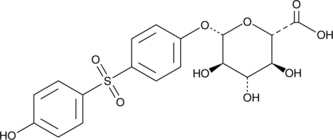
- BPSG
- BPS Glucuronide
Shipping & Storage Information
Recommended Products
Certificates of Analysis & Batch Specific Data
Provide batch numbers separated by commas to download or request available product inserts, QC sheets, certificates of analysis, data packs, and GC-MS data.

Visit Our Environmental Toxicology Resource Center
Explore additional resources to study natural toxins, pollutants including PFAS and 6-PPD-Q, and their biological effects.
ENVIRONMENTAL TOXICOLOGY TOOLS & SERVICESProduct Description
Bisphenol S glucuronide (BPSG) is a metabolite of BPS (Item No. 45556).1 It is formed from BPS primarily by the UDP-glucuronosyltransferase (UGT) isoform UGT1A9. BPSG decreases the basal glycolytic capacity of non-cancerous primary urothelial cells and increases the basal glycolytic and mitochondrial capacities of RT4 bladder cancer cells.2 BPSG is inactive at estrogen and thyroid hormone receptors and exhibits negligible transfer across the human placenta ex vivo.3,4 It has been found in various foods, including fish, vegetables, and meats.5
WARNING This product is not for human or veterinary use.
References & Product Citations
1. Differences in the glucuronidation of bisphenols F and S between two homologous human UGT enzymes, 1A9 and 1A10. Xenobiotica 45(6), 511-519 (2015).
2. Glucuronidated metabolites of bisphenols A and S alter the properties of normal urothelial and bladder cancer cells. Int. J. Mol. Sci. 23(21), 12859 (2022).
3. Influence of metabolism on endocrine activities of bisphenol S. Chemsphere 157, 152-159 (2016).
4. Is bisphenol S a safer alternative to bisphenol A in terms of potential fetal exposure? Placental transfer across the perfused human placenta. Chemsphere 221, 471-478 (2019).
5. Occurrence of bisphenol analogues and their conjugated metabolites in foodstuff. Sci. Total Environ. 948, 174922 (2024).
Contact Info
Cayman Chemical1180 East Ellsworth RoadAnn Arbor, Michigan 48108 USAToll Free: (800) 364-9897(USA and Canada only)Fax: (734) 971-3640


