
Technical Support & Resources
Visit our FAQ
Contact Us
Toll Free Phone (USA and Canada Only): (888) 526-5351
Direct Phone: (734) 975-3888
Technical Information
- Becaplermin
- IBGC5
- PDGF-2
- PDGFB
- Platelet-Derived Growth Factor B Chain
- Platelet-Derived Growth Factor β Polypeptide
- Proto-oncogene c-Sis
- SIS
- SSV
Shipping & Storage Information
Recommended Products
Certificates of Analysis & Batch Specific Data
Provide batch numbers separated by commas to download or request available product inserts, QC sheets, certificates of analysis, data packs, and GC-MS data.
Kinase Resource Center
Discover Products & Resources for Kinase Research
- Kinase inhibitors, screening libraries, assay kits, & more
- Tools to study kinase signaling pathways:
- Growth factor signaling
- PI3K/Akt/mTOR
- MAPKs (ERK, p38, & JNK)
- JAK/STAT signaling
- Articles, resources, & advice
Product Description
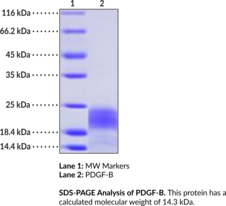
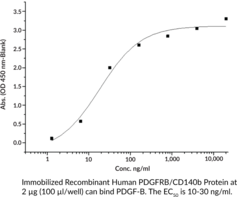
PDGF-B is a secreted growth factor and member of the PDGF family.1 It is composed of a signal peptide, a pro-peptide sequence, a growth factor domain containing a cystine knot, and a C-terminal tail. PDGF-B is expressed at high levels in the heart, placenta, and fetal kidney and in the brain in the substantia nigra.2 It exists as either a homodimer, PDGF-BB, which can activate PDGFRα or PDGFRβ, or a heterodimer with PDGF-A, PDGF-AB, which can only activate PDGFRα, and induces signaling through multiple pathways, including ERK/MAPK, PI3K/Akt/mTOR, PLC/PKC, and JAK/STAT.1,3,4 PDGF-B is a potent mitogen for cells of mesenchymal origin and is necessary for vascular development and vascular smooth muscle cell proliferation in the CNS, lungs, heart, placenta, and skin.4,5 A fusion between the genes encoding PDGF-B and collagen 1A1, PDGFB and COL1A1, leads to overproduction of PDGF-B and is associated with various benign and malignant tumors, including dermatofibrosarcoma protuberans.4 Formulations containing PDGF-B have been used in the treatment of diabetic neuropathic foot ulcers. Cayman's PDGF-B (human, recombinant) protein can be used for binding assays. This protein consists of 124 amino acids and has a calculated molecular weight of 14.3 kDa. By SDS-PAGE, under reducing conditions, the apparent molecular mass of the protein is 20 kDa due to glycosylation.
WARNING This product is not for human or veterinary use.
References & Product Citations
1. Platelet-
2. PDGF-
3. Structural and functional properties of platelet-
4. The role of small molecule platelet-
5. Endothelial-
Contact Info
Cayman Chemical1180 East Ellsworth RoadAnn Arbor, Michigan 48108 USAToll Free: (800) 364-9897(USA and Canada only)Fax: (734) 971-3640


