
Technical Support & Resources
Visit our FAQ
Contact Us
Toll Free Phone (USA and Canada Only): (888) 526-5351
Direct Phone: (734) 975-3888
Product Categories
Product Type
Cholera Toxin B Subunit (recombinant)
Item No. 46349
Technical Information
- Cholera Enterotoxin B Chain
- Cholera Enterotoxin Gamma Chain
- Cholera Enterotoxin Subunit B
- Choleragenoid
- CTB
- CTxB
Shipping & Storage Information
Recommended Products
Certificates of Analysis & Batch Specific Data
Provide batch numbers separated by commas to download or request available product inserts, QC sheets, certificates of analysis, data packs, and GC-MS data.
Lipid Resource Center
Discover Products & Resources for Lipid Research
- High-purity lipid standards
- Lipid roles in biology
- Lipids in health & disease
- Lipids for pharmaceutical development
- Protocols, advice, & resources
Product Description
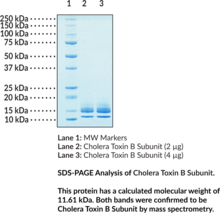
Cholera toxin is produced by V. cholerae and is a multimeric enterotoxin that consists of a single A subunit surrounded by five B subunits.1,2 The non-toxic pentameric B subunit of cholera toxin binds to ganglioside GM1 (Item No. 19579), which acts as a receptor on mammalian cells, and facilitates entrance of the toxic A subunit into cells.3,1 Cholera toxin B subunit (CTB) has been widely used in glycosphingolipid and membrane biology to study lipid rafts, nanodomain assembly, membrane organization and curvature, clathrin-independent endocytosis, and retrograde trafficking in the central nervous system (CNS) either alone or conjugated to a reporter.4,5,6 It has also been used as a carrier protein and an adjuvant, where it increases IgA immune responses, antigen presentation, B cell differentiation, and T cell proliferation.7,8 Formulations containing recombinant CTB have been used as cholera vaccines. Cayman’s Cholera Toxin B Subunit (recombinant) protein can be used for binding assay, cell-based assay, and Western blot (WB) applications.
WARNING This product is not for human or veterinary use.
References & Product Citations
1. Insights on the trafficking and retro-
2. Cholera toxin B: One subunit with many pharmaceutical applications. Toxins (Basel) 7(3), 974-996 (2015).
3. Dissecting the cholera toxin-
4. Cholera toxin binds to lipid rafts but has a limited specificity for ganglioside GM1. Immunol. Cell Biol. 85(5), 378-382 (2007).
5. Cholera toxin as a probe for membrane biology. Toxins (Basel) 13(8), 543 (2021).
6. Iontophoretic application of unconjugated cholera toxin B subunit (CTb) combined with immunohistochemistry of neurochemical substances: A method for transmitter identification of retrogradely labeled neurons. Brain Res. 534(1-2), 209-224 (1990).
7. Evaluation of cholera toxin B subunit as a novel carrier protein for polysaccharide conjugate vaccines. Vaccines (Basel) 13(11), 1159 (2025).
8. Cholera toxin and cholera B subunit as oral-
Contact Info
Cayman Chemical1180 East Ellsworth RoadAnn Arbor, Michigan 48108 USAToll Free: (800) 364-9897(USA and Canada only)Fax: (734) 971-3640