
Technical Support & Resources
Information provided in the product description is from published literature. Due to the nature of scientific experimentation, your results (e.g., selectivity and effective concentrations) or specific application for this product may differ. If you have questions about how this product fits your application, please contact our technical support staff.
Visit our FAQ
Contact Us
Toll Free Phone (USA and Canada Only): (888) 526-5351
Direct Phone: (734) 975-3888
Product Categories
Research Area
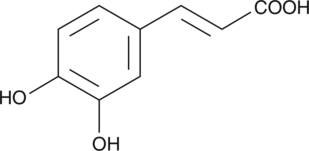
Technical Information
- 3,4-Dihydroxycinnamic Acid
Shipping & Storage Information
Recommended Products
Certificates of Analysis & Batch Specific Data
Provide batch numbers separated by commas to download or request available product inserts, QC sheets, certificates of analysis, data packs, and GC-MS data.
Lipid Resource Center
Discover Products & Resources for Lipid Research
- High-purity lipid standards
- Lipid roles in biology
- Lipids in health & disease
- Lipids for pharmaceutical development
- Protocols, advice, & resources
Product Description
Caffeic acid is a polyphenol that has been found in E. alatus and has diverse biological activities.1,2,3,4 It is an inhibitor of lysine demethylase 6A (KDM6A) and KDM4C (IC50s = 5.5 and 13.7 µM, respectively).1 Caffeic acid also inhibits 12-lipoxygenase (12-LO) and 5-LO (IC50s = 5.1 and 72 µM, respectively) and matrix metalloproteinase-9 (MMP-9) and MMP-2 (IC50s = 8 and 12 µM, respectively).2,3,4 It inhibits increases in migration and invasion induced by phorbol 12-myristate 13-acetate (PMA; Item No. 10008014) in HepG2 hepatocellular carcinoma cells when used at a concentration of 100 µg/ml.4 Caffeic acid (5 mg/kg three times per week) decreases tumor growth and the number of liver metastases in a HepG2 mouse xenograft model.
WARNING This product is not for human or veterinary use.
References & Product Citations
1. Identification of catechols as histone-
2. Inhibition of arachidonate lipoxygenase activities by 2-
3. Caffeic acid is a selective inhibitor for leukotriene biosynthesis. Biochim. Biophys. Acta 792(1), 92-97 (1984).
4. Novel and therapeutic effect of caffeic acid and caffeic acid phenyl ester on hepatocarcinoma cells: Complete regression of hepatoma growth and metastasis by dual mechanism. The FASEB Journal 18(14), 1670-1681 (2004).
A fluorescence-
Contact Info
Cayman Chemical1180 East Ellsworth RoadAnn Arbor, Michigan 48108 USAToll Free: (800) 364-9897(USA and Canada only)Fax: (734) 971-3640


