
Technical Support & Resources
Information provided in the product description is from published literature. Due to the nature of scientific experimentation, your results (e.g., selectivity and effective concentrations) or specific application for this product may differ. If you have questions about how this product fits your application, please contact our technical support staff.
Visit our FAQ
Contact Us
Toll Free Phone (USA and Canada Only): (888) 526-5351
Direct Phone: (734) 975-3888
Product Categories
Research Area
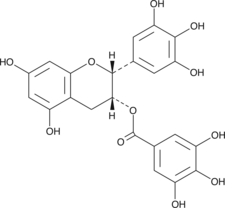
Technical Information
- EGCG
Shipping & Storage Information
Recommended Products





Certificates of Analysis & Batch Specific Data
Provide batch numbers separated by commas to download or request available product inserts, QC sheets, certificates of analysis, data packs, and GC-MS data.

Explore Obesity & Metabolic Disease Resources
Discover high-quality research tools to investigate GLP-1 mechanisms and next-generation metabolic targets.
OBESITY RESEARCH SOLUTIONSProduct Description
(–)-Epigallocatechin gallate (EGCG) is a phenol that has been found in green and black tea plants and has diverse biological activities.1,2,3,4,5,6,7 It is lytic against T. cruzi amastigotes, with a 50% bactericidal concentration (MBC50) value of 0.53 pM.1 EGCG decreases deoxyguanosine oxidation and tyrosine nitration (IC50s = 0.25 and 0.11 mM, respectively) and inhibits macrophage-mediated LDL oxidation in vitro.2,3 EGCG increases LDL receptor binding activity and lowers cholesterol levels in HepG2 cells via increased cholesterol efflux.4 It inhibits heregulin-β1-induced activation of ErbB2 and ErbB3, as well as migration and invasion of MCF-7 breast cancer cells.5 In vivo, EGCG reduces food intake and body weight, serum levels of insulin, leptin, testosterone, and growth hormone, and the size of the ventral prostate, testis, liver, and spleen in male Sprague Dawley, lean Zucker, and obese Zucker rats when administered at doses of 82, 81, and 92 mg/kg, respectively.6 It also reduces increases in hepatic steatosis, inflammatory cell infiltration, and injury in a mouse model of non-alcoholic steatohepatitis (NASH) induced by a methionine- and choline-deficient diet when administered at doses of 50 and 100 mg/kg.7
WARNING This product is not for human or veterinary use.
References & Product Citations
1. Anti-
2. (−)-
3. Inhibitory effect of tea flavonoids on the ability of cells to oxidize low density lipoprotein. Biochem. Pharmacol. 58, 1695-1703 (1999).
4. Modulation of cholesterol metabolism by the green tea polyphenol (−)-
5. Inhibitory effect of (‒)-
6. Modulation of endocrine systems and food intake by green tea epigallocatechin gallate. Endocrinology 141(3), 980-987 (2000).
7. Epigallocatechin gallate attenuated non-
Contact Info
Cayman Chemical1180 East Ellsworth RoadAnn Arbor, Michigan 48108 USAToll Free: (800) 364-9897(USA and Canada only)Fax: (734) 971-3640


