
Technical Support & Resources
Information provided in the product description is from published literature. Due to the nature of scientific experimentation, your results (e.g., selectivity and effective concentrations) or specific application for this product may differ. If you have questions about how this product fits your application, please contact our technical support staff.
Visit our FAQ
Contact Us
Toll Free Phone (USA and Canada Only): (888) 526-5351
Direct Phone: (734) 975-3888
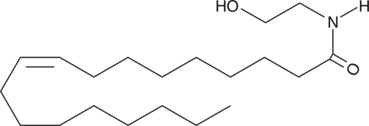
Technical Information
- Oleic Acid Ethanolamide
- OEA
Shipping & Storage Information
Recommended Products
Certificates of Analysis & Batch Specific Data
Provide batch numbers separated by commas to download or request available product inserts, QC sheets, certificates of analysis, data packs, and GC-MS data.

Explore Obesity & Metabolic Disease Resources
Discover high-quality research tools to investigate GLP-1 mechanisms and next-generation metabolic targets.
OBESITY RESEARCH SOLUTIONSProduct Description
Oleoyl ethanolamide (OEA) is an analog of the endocannabinoid AEA found in brain tissue and in chocolate.1 It is one of the long chain fatty acid ethanolamides that accumulates rapidly in infarcted tissue,2 but its biosynthesis is reduced in the intestine of rats following food deprivation.3 OEA is an endogenous, potent agonist for PPARα, exhibiting an EC50 value of 120 nM in a transactivation assay.4 Systemic administration of OEA suppresses food intake and reduces weight gain in rats (10 mg/kg intraperitoneally) and PPARα wild-
WARNING This product is not for human or veterinary use.
References & Product Citations
1. Brain cannabinoids in chocolate. Nature 382(6593), 677-678 (1996).
2. Inhibition of permeability-
3. An anorexic lipid mediator regulated by feeding. Nature 414(6860), 209-212 (2001).
4. Oleylethanolamide regulates feeding and body weight through activation of the nuclear receptor PPAR-
Characterisation of (R)-
Contact Info
Cayman Chemical1180 East Ellsworth RoadAnn Arbor, Michigan 48108 USAToll Free: (800) 364-9897(USA and Canada only)Fax: (734) 971-3640


