
Technical Support & Resources
Information provided in the product description is from published literature. Due to the nature of scientific experimentation, your results (e.g., selectivity and effective concentrations) or specific application for this product may differ. If you have questions about how this product fits your application, please contact our technical support staff.
Visit our FAQ
Contact Us
Toll Free Phone (USA and Canada Only): (888) 526-5351
Direct Phone: (734) 975-3888
Product Categories
Research Area
Technical Information
- DHC
Shipping & Storage Information
Recommended Products
Certificates of Analysis & Batch Specific Data
Provide batch numbers separated by commas to download or request available product inserts, QC sheets, certificates of analysis, data packs, and GC-MS data.
Lipid Resource Center
Discover Products & Resources for Lipid Research
- High-purity lipid standards
- Lipid roles in biology
- Lipids in health & disease
- Lipids for pharmaceutical development
- Protocols, advice, & resources
Product Description
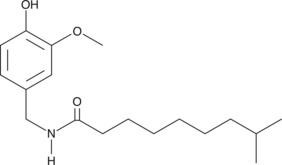
Dihydrocapsaicin is a terpene alkaloid that has been found in Capsicum and has diverse biological activities.1,2,3 It is active against E. faecalis, B. subtilis, S. aureus, P. aeruginosa, K. pneumoniae, E. coli, and C. albicans (MICs = 0.6-10 µg/ml).1 Dihydrocapsaicin scavenges DPPH (Item No. 14805) and ABTS (Item No. 27317) radicals in cell-free assays. It increases LC3-II, a marker of autophagy, and catalase levels and reduces reactive oxygen species (ROS) production in normal WI38 lung fibroblasts and H1299, but not A549 or H460, lung cancer cells when used at a concentration of 200 µM.2 Dihydrocapsaicin is an agonist of transient receptor potential vanilloid 1 (TRPV1) and inhibits NETosis induced by phorbol 12-myristate 13-acetate (TPA; Item No. 10008014) in isolated human neutrophils.4,5 It induces cortical and systemic hypothermia and reduces infarct volume in a rat model of ischemia-reperfusion injury induced by middle cerebral artery occlusion (MCAO) when administered at a dose of 0.5 mg/kg, i.p.3
WARNING This product is not for human or veterinary use.
References & Product Citations
1. Quantification, antioxidant and antimicrobial activity of phenolics isolated from different extracts of Capsicum frutescens (pimenta malagueta). Molecules 19(4), 5434-5447 (2014).
2. Selective induction of catalase-
3. Dihydrocapsaicin (DHC) enhances the hypothermia-
4. Shivering and tachycardic responses to external cooling in mice are substantially suppressed by TRPV1 activation but not by TRPM8 inhibition. Am. J. Physiol. Regul. Integr. Comp. Physiol. 305(9), R1040-R1050 (2013).
5. High-
Contact Info
Cayman Chemical1180 East Ellsworth RoadAnn Arbor, Michigan 48108 USAToll Free: (800) 364-9897(USA and Canada only)Fax: (734) 971-3640


