
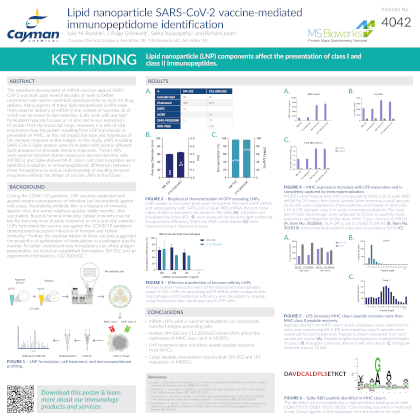
Lipid Nanoparticle SARS-CoV-2 Vaccine-Mediated Immunopeptidome Identification
Scientific posters
In this study, LNPs encoding SARS-CoV-2 Spike protein were formulated with several different lipids proposed to stimulate immune responses. These LNPs were used to transfect human monocyte-derived dendritic cells (MDDCs), and Spike-derived MHC class I and class II peptides were identified. Evaluation of immunopeptidomic differences between these formulations as well as understanding of resulting immune responses will help the design of vaccine LNPs in the future.
Do you have a question or comment for the presenter? Let us know.
To cite this poster: Rumble, J.M., Gronevelt, J.P., Nyayapathy, S., et al. Lipid nanoparticle SARS-CoV-2 vaccine-mediated immunopeptidome identification. Poster presented at: The Annual Meeting of the American Association of Immunologists; May 3-7, 2025. Honolulu, HI.
Improved Identification of Allele-specific MHC class II Immunopeptidome
Scientific posters
In this study, we have developed a workflow to improve the experimental identification of allele-specific MHC class II-associated peptides by biotinylating the α chain of HLA-DR in live cells. This was accomplished using the HLA-DR-null HL-60 cell line, cotransfecting with BirA and Avi-tagged MHC expression constructs. Supply of exogenous biotin ensured the specific biotinylation of MHC, which was then enriched from lysates using either streptavidin or HLA-DR-specific antibody. Peptides were eluted from these complexes and identified by mass spec. This procedure successfully captured all HLA-DR expressed by the cells and peptides identified by the traditional immunoaffinity approach were compared with the biotinylation approach.
Do you have a question or comment for the presenter? Let us know.
To cite this poster: Ho, B., Good, P., Nyayapathy, S., et al. Improved identification of allele-specific MHC class II immunopeptidome. Poster presented at: The Annual Meeting of the American Association of Immunologists; May 3-7, 2024. Chicago, IL.
Immunopeptidome Profiling of Xenograft Glioma Samples
Scientific posters
Characterization of the peptides presented by MHC molecules (pMHC) on cancer cells and their immunogenic potential is key for generating anti-cancer immune responses. Experimental identification of pMHC is performed using MHC immunoprecipitation and mass spec sequencing of eluted peptides.
In the current study, we characterize the immunopeptidome of two human glioma lines, U87 and DIPG, which were grown in nude mice. As one potential complication of cells grown in mice may be contribution of mouse pMHC to the overall peptide list, we tested specific depletion of mouse MHC prior to immunoprecipitation of human MHC complexes. We analyzed all peptide lists for the actual contribution of mouse-derived peptides to the immunopeptidome and found the true contribution of murine peptides to be minimal.
Do you have a question or comment for the presenter? Let us know.
To cite this poster: Rumble, J.M., Nyayapathy, S., Jones, R., et al. Immunopeptidome profiling of xenograft glioma samples. Poster presented at: 2023 Michigan Life Sciences Showcase; September 18, 2023; Lansing, MI.
Biophysical Characterization of MR1 (K43A)/β2M Complex
Scientific posters
To cite this poster: Stewart, S., Muzzarelli, K.M., Good, P.D., et al. Biophysical Characterization of MR1 (K43A)/β2M Complex. Poster presented at: 19th Annual PEGS Boston Conference; May 15-19, 2023; Boston, MA.
CT26 Neoantigen Presentation and Immunogenicity
Scientific posters
We show that immune responses elicited to neoantigens can be identified through immunopeptidome profiling in this work.
Vaccination against tumor antigens is one method being explored to generate immune responses against tumors and may be particularly effective in conjunction with therapies currently in the clinic, such as checkpoint inhibition. Identification of antigens for use in a vaccine is the pinch point of this method. Using immunopeptidome profiling, we have narrowed a collection of published potential neoantigens to those presented by MHC class I in the CT26 mouse colorectal cancer cell line. These peptides were synthesized used to immunize BALB/c mice, and immunogenicity of the peptide mix was evaluated by ELISpot to assess IFN-γ responses in immunized mice. These experiments support a complete workflow for the selection of potential cancer neoantigens that experimentally exhibit both MHC presentation and immunogenicity.
Do you have a question or comment for the presenter? Let us know.
To cite this poster: Nyayapathy, S., Jones, R., Ford, M., et al. CT26 neoantigen presentation and immunogenicity. Poster presented at: American Association for Cancer Research Annual Meeting 2023; April 14-19, 2023.
Immunopeptidome Analysis of Mouse MHC Class I
Scientific posters
In this study, we compare different antibodies to mouse MHC class I complexes for their efficiency of associated peptide recovery. Input was murine EL-4 cells, which are T lymphoblast cells derived from a C57BL/6 background. We performed immunoprecipitation (IP) with different antibodies either singly or sequentially to enrich MHC class I, followed by gentle elution of associated peptides, and finally peptide analysis by mass spectrometry. Each IP workflow yielded a different (but overlapping) cohort of peptides, suggesting optimal methodologies for analyses of immunopeptidomes from common laboratory mouse strains.
Do you have a question or comment for the presenter? Let us know.
To cite this poster: Nyayapathy, S., Jones, R., Ford, M., Pisano, M., and Rumble, J. Immunopeptidome Analysis of Mouse MHC Class I. Poster presented at: American Association for Cancer Research Annual Meeting 2022; April 10 - 13, 2022.
Cancer Neoepitope Identification in Soluble HLA from Patient Plasma
Scientific posters
The roles of the major histocompatibility complexes (MHCs) in anticancer immunity are well established. Cytotoxic immune cells can recognize MHC presentation of unique peptides from altered proteins on the surface of tumor cells (tumor neoantigens) or the downregulation of MHC itself and kill the affected cells. One of the hallmarks of cancer progression is the evasion of antitumor immunity by various mechanisms, including the upregulation of checkpoint proteins. Checkpoint inhibitors, which have recently seen dramatic success in the clinic in some cancers, act by inducing potent immune responses to tumor neoantigens. In addition, the promise of personalized medicine lies in the theoretical ability to teach the immune system through vaccination to recognize and kill tumor cells bearing MHC-presented neoantigens.
Do you have a question or comment for the presenter? Let us know.
To cite this poster: Rumble, J.M., Pisano, M., Jones, R., et al. Cancer neoepitope identification in soluble HLA from patient plasma. Poster presented at: 2020 American Association for Cancer Research (AACR) Virtual Meeting II; June 22-24, 2020.
Chemotherapeutic Drug-Induced Tumor Neoantigen Discovery
Scientific posters
We hypothesize that some chemotherapeutics can cause DNA mutations that are translated into proteins and peptides that make their way into the MHC class I peptide presentation pathway. If these neoantigens are seen by CD8+ T cells as foreign, T cells will attack these tumor cells. This could provide one mechanism of action for an increase in therapeutic efficacy in tumors treated with combinations of chemotherapeutics and checkpoint inhibitors. We tested the ability of two drugs, SN-38 (an active metabolite of irinotecan) and oxaliplatin, to induce neoantigens by sequencing peptides from class I molecules in a colon cancer cell line.
Do you have a question or comment for the presenter? Let us know.
To cite this poster: Rumble, J., Mobley, J., Jones, R., et al. Chemotherapeutic drug-induced tumor neoantigen discovery. Poster presented at: 2019 American Association for Cancer Research (AACR) Annual Meeting; March 29-April 3, 2019; Atlanta, GA.
MS Based HLA Peptide Discovery Tumor Neoantigens and Biotherapeutic T Cell Epitopes
Scientific posters
Do you have a question or comment for the presenter? Let us know.
Mass spectrometry as a tool for MHC Class I and II neoantigen discovery
Scientific posters
Contact Info
Cayman Chemical1180 East Ellsworth RoadAnn Arbor, Michigan 48108 USAToll Free: (800) 364-9897(USA and Canada only)Fax: (734) 971-3640


