
Log InRegister
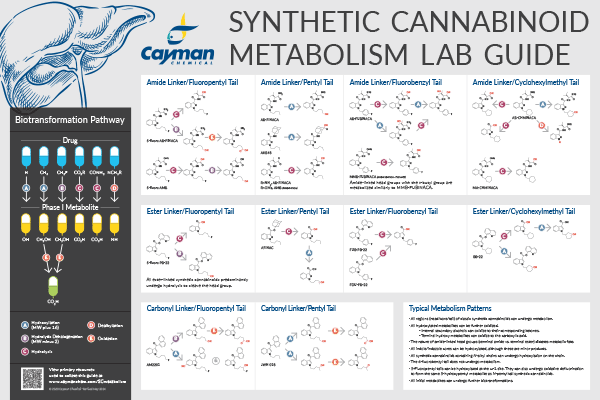
Synthetic Cannabinoid Metabolism Lab Guide
Lab Wall Posters
Synthetic cannabinoids undergo rapid and extensive metabolism to phase I metabolites that can sometimes retain high potency or may even be toxic compared to their parent compounds. Because of this rapid metabolism in vivo, it is typically impossible to detect the parent synthetic cannabinoids in biological samples. Metabolite detection is often the only viable way to determine synthetic cannabinoid exposure. Cayman's scientists have developed this laboratory guide for toxicologists and drug chemists to help identify these clinically relevant metabolites from several major classes of synthetic cannabinoids.
In this guide for synthetic cannabinoid metabolism we review:
- The Phase I Metabolite Biotransformation Pathway
- Metabolites of Amide-, Ester-, and Carbonyl-Linked Head Group Classes of Synthetic Cannabinoids
- Typical Synthetic Cannabinoid Metabolism Patterns
To cite this poster: Schelkun, R.M. and Iula, D.M. Synthetic Cannabinoid Metabolism Lab Guide. May 2024.
Phytocannabinoid Guide: Biosynthesis, Naming, and Numbering
Lab Wall Posters
Updated Februrary 2024
To cite this poster: St. Germaine, D.M. and Williams, J.B. Phytocannabinoid Guide: Biosynthesis, Naming, and Numbering. February 2024.
Laboratory Guide for Synthetic Cannabinoid Identification and Naming
Lab Wall Posters
Updated February 2022
Several novel synthetic cannabinoids have recently emerged in the illicit drug supply after the introduction of a synthetic cannabinoid structural-class regulation implemented by China in July 2021. New cannabimimetic scaffolds observed include the OXIZID series and a new methylene spacer, ABD-FUBIATA. Cayman's scientists have developed this laboratory guide for bench chemists and toxicologists to help identify novel synthetic cannabinoids.
- Common Synthetic Cannabinoid Mass Spec Fragments
- Mass Spectrum of MMB-FUBINACA and Tips for Interpretation
- Synthetic Cannabinoid Naming Conventions by Head, Core, and Tail Groups
To cite this poster: Schelkun, R.M. and Iula, D.M. Laboratory Guide for Synthetic Cannabinoid Identification and Naming. February 2022.
Cannabinoid Receptors
Lab Wall Posters
Updated August 2023
Learn more in the review article Cannabinoid Signaling: Insights to Future Pharmacotherapeutic Development.
View a complete list of binding affinity journal articles referenced in this poster here.
Contact Info
Cayman Chemical1180 East Ellsworth RoadAnn Arbor, Michigan 48108 USAToll Free: (800) 364-9897(USA and Canada only)Fax: (734) 971-3640


