
News & Announcements
Cannabinoid Signaling: Insights to Future Pharmacotherapeutic Development
Article from 2020-09-03
Active compounds found in plants of the Cannabis genus as well as endogenous analogs of these substances, and a myriad of synthetic analogs can influence a wide range of biological processes by engaging G protein-coupled receptors (GPCRs) of the endocannabinoid system (Figure 1). This system also includes the enzymes involved in endocannabinoid synthesis, transporters that enable cellular uptake/release, and enzymes that initiate endocannabinoid degradation. Many additional receptors including GPR18, GPR55, and GPR119, peroxisome proliferator-activated receptors (PPARs), and several members of the transient receptor potential (TRP) ion channel superfamily are also closely associated. Parts of this system are present in virtually every cell type of the human body, situating them to influence varied physiological processes.
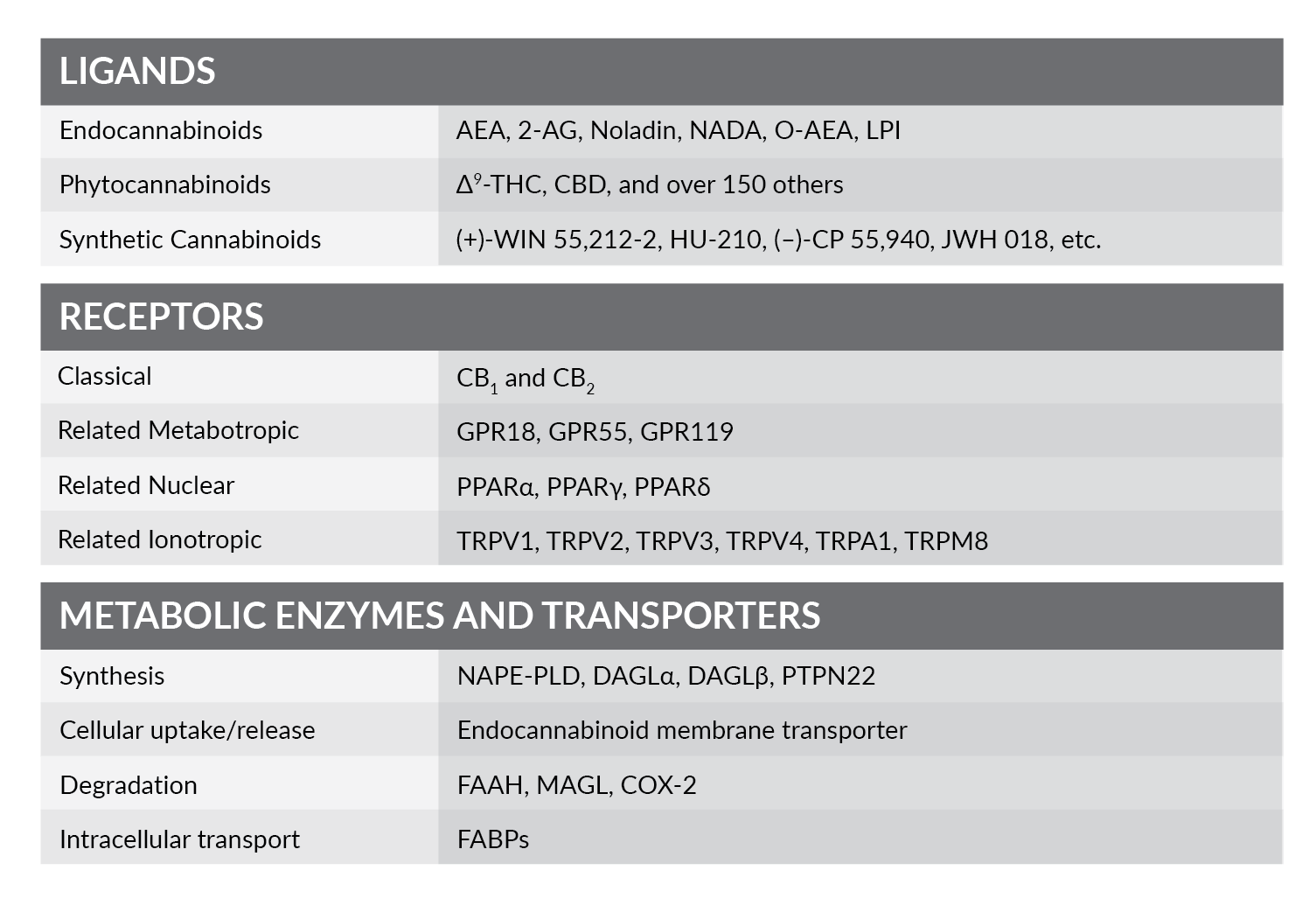
Figure 1. Cannabinoid system overview.
Cannabinoid Receptor Distribution and Mechanism of Action
The mechanism of actions of cannabinoids are becoming more realized with the understanding of the expression and distribution of the cannabinoid receptors CB1 and CB2 (Figure 2). CB1 receptors, though predominant in the brain, are also expressed in the spleen, lung, thymus, heart, and vasculature. In the CNS, they are most highly expressed by the axons and presynaptic termini of neurons in the amygdala, hippocampus, cortex, basal ganglia, and cerebellum. They are strongly associated with GABAergic (inhibitory) and glutamergic (excitatory) neurons, where they mediate inhibition of ongoing release of inhibitory and excitatory neurotransmitters.
Figure 2. Distribution of CB1 and CB2 and their associated functions.
CB1 receptors are coupled to Gi/Go proteins in a manner that leads to the inhibition of adenylate cyclase activity, activation of the β-arrestin pathway, regulation of L-, N- and P- or Q-type Ca2+ channels and G protein-regulated A-type and inwardly rectifying K+ channels, initiation of intracellular Ca2+ transients, stimulation of MAPK, and/or induction of immediate early gene expression (Figure 3). These receptors can also signal through Gs proteins, working in opposition to stimulate adenylate cyclase activity, causing a rise in intracellular cAMP levels. Under certain circumstances, CB1 can also couple to Gq. In a form of biased agonism, the actual ligand determines the signaling preference among these possible second messenger pathways.
Figure 3. G protein coupling of cannabinoid receptors.
Ligand binding to the receptor occurs through lateral insertion via the lipid bilayer rather than directly from solution. CB1 receptors also possess one or more allosteric sites wherein some ligands interact to enhance or inhibit CB1 receptor activation by direct agonists. Some CB1 receptors form heteromers with dopamine D2 receptors, μ-opioid receptors, and orexin-1 receptors, which can affect CB1 receptor activation by agonists adding to the complexity of cannabinoid signaling.
CB2 receptors are most abundant in tissues with immune function both outside of the brain, such as spleen, tonsils, bone marrow, pancreas, peripheral blood leukocytes, and inside of the brain in astrocytes and microglia (Figure 2). They function to modulate immune cell migration and cytokine release, but also have roles in cardiovascular and respiratory systems, bone, the gastrointestinal tract, liver, and the reproductive system.
CB2 receptors couple to Gi/o proteins to signal a response through inhibition of cAMP production, MAPK activation, and immediate early gene expression (Figure 3). No modulation of ion channels or alterations of intracellular Ca2+ has been observed in host cells expressing CB2 receptors.
Cannabinoid Receptor Structure
Much of the understanding of how ligands physically activate and inactivate CB receptors comes from structural observation of binding with agonists and antagonists wherein the C-terminal intracellular helix adopts an active or inactive conformation. The intracellular loop 2, particularly residue L222, of both CB1 and CB2 receptors plays a critical role in Gi and Gs protein coupling and specificity, making the inhibition versus activation of adenylate cyclase ligand specific. The first crystal structure of the human CB1 receptor in complex with a tight binding antagonist was successfully resolved in 2016. Since then, three more crystal structures and two cryo-electron microscopic (cryo-EM) structures of CB1 have been obtained and reported (Figure 4). Comparisons between the agonist- and antagonist-bound CB1 complexes show notable structural rearrangements around an extended twin molecular toggle switch (F200 and W356), whose activation leads to G protein binding and plasticity in the orthosteric binding pocket that can accommodate a variety of ligands with different shapes and sizes. F200 functions as a latch to restrict the movement of W356 and locks CB1 in the inactive state unable to bind G proteins.
Figure 4. Cryo-EM structure of CB1-Gi coupling bound with AM841 agonist [PDB ID(6KPG)] as determined by Hua, T., et al. and amino acid map of the receptor. Magenta, CB1; green, agonist; red, Gαi; yellow, Gβ; grey, single-chain variable fragment scFv16; cyan, Gγ.
The first crystal structure of CB2 bound to high-affinity synthetic antagonist was reported in 2019, and both the crystal structure and cryo-EM structure of agonist-bound CB2 was revealed in 2020 (Figure 5). The N-terminal sequence has different behaviors between the two receptors. Compared to CB1, CB2 only experiences minor conformational changes upon agonist binding. With antagonist bound, CB1 conforms to a V-shaped loop that inserts into the cannabinoid binding pocket. However, this portion of CB2 remains extended and does not interact with the pocket, instead hovering over it with no direct contact during antagonist binding. Also, there is only a single toggle switch residue (W258) for CB2. Interestingly, the antagonist-binding motif in CB2 looks similar to the agonist-binding motif in CB1, providing a structural basis for the fact that CB2 antagonists are often CB1 agonists. These structural differences also define ligand preference in that CB1 requires the polycyclic core of a potential ligand to have an alkyl chain of five or more carbons, while CB2 recognizes much smaller compounds.
Figure 5. Cryo-EM structure of CB2-Gi coupling bound with (+)-WIN 55,212-2 [PDB ID (6PTO)] and amino acid map of the receptor. Grey, CB2; green, WIN55,212-2; red, Gαi; yellow, Gβ; cyan, Gγ.
Receptor Pharmacology
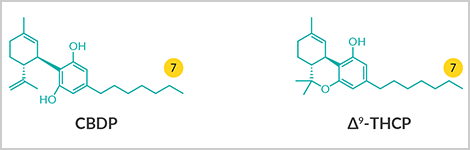
Cannabinoid receptor ligands can be classified into four main chemical groups: classical, nonclassical, aminoalkylindole, and eicosanoid (Figure 6). The classical group contains dibenzopyran derivatives, the most well-known of which are Δ9-THC and HU-210, a synthetic analog of Δ8-THC. In 2019, the novel phytocannbinoid Δ9-THCP was isolated from Cannabis and shown to bind to both CB1 and CB2. Its affinity for CB1 as well as cannabimimetic activity attributed to its elongated alkyl side chain is significantly higher than that of Δ9-THC. The nonclassical group consists of bicyclic and tricyclic analogs of Δ9-THC that lack a pyran ring, such as (–)-CP 55,940. Aminoalkylindoles (represented by (+)-WIN 55,212-2) and eicosanoids (comprised of endocannabinoids) have structures that are distinctly different from classical and nonclassical cannabinoid receptor agonists and also from each other. A fifth chemical classification has also emerged: peptide-like compounds. The endogenous peptide hemopressin, its derivatives RVD-Hpα and VD-Hpα, and the novel Pep19 have all been shown to function as ligands of cannabinoid receptors.
Figure 6. Types of cannabinoid ligands.
Competitive antagonists that display significant CB1-selectivity include rimonabant, AM251, AM281, LY320135, and taranabant. These compounds all work as inverse agonists, eliciting responses in some CB1 receptor-containing tissues that are contradictory from those induced by a CB1 receptor agonist. NESS 0327 and AM4113, which are structural analogs of rimonabant, behave as neutral antagonists in that they lack any detectable ability to induce signs of inverse agonism at the CB1 receptor. The CB2-selective inverse agonists most often used as experimental tools include AM630 and SR 144528. A neutral antagonist that selectively targets the CB2 receptor has yet to be developed.
There is interest not only in directly acting cannabinoid receptor agonists and antagonists, but also in compounds that can affect the activity of the endocannabinoid system indirectly by allosterically modulating endocannabinoid-induced activation of cannabinoid receptors or by altering the concentration of endocannabinoids at their receptors through effects on endocannabinoid production. Some cannabinoid receptor agonists and antagonists can also activate or block non-CB1/CB2 GPCRs, ligand- and voltage-gated ion channels, and/or nuclear receptors (PPAR receptors). They do, however, target these channels or receptors at different potencies than that which can activate or block CB1 and/or CB2 receptors. For example, arachidonoyl ethanolamide (anandamide) can activate T-type voltage-gated calcium channels, voltage-gated KV3.1 and KV4.3 potassium channels, calcium-activated (BK) potassium channels, NMDA receptors, TRPV receptors, glycine receptors, and allosteric sites on serotonin 5-HT3, and nicotinic acetylcholine receptors. Cannabidiol (CBD), which has weak CB1 and CB2 antagonistic effects and behaves as a negative allosteric modulator of CB1, can act as a FAAH inhibitor, TRPV1 agonist, adenosine A2A agonist, PPARγ activator, 5-HT1a agonist, and GPR55 antagonist. The combinatorial actions of these compounds on various receptors and channels likely endow their ultimate functions.
Pharmacotherapeutic Implications
Cannabinoid receptor modulation is involved in cognition, memory, anxiety, control of appetite, emesis, motor behavior, sensory, autonomic and neuroendocrine responses, immune responses, and inflammatory effects as well as liver injury and hepatocellular carcinoma. The pharmacologic regulation of CB1 has been proposed as a promising therapeutic strategy for pain, inflammation, obesity, neurodegenerative disorders, and cancer. Meanwhile, CB2 has been explored as a therapeutic target for immune modulators, pain management, osteoporosis, and the treatment of liver diseases. Indeed, the endocannabinoid system functions as a gatekeeper of the immune system, regulating cytokine release and immune cell migration, which has implications in preventing the onset of pathological immune responses through the regulation of inflammation, autoimmunity, antitumor, and antipathogen immune responses.
Many in vitro and in vivo studies aimed at exploiting the putative therapeutic potential of cannabinoids have largely focused on isolating Δ9-THC and CBD and the need to develop appropriate formulations to separate any psychoactive effects from therapeutic benefits. This has led to the establishment of the first Δ9-THC-containing and CBD-containing FDA-approved therapeutics. Dronabinol (Marinol®, Syndros®) is a Δ9-THC formulation used as an appetite stimulant and anti-emetic that the FDA has only approved for use in HIV/AIDS-induced anorexia and chemotherapy-induced nausea and vomiting. Several countries have approved the use of nabiximols (Sativex®), a 1:1 combination of Δ9-THC and CBD, for the treatment of pain and/or spasticity in multiple sclerosis. The synthetic THC mimic nabilone (Cesamet®), which has therapeutic use as an antiemetic and as an adjunct analgesic for neuropathic pain, is in a phase III clinical trial for treating non-motor symptoms in Parkinson’s disease. Epidiolex®, a prescription oral solution of CBD, is being used to treat seizures associated with certain forms of epilepsy and tuberous sclerosis complex. However, the Cannabis plant contains more than 100 different cannabinoids, including numerous secondary cannabinoid metabolites as well as terpenes and flavonoids that likely contribute synergistically to its therapeutic benefits. Due to this entourage effect, focus will need to shift to these other Cannabis components in order to fully understand which components have pharmacotherapeutic potential. Attention has also focused on anandamide analogs including arachidonoyl 2’-chloroethylamide and arachidonoyl cyclopropylamide, CB1-selective agonists that have been shown to have antidepressant and antinociceptive effects as well as the ability to potentiate anticonvulsant drugs in animal models of epilepsy. CB2-selective agonists are a keen focus in the field of therapeutic uses since specific modulation of CB2 may avoid the CNS-related side effects known to occur with CB1-selective agonists. With recent revelation of the ligand-bound, cryo-EM structure of the active CB2 receptor in complex with Gi-protein, new ligands rationally designed to interact with CB2 as selective agonists will be on the horizon.
Request a Cannabinoid Receptor Wall Poster for a guide to what is currently known about cannabinoid receptor signaling.
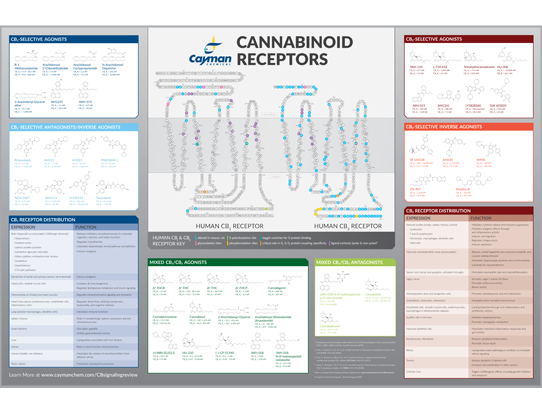
Cayman offers a broad range of pharmacological tools to help growers profile the cannabinoid species in their products and to help researchers delineate cannabinoid receptor-mediated activity and will continue to produce novel receptor agonists and antagonists to support a new and better understanding of the various mechanisms of action.
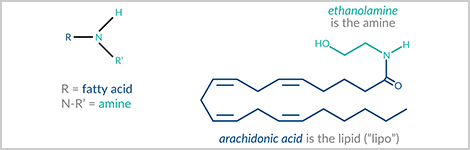 Lipoamines
Suggested Reading
An, D., Peigneur, S., Hendrickx, L.A., et al. Targeting cannabinoid receptors: Current status and prospects of natural products. Int. J. Mol. Sci.21(14), 5064 (2020).
Hua, T., Li, X., Wu, L., et al. Activation and signaling mechanism revealed by cannabinoid receptor-Gi complex structures. Cell180(4), 655-665 (2020).
Mallipeddi, S., Janero, D.R., Zvonok, N., et al. Functional selectivity at G-protein coupled receptors: Advancing cannabinoid receptors as drug targets. Biochem. Pharmacol. 128, 1-11 (2017).
Oláh, A, Szekanecz, Z., and Bíró, T. Targeting cannabinoid signaling in the immune system: "High"-ly exciting questions, possibilities, and challenges. Front. Immunol. 8, 1487 (2017).
Shahbazi, F., Grandi, V., Banerjee, A., et al. Cannabinoids and cannabinoid receptors: The story so far. iScience23(7), 101301 (2020).
Xing, C., Zhuang, Y., Xu, T.-H., et al. Cryo-EM structure of the human cannabinoid receptor CB2-Gi signaling complex. Cell180(4), 645-654 (2020).
Ye, L., Cao, Z., Wang, W., et al. New insights in cannabinoid receptor structure and signaling. Curr. Mol. Pharmacol.12(3), 239-248 (2019).
Zou, S. and Kumar, U. Cannabinoid receptors and the endocannabinoid system: Signaling and function in the central nervous system. Int. J. Mol. Sci.19(3), 833 (2018).
Contact Info
Cayman Chemical1180 East Ellsworth RoadAnn Arbor, Michigan 48108 USAToll Free: (800) 364-9897(USA and Canada only)Fax: (734) 971-3640


