
News & Announcements
Characterizing Novel Targets of the Anti-Apoptotic Protein, Mcl-1
Article from 2021-04-19
Cayman's Structural Biology expert in collaboration with University of California Riverside School of Medicine researchers work to discover a novel, potent, and selective lysine-covalent inhibitor of Mcl-1-driven cancers.
Myeloid cell leukemia-1 (Mcl-1), a member of anti-apoptotic Bcl-2 family proteins, functions as a regulator of mitochondrial homeostasis. Because it is frequently overexpressed in human primary and drug-resistant cancer cells, it has become a cancer therapeutic target. Mcl-1 sequesters pro-apoptotic proteins BAK/BAX through the BH3 domain-containing hydrophobic groove (Figure 1). This interaction promotes survival and prevents execution of the apoptotic program. When activated by stress or upstream signals, BH3-interacting proteins BID/BIM bind instead to the Mcl-1 hydrophobic groove, releasing BAK/BAX. While BAK is already tethered to the mitochondrial membrane, BAX is free to translocate from the cytosol to the mitochondria to exert its apoptotic function.
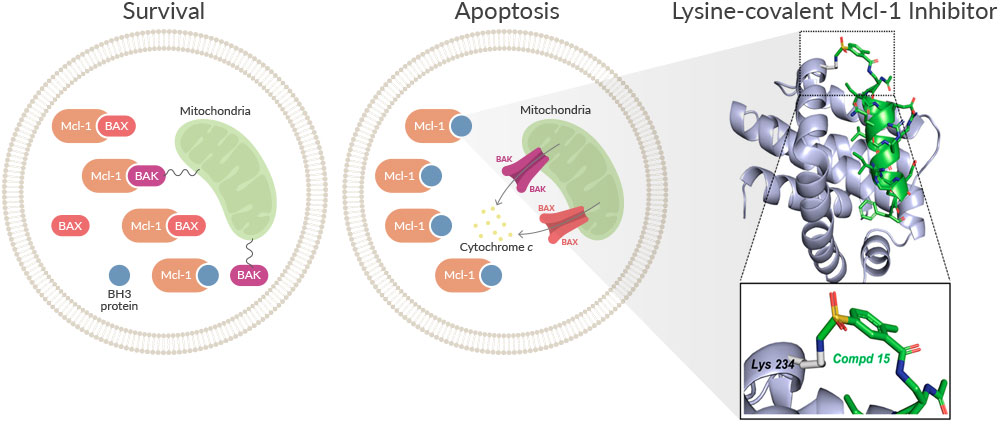
Figure 1. Pro- and anti-apoptotic Bcl-2 family proteins maintain cellular homeostasis. The BH3 domain-containing groove is a target of novel lysine-covalent Mcl-1 inhibitors. Image adapted from Xiang, W., Yang, C.-Y., and Bai, L. MCL-1 inhibition in cancer treatment. Onco. Targets Ther. 11, 7301-7314 (2018). CC BY-NC 3.0 Structure obtained from Gambini, L., Udompholkul, P., Baggio, C., et al. Design, synthesis, and structural characterization of lysine covalent BH3 peptides targeting Mcl-1. J. Med. Chem. (2021).
Working from the structure of high-affinity, endogenous binding partners of Mcl-1 and previous success in covalently targeting prevalent lysine residues to develop potent, selective protein-protein interaction inhibitors, this study characterized a novel, potent, and selective lysine-covalent BH3-based Mcl-1 inhibitor.
Starting from a non-selective BIM peptide, a minimal peptide region that retained nanomolar binding affinity for human Mcl-1 was determined.
Then, structure-based considerations were used to design and synthesize covalent agents. Binding and kinetics data revealed two clear candidates.
Structural studies of the complex between one of these compounds and human Mcl-1 provided atomic resolution (1.95 Å resolution) details on the targeted lysine residue and on the geometry of the inhibitor.
Preliminary cellular studies suggest that this novel inhibitor can covalently interact with Mcl-1 in a non-small cell lung cancer A549 cell line, causing Mcl-1 degradation, but future studies will be needed to improve cellular efficacy.
These inhibitors could form the basis for future, improved versions that could be deployed using known cell permeabilization strategies for development into potential BH3-based, Mcl-1 targeting therapeutics and lysine-covalent, pro-apoptotic agents.
Read the Article
Our Structure-Based Drug Design Services are performed by scientists with proven experience in protein production, biophysical characterization (DSF, SPR), X-ray structure determination, and in silico docking (CADD). Our structural biology experts have determined over 250 high-resolution crystal structures of a variety of targets, advancing drug discovery and development efforts for our clients. Contact us for help with your next discovery.
In addition to the capabilities to design new inhibitors, Cayman also offers the following Mcl-1 inhibitors in our catalog to facilitate research of this signaling pathway.
Mcl-1 Inhibitors
A-1210477
AZD 5991
3,6-dichloro-benzo[b]thiophene-2-Carboxylic Acid
MIM1
ML-311
S63845
UMI-77
You May Also Be Interested In
Meet the Expert: Structural Biology Services
Contact Info
Cayman Chemical1180 East Ellsworth RoadAnn Arbor, Michigan 48108 USAToll Free: (800) 364-9897(USA and Canada only)Fax: (734) 971-3640


