
News & Announcements
Delving into the World of Lysergamides: The Past, Present, and Future Webinar Highlights
Article from 2024-04-17
Key insights on history, identification and naming, synthesis, and emerging analogs
Camille Watson-Gooden and Danielle St. Germaine, experts in lysergamide chemistry and analysis at Cayman Chemical, discuss the history, modifications, fragmentation, and new emerging analogs of lysergamides.
| |
Lysergamide History (50s)
Lysergamides are a class of alkaloids with a tetracyclic ergoline core structure. The ergoline scaffold allows for variable targeting of serotonin, dopamine, and adrenergic receptors. Many current and historical pharmaceuticals utilize the ergoline scaffold to target the receptors for these endogenous ligands with ergoline derivatives. Pharmaceutical preparations inspired by ergot alkaloids have been used to prevent and/or treat several conditions, ranging from postpartum hemorrhage and migraine headaches to Parkinson’s disease and vascular dementia.
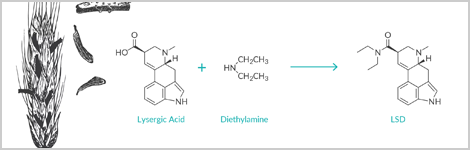
LSD (lyserg-säure-diäthylamid A.K.A. lysergic acid diethylamide, LAD) (Figure 1) is the most notorious lysergamide. LSD was first synthesized in 1938 by Dr. Albert Hofmann, a chemist at the Sandoz AG Pharmaceutical Company in Switzerland.
Figure 1. Structure of LSD.
Research Tools for LSD
| Product Name | Item No. |
| LSD (CRM) | 35189 |
| LSD (D-tartrate) (solution) | 28289 |
| LSD (L-hemitartrate) (solution) | 37663 |
| LSD-d10 (D-tartrate) (solution) | 37662 |
| iso-LSD (solution) | 34183 |
Lysergamide Pharmacology (10m 32s)
The psychedelic experience of LSD is linked to activation of serotonin (5-HT) receptors, in particular, the 5-HT2A receptor subtype, though other mechanisms may also be at play. LSD has mixed agonist properties at 5-HT, dopamine D2, and α1A- and α1B-adrenergic receptors.
Several chemical modifications to the ergoline structure can influence the psychedelic effects of lysergamides. The two conventions used for numbering lysergamides are the Hofmann and IUPAC systems. The Hofmann notation is most common.
The psychedelic properties of LSD depend on the stereochemistry of positions 8 and 5, the saturation at position 9, and the chain length of substituents on the amide position (Figure 2). Substitution at the 2 position is inactivating. Clinical trials exploring the use of 2-bromo LSD are set to begin in 2024. These critical sites responsible for the psychedelic properties of LSD are demarcated on the figure below with asterisks.
Figure 2. Modifications that alter the psychedelic properties of LSD.
Lysergamide Identification and Naming (16m 34s)
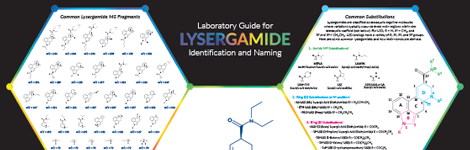
Variations to the tetracyclic ergoline core typically occur at three main regions (Figure 3). These modifications give rise to LSD analogs.
The main modifications are:
Amide N18 substitutions
Ring (D) substitutions at the N6 position
Ring (B) substitutions
The naming conventions used for LSD analogs typically denote the identity of the substituents in the analog. Some consideration when naming is also given based on choosing unique names that distinguish them from other lysergamides as well as auditory and visual appeal of the chosen name.
Figure 3. Location of lysergamide modifications.
Naming Systems for Lysergamides
| | Amide N18 substitutions | Piperidine ring (D) modifications | Indole ring (B) modifications |
| Abbreviation | Code Letters | LAD | LSD |
| Full Name | Dependent on the diethyl substituents | Lysergic Acid Diethylamide | Lyserg-Säure-Diäthylamid |
| System | Shulgin | Shulgin | Hofmann |
View the Standardized Naming System for Substituted Tryptamines Article
Amide N18 Substitutions
The nomenclature of the amide portion of lysergamides sometimes derives from the ethylamino substituents in tryptamine nomenclature. These substitutions also generally follow the tryptamine nomenclature for naming, where the smallest molecule is named first, followed by the larger substituents.
Amide N18 Substitutions
| Full Name | Abbreviation | Item No. |
| Lysergic Acid Amide* | LSA/LAA or LA | |
| Lysergic Acid Azetidide* | LSZ | 36238 |
| Lysergic acid methyl propyl amide | LAMPA | 31500 |
| Lysergic Acid Morpholide* | LSM-775 | 28579 |
| Methyl iso-propyl lysergic acid amide | MiPLA | 31501 |
* The tryptamine naming convention does not apply for lysergamides with single amide N18 substitutions.
Ring (D) Substitutions at N6 Position
Lysergamides with these substitutions follow a Shulgin-style naming convention using LAD as the parent name.
Ring (D) Substitutions
| Full Name | Abbreviation | Item No. |
| Allyl lysergic acid diethylamide | AL-LAD | 30442 |
| Ethyl lysergic acid diethylamide | ETH-LAD | |
| iso-Allyl lysergic acid diethylamide | iso-AL-LAD | 37661 |
| Propyl lysergic acid diethylamide | PRO-LAD |
Ring (B) Substitutions
Lysergamides with these substitutions follow the Hofmann-style naming convention using LSD as the parent name. The use of "1" in the lysergamide name denotes the position at the indole nitrogen, and the next letter in the abbreviated name indicates the identity of the substituent.
Ring (B) Substitutions
| Full Name | Abbreviation | Item No. |
| Acetyl lysergic acid diethylamide | ALD-52 | 27818 |
| 1-Butanoyl lysergic acid diethylamide | 1B-LSD | 27817 |
| 1-Cyclopropionyl lysergic acid diethylamide | 1cP-LSD | 30187 |
| 1-Propionyl lysergic acid diethylamide | 1P-LSD | 27727 |
| 1-Valeroyl lysergic acid diethylamide | 1V-LSD | 35744 |
Lysergamide Synthesis & Starting Materials (23m 30s)
Understanding the synthesis of lysergamides is critical to understanding what new compounds may appear on user sites, forums, and in forensic casework. Clandestine chemists prefer to use inexpensive starting materials in lysergamide synthesis.
Amide N18 Substitutions
The diethylamide group of LSD can easily be swapped out using base hydrolysis to cleave the lattice to form lysergic acid, followed by amino acid coupling or an acid chloride strategy to aminate the LSD analog (Figure 4).
Figure 4. Amide N18 substitution chemistry.
Piperidine N6 Substitutions
The N6 position of the piperidinyl ring may be demethylated to form nor-LSD (nor-without) and then re-alkylated with an alkyl chain containing an appropriate leaving group to form the appropriate analog (Figure 5).
Figure 5. Piperidine N6 substitution chemistry.
Indole Ring B Substitutions
Adding acyl or alkyl substituents to the N1 nitrogen is the simplest way for clandestine chemists to skirt regulatory measures. In recent years, an increase in indole ring B-substituted lysergamides have appeared on illicit markets. Clandestine chemists favor acyl substituents, which are derived from commercially available carboxylic acid starting materials (Figure 6).
Figure 6. Indole ring B substitution chemistry.
Byproducts of Lysergamide Synthesis
Lysergamides are notoriously unstable and degrade in the presence of light. When subjected to strong acidic and basic conditions, the amide of LSD is epimerized to its diastereomer iso-LSD. These compounds have the same fragments but slightly different retention times.
EI-MS Fragmentation of Lysergamides (29m 05s)
The EI-MS fragmentation pattern of these substances can be used to aid in the identification of lysergamides. We have collected five tips to consider for EI-MS interpretation of lysergamide fragmentation patterns.
Five Tips for EI-MS Interpretation
Lysergamides typically show the MW ion peak
A peak (a base peak in some cases) at m/z = 221 is an indicator that the substituent at N6 is a methyl group
Analogs with an additional substituent at N1 (typically an acyl group) often show a second base peak with m/z = [221 + mass of acyl group] -1
Analogs with different substituents at the N6 position often show m/z = 207 as a base peak. The peak at m/z = 221 is absent
Observation of the m/z = 72 peak (Figure 7) indicates that N18 has one of the following substituents*:
LSD
MiPLA
LAMPA
Figure 7. Structures of m/z = 72 substituents.
Emerging Lysergamides (41m 45s)
In attempt to thwart regulatory countermeasures, novel lysergamides regularly appear on grey market websites and user forums. However, these products may not be the actual compound they claim to be, as in the case of 1D-LSD. Seized material marketed as 1D-LSD was correctly characterized as 1T-LSD based on the fragmentation pattern.
Available from Cayman
Cayman has a range of reference standards available as parent drugs, metabolites, degradants, and structurally related compounds in both their native and stable isotope forms. Our chemists manufacture both well-known and novel compounds in our DEA-regulated facilities.
You May Also Be Interested In
Contact Info
Cayman Chemical1180 East Ellsworth RoadAnn Arbor, Michigan 48108 USAToll Free: (800) 364-9897(USA and Canada only)Fax: (734) 971-3640


