
Orphines Naming Guide
Featured Guides
NPS Snapshot: Kratom-Derived Semi-Synthetic Opioids
Featured Guides
A growing wave of consumer products labeled as ‘kratom’, ‘7-hydroxy mitragynine’, or ‘7-OH’—which contain potent semi-synthetic opioids—marks the emergence of a new class of kratom-derived NPS. Since 2024, new kratom-related products containing 7-hydroxy mitragynine and mitragynine pseudoindoxyl have entered the market, often disguised as natural supplements. Though structurally distinct from traditional opioids, these compounds can mimic opioid effects and are frequently misrepresented in labeling. This NPS Snapshot summarizes the structures of potent kratom-related NPS, mitragynine conversion pathways, and the historical context of natural kratom alkaloids.
View All Kratom Alkaloids & Semi-Synthetics
To cite this NPS snapshot: Iula, D.M. NPS snapshot: kratom-derived semi-synthetic opioids. Cayman Chemical (October 2025).
Rise of the Orphines: Understanding the evolution, naming, and structural elucidation of a rapidly emerging piperidinylbenzimidazolone scaffold
Webinars
Orphines are a class of rapidly evolving NSOs (novel synthetic opioids) sporting a piperidinylbenzimidazolone core. Orphines like cychlorphine have been implicated in multiple fatalities and continue to make international headlines. These opioids can be easily modified to circumvent regulation without losing potency at the µ-opioid receptor (MOR), potentiating their capacity for harm.
Listen as Danielle St. Germaine, a senior scientist at Cayman Chemical, addresses this emerging threat by providing an overview of the history, pharmacology, nomenclature, marketplace trends, and evolution of the piperidinylbenzimidazolone scaffold. Tips for structural elucidation utilizing EI-MS fragmentation will be provided as well as other valuable resources.
Presented as part of the 2026 ONIC Law Enforcement Drug Summit.
Do you have a question or comment for the presenter? Let us know.
Understanding the Metabolism of Ethylbromazolam Using Human Liver Microsomes
Scientific posters
Ethylbromazolam is a novel psychoactive substance (NPS) structurally similar to the known benzodiazepine Bromazolam. This ethyl analogue emerged on the illicit drug market in early 2025, with reports of detection in multiple countries throughout that year and more following in 2026. Much is known about Bromazolam in terms of its pharmacology and toxicology, however, there is limited availability of information around this new ethyl analogue. Ethylbromazolam has not been approved for medical use and its presence in counterfeit pharmaceuticals poses a health risk.
In this scientific poster, we report the study to identify probable phase I metabolites of the novel designer benzodiazepine Ethylbromazolam through incubation with human liver microsomes (HLMs) followed by liquid chromatography and high-resolution mass spectrometry analysis.
Do you have a question or comment for the presenter? Let us know.
To cite this poster: Layle, N., Bassman, J., Goodwin, S., et al. Understanding the Metabolism of Ethylbromazolam Using Human Liver Microsomes. Poster presented at: SOFT-TIAFT 2026 Joint Meeting; September 19 – 24, 2026; Chicago, IL.
Ethylbromazolam: Cayman NPS Metabolism Monograph, Issue 5
Monographs
Ethylbromazolam is a novel psychoactive substance (NPS) structurally similar to the known benzodiazepine bromazolam. This ethyl analog emerged on the illicit drug market in early 2025, with reports of detection in multiple countries throughout that year and more following in 2026. Much is known about bromazolam, but limited information is available on the pharmacology and toxicology of this new ethyl analogue. This study uses pooled human liver microsomes and LC-MS/MS analysis to identify presumptive phase I metabolites of ethylbromazolam, supporting forensic toxicologists in detecting emerging designer benzodiazepines.
To cite this monograph: Bassman, J.R., Layle, N.K., Goodwin, S.K., et al. Ethylbromazolam. Cayman NPS Metabolism Monograph Issue 5 (2026).
What’s new with benzodiazepine NPS: Here come the ethyl analogues!
Webinars
Benzodiazepines were discovered in the 1950s and were rapidly adopted as prescription medicines for the treatment of a variety of conditions, such as anxiety or use as sedatives. However, the increase in popularity of benzodiazepines, along with their addictive properties, also led to an increase in the misuse and abuse of these compounds.
In this presentation, Kirk Hering, Director of Process Exploration and Psychoactive Substance Chemistry at Cayman Chemical, reviews the known metabolic pathways of established designer benzodiazepines and discusses the metabolites likely to form from emerging NPS ethyltriazolobenzodiazepines.
Presented as part of the CFSRE's 2026 Current Trends in Forensic Toxicology Symposium.
Do you have a question or comment for the presenter? Let us know.
NSOs, DBZDs, and HLMs! Oh My!
Webinars
Novel designer benzodiazepines (DBZD) and novel synthetic opioids (NSO) continue to emerge on the illicit novel psychoactive substance (NPS) market. Given this trend, and the continuing rise in benzodiazepine prescriptions, the likelihood for benzodiazepines to appear in toxicological samples alongside synthetic opioids is high. Understanding the synthesis and analytical interpretation of both NPS classes can help prepare forensic toxicologists for the appearance of unknown compounds in their casework.
Join Nathan Layle and Becca Boyce, synthetic organic chemists at Cayman Chemical, as they present the results of our in-house human liver microsome (HLM) studies and demonstrate how these findings can be applied to new analogs. Attendees will gain insights into emerging compounds and metabolites that may soon appear in forensic casework.
Presented as part of the CFSRE's 2026 Current Trends in Forensic Toxicology Symposium.
Do you have a question or comment for the presenter? Let us know.
Analysis of a Complex Mixture of 13 Benzodiazepines Using HPLC-PDA Detection
Application notes
Chromatographic Separation of 7-Hydroxy Mitragynine from Mitragynine Pseudoindoxyl
Application notes
Key Features:
- The co-elution of 7-hydroxy mitragynine (7-HMG; 7-OH) and mitragynine pseudoindoxyl (MP), two important mitragynine-related alkaloids, by traditional GC-MS methods makes testing a challenge for analysts.
- If testing methods are unable to resolve these two substances in casework, identification and quantification can become compromised.
- The rise of consumer products on the drug market containing potent semi-synthetic opioids derived from kratom, such as 7-hydroxy mitragynine and mitragynine pseudoindoxyl, is of great public health and safety concern.
- Several chromatographic methods to achieve separation are explored in this application note. Method information presented herein may be used to assist labs in developing methods to identify and quantify 7-hydroxy mitragynine and mitragynine pseudoindoxyl in seized drug analysis and/or toxicology cases.
Analysis of a Complex Mixture of Orphines Using HPLC-PDA Detection
Application notes
Semi-Synthetic Opioids: Cracking the Kratom Code
Webinars
Mitragynine is an indole-based alkaloid and is one of the main psychoactive constituents in the Southeast Asian plant Mitragyna speciosa, commonly known as kratom. It is an atypical opioid that is typically consumed as a part of kratom for its pain-relieving and euphoric effects and has also been researched for its use to potentially manage symptoms of opioid withdrawal and as a treatment for alcohol use disorder (AUD). More recently, analogs of mitragynine have begun to appear in the unregulated consumer marketplace and some are readily available in gas stations and vape shops in products branded as "7-hydroxymitragynine" or "7OH" causing heightened concern due to studies showing that 7-hydroxy mitragynine and mitragynine pseudoindoxyl (the rearrangement product of 7-hydroxy mitragynine) are more potent opioid agonists, exceeding that of mitragynine on the order of 10x and 100x, respectively.
Listen as Nathan Layle and Camille Waston-Gooden, synthetic chemists at Cayman Chemical, explain more about the history, pharmacology, metabolism, semi-synthetic modifications, and new emerging analogs of Mitragynine.
Presented as part of the CFSRE's 2026 Current Trends in Seized Drug Analysis Symposium.
Do you have a question or comment for the presenter? Let us know.
What's New With NPS: The Rise of Semi-synthetics Complicates the Picture
Webinars
Donna Iula summarizes the novel substances of greatest concern across classes such as synthetic opioids, benzodiazepines, stimulants, and synthetic cannabinoids including the concerning rise of semi-synthetic opioid NPS derived from Kratom, which are extremely potent.
Presented as part of the CFSRE's 2026 Current Trends in Seized Drug Analysis Symposium.
Do you have a question or comment for the presenter? Let us know.
N-Propionitrile Chlorphine: Cayman NPS Metabolism Monograph, Issue 4
Monographs
This NPS metabolism monograph highlights N-propionitrile chlorphine (also known as cyclorphine or cychlorphine), a novel synthetic opioid (NSO) first identified by the CFSRE in 2024. Structurally related to brorphine, a potent μ-opioid receptor agonist and DEA Schedule I controlled substance, this analog reflects the growing global prevalence of modified synthetic opioids in the emerging "orphine" class. Using pooled human liver microsomes in vitro and LC-MS/MS, the monograph identifies presumptive phase I metabolites to support forensic toxicologists in detecting emerging NSOs.
To cite this monograph: Bassman, J.R., Layle, N.K., Goodwin, S.K., et al. N-Propionitrile Chlorphine. Cayman NPS Metabolism Monograph Issue 4 (2025).
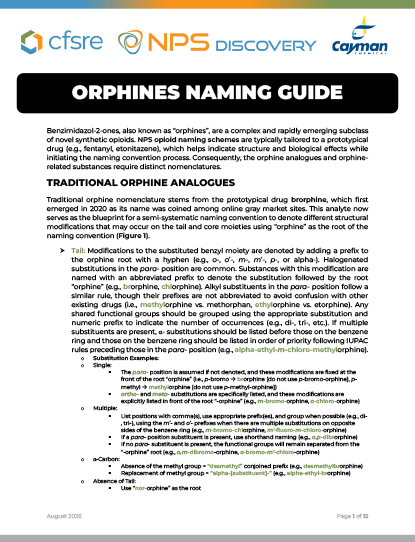
NPS Snapshot: Orphines
Guides
Creating Custom Cannabis CRM Mixtures: Forty-seven Phytocannabinoids, One HPLC Method
Application notes
- Chromatography was run on 47 phytocannabinoid compounds (12 acid and 35 neutral).
- Co-eluting neutral compounds were identified and segregated for the acceptable validation of an HPLC method.
- This method supports Cayman’s quick turn production of custom phytocannabinoid CRMs.
To cite this application note: Franckowski, R., Gregerson, M., Calati, K., et al. Creating Custom Cannabis CRM Mixtures: Forty-seven Phytocannabinoids, One HPLC Method. Application Note, Cayman Chemical (2025).
Semi-Synthetic Cannabinoids: An Emerging NPS Overview and Case Study on In-Vitro Metabolism
Webinars
Semi-synthetic cannabinoids (SSCs) represent an emerging class of Novel Psychoactive Substances (NPSs) that are often advertised and sold as legal. SSCs can be described as partially synthetic materials that are derived from natural components of the Cannabis Sativa L. plant, such as Cannabidiol (CBD). New studies on the in-vivo and in-vitro metabolism of SSC’s, such as Δ10-THC, Δ6a,10a-THC, and HHC, are emerging, which detail the similarities and differences seen to natural phytocannabinoid like Δ9-THC.
Alicyn Stothard and Jonathon Bassman, synthetic organic chemists at Cayman Chemical, discuss the overall landscape of newly emerging SSCs and their metabolism, along with a case study utilizing LC/MS-based identification of putative in-vitro metabolites for the SSC’s Δ10-THC and Δ6a,10a-THC.
Presented as part of the CFSRE's 2025 Current Trends in Forensic Toxicology Symposium.
Do you have a question or comment for the presenter? Let us know.
The Shifting Synthetic Cannabinoid NPS Landscape
Webinars
Jeffrey Williams presents a summary of the current wave of NPS called ‘semi-synthetic cannabinoids’ which are complicating the NPS scene.
Presented as part of the CFSRE's 2025 Current Trends in Forensic Toxicology Symposium.
Do you have a question or comment for the presenter? Let us know.
Laboratory Guide for Nitazene Identification, Naming, and Metabolism
Lab Wall Posters
In this guide for nitazene identification, naming, and metabolism, we cover:
- Mass Spectrum of Etonitazene and Tips for Interpretation
- Common Mass Spec Fragments
- Common Nitazene Naming Conventions
- Nitazene Metabolism
Metabolic Profiling of the Semi-synthetic Tetrahydrocannabinols (THCs), Δ10-THC and Δ6a,10a-THC, Using Human Liver Microsomes and LC/MS
Webinars
Listen as Nathan Layle, a synthetic organic chemist at Cayman Chemical, discusses the LC/MS-based identification of putative in vitro metabolites of the semi-synthetic tetrahydrocannabinols Δ10-THC and Δ6a,10a-THC.
Presented as part of the 77th Annual Scientific Conference of the American Academy of Forensic Sciences.
Do you have a question or comment for the presenter? Let us know.
NPS Snapshot: Semi-synthetic Cannabinoids
Guides
Making a splash: Nitazenes and Orphines, the latest wave of opioid NPS
Webinars
Listen as Danielle St. Germaine, a synthetic organic chemist in Cayman’s Forensic Chemistry Department, offers insight into these emerging threats and highlights valuable tools and resources available on our website.
Presented as part of the 2024 All Ohio Drug Chemists Meeting in Columbus, Ohio.
Do you have a question or comment for the presenter? Let us know.
Δ9-THC, Δ10-THC, and Δ6a,10a-THC: Cayman NPS Metabolism Monograph, Issue 3
Monographs
The goal of this monograph is to identify the probable metabolites of the newly emerging semi-synthetic cannabinoids Δ10-THC and Δ6a,10a-THC using human liver microsomes (HLMs) and high-resolution mass spectrometry. The metabolism of Δ9-THC with HLMs was also investigated to provide forensic toxicologists a comparative understanding of the key fragments needed for identification.
This monograph was updated on April 18th, 2025, to provide clarification on the interpretation of the (6aR,9R)-Δ10-THC metabolite at R.T. 14.16 minutes in Figure 8.
To cite this monograph: Bassman, J.R., Layle, N.K., Gregerson, M.C., et al. Δ9-THC, Δ10-THC, and Δ6a,10a-THC. Cayman NPS Metabolism Monograph Issue 3 (2025).
New Drug Monograph: N-Propionitrile Chlorphine
Monographs
Some Assembly Required: Emerging Synthetic Cannabinoids
Webinars
Following China's generic structural class ban of several sub-classes of synthetic cannabinoids in 2021, the NPS/designer-drug landscape continues to evolve to evade regulation. As new structural variations appear on the grey market, another new phenomenon is the emergence of 'DIY' semi-finished kits. These semi-finished kits provide the end-user with non-regulated precursors enabling the user to finish the synthesis themselves to the desired synthetic cannabinoid of choice. Because the end-user often does not have the appropriate engineering and quality controls in place, drug substances on the illicit market are commonly contaminated with unreacted chemical precursors. Several of these tail-less penultimate precursors have been detected on the grey market since late 2021.
Listen in as Holly Pierzynski, Cayman's Manager of Forensic Novel Psychoactive Substance Research, discusses several emerging synthetic cannabinoids, their precursors, synthesis, and byproducts from the synthesis. This presentation also highlights Cayman's new application note, "GC Separation of ADB-BUTINACA from its precursor ADB-INACA".
Presented as part of the 2024 Midwestern Association of Forensic Scientists Conference in Kansas City, Missouri.
Do you have a question or comment for the presenter? Let us know.
GC Separation of ADB-BUTINACA from its Precursor ADB-INACA
Application notes
Key Features
- Coelution of ADB-BUTINACA and its synthetic precursor ADB-INACA makes traditional GC-MS methods difficult for the quantification of these two novel psychoactive substances (NPS). Quantities of these synthetic cannabinoids are distorted if the testing methods are unable to resolve the two substances in analyzed samples.
- A new GC method for the separation of ADB-BUTINACA from its precursor ADB-INACA offers a reliable and robust solution for identifying this DEA Schedule I compound.
To cite this application note: Pierzynski, H.G., Liu, J., Calati, K.B., et al. GC separation of ADB-BUTINACA from its precursor ADB-INACA. Application Note, Cayman Chemical (2024).