
News & Announcements
Glycinated lyso-CTH: A Novel lyso-CTH Internal Standard for Fabry Disease
Article from 2016-06-06
This article was originally published in the June 2016 edition of Matreya’s Newsletter for Glyco/Sphingolipid Research (PDF).
Fabry disease is a lysosomal storage disorder caused by a mutated α-galactosidase gene and characterized by a deficiency in the enzyme α-galactosidase.1 This lack of activity results in a reduced or absent ability to cleave terminal α-galactose units from glycolipids. The lysosome then begins to accumulate glycolipid intermediates, especially globotriaosylceramide (Gb3, ceramide trihexoside, CTH) and lyso-globotriaosylceramide (lyso-Gb3, lyso-ceramide trihexoside, lyso-CTH, globotriaosylsphingosine).2 Accumulation of these lipids leads to multiple serious systemic disorders. Early detection and treatment of this disease is critical to prevent damage to multiple organs.
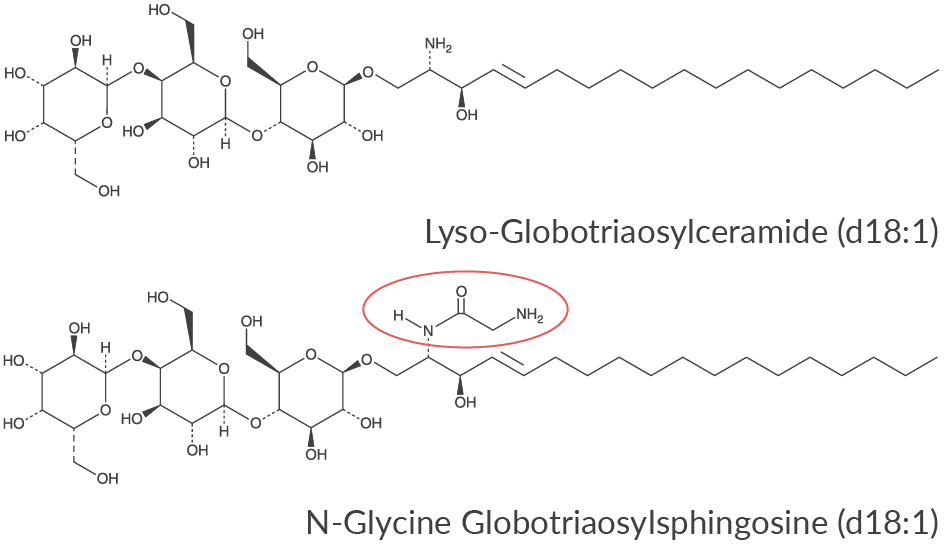
Gb3 and lyso-Gb3 have been shown to be excellent biomarkers for Fabry disease.3 N-Glycine globotriaosylsphingosine (N-glycinated lyso-Gb3, N-glycinated lyso-CTH) is an analog of lyso-Gb3 that is ideal for use as an internal standard in the extraction and mass spectrometry (MS) analysis of the Fabry disease biomarker lyso-Gb3. Its properties, such as polarity, ionization, sensitivity, and fragmentation pattern, are almost identical compared to the native species.1 The free amine group of glycine gives this standard very similar physical characteristics to the natural lyso-Gb3, while adding an additional 57 units makes it easy to identify by MS. This is an excellent internal standard for clinical assays.
More Lysosomal Storage Disorders Research Tools from Cayman
You May Also Be Interested In…
Gb3 and lyso-Gb3 and Fabry Disease
Biomarker Standards for Fabry Disease Diagnosis and Monitoring
Glycinated Lyso-Glycosphingolipids as New Mass Spectrometry Internal Standards
References
1. Krüger, R., Tholey, A., Jakoby, T., et al. Quantification of the Fabry marker lysoGb3 in human plasma by tandem mass spectrometry. J. Chromatogr. B Analyt. Technol. Biomed. Life Sci. 883-884, 128-135 (2012).
2. Auray-Blais, C., Ntwari, A., Clark, J.T.R., et al. How well does urinary lyso-Gb3 function as a biomarker in Fabry disease? Clin. Chim. Acta 411(23-24), 1906-1914 (2010).
3. Bekri, S., Lidove, O., Jaussaud, R., et al. The role of ceramide trihexoside (globotriaosylceramide) in the diagnosis and follow-up of the efficacy of treatment of Fabry disease: A review of the literature. Cardiovasc. Hematol. Agents Med. Chem. 4(4), 289-297 (2006).
Contact Info
Cayman Chemical1180 East Ellsworth RoadAnn Arbor, Michigan 48108 USAToll Free: (800) 364-9897(USA and Canada only)Fax: (734) 971-3640


