
News & Announcements
Glycinated Lyso-Glycosphingolipids as New Mass Spectrometry Internal Standards
Glycinated Lyso-Glycosphingolipids as New Mass Spectrometry Internal Standards
Article from 2016-12-05
This article was originally published in the December 2016 edition of Matreya’s Newsletter for Glyco/Sphingolipid Research (PDF).
Lyso-glycosphingolipids are important biomolecules in both healthy and diseased physiological processes. Suitable standards are needed for identifying and quantitating these key biological components in order to understand their functions and to diagnose and monitor associated diseases. Often glycosphingolipids are labeled with a stable isotope on the fatty acid of the ceramide. However, lyso-sphingolipids do not have this option because they lack the fatty acid component. Synthetically attaching a label to either the sphingosine or oligosaccharide involves a difficult synthesis. As an alternative approach, Krüger et al. demonstrated that a glycine molecule attached to the amine of sphingosine would give an easily identifiable compound that shares almost identical physical properties with the native unlabeled lyso-glycosphingolipid.1 Cayman offers four glycinated lyso-glycosphingolipids as mass spectroscopy internal standards: N-glycine glucosylsphingosine, N-glycine galactosylsphingosine, N-glycine lactosylsphingosine, and N-glycine globotriaosylsphingosine.
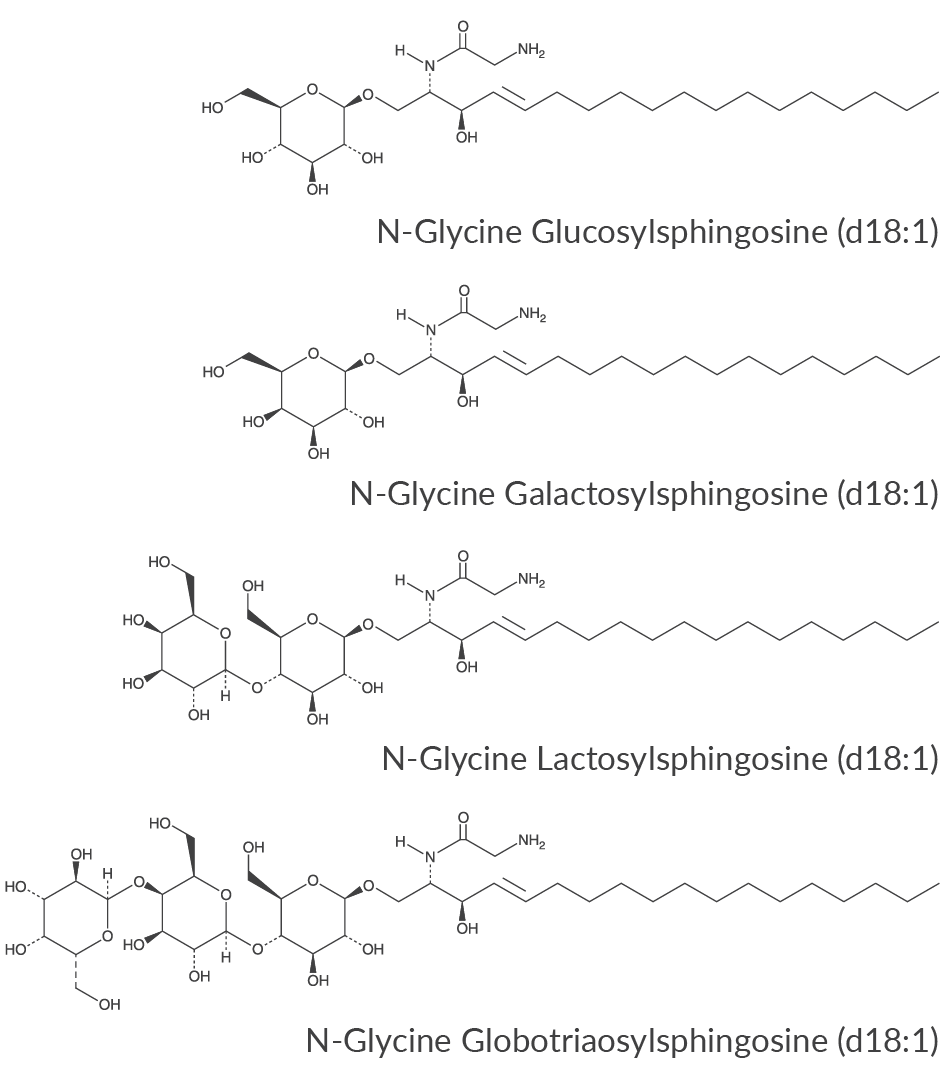
Glucosylsphingosine has been used as a reliable and specific biomarker for Gaucher disease (GD). When evaluating the sensitivity and specificity of glucosylsphingosine with regard to healthy controls versus GD carriers and other lysosomal storage disease control groups, only GD patients display elevated levels of glucosylsphingosine.2 These levels are higher than the pathological cut-off, verifying the specificity of glucosylsphingosine as a biomarker for this disease. Glucosylsphingosine has also been monitored during enzyme replacement therapy, revealing a decrease in this sphingolipid biomarker over time.
Lactosylceramide is the precursor of many other glycosphingolipids and functions as a second messenger and receptor ligand. Many cellular processes are dependent on lactosylceramide since it is the substrate for neutral oligoglycosylceramides and gangliosides, all of which have their own vital functions. Lactosylceramide also helps to stabilize the lipid membrane, activate receptor molecules, and acts as a ligand for certain bacteria and toxins. In animals where it is found mostly in epithelial and neuronal cells, it is expressed on neutrophils and macrophages, where it binds to toxins and bacteria, which are then engulfed and eliminated. Niemann-Pick type C, a neurovisceral lysosomal cholesterol trafficking and lipid storage disorder, leads to an accumulation of multiple lipids, including excess unesterified cholesterol, GM2 and GM3 gangliosides, lactosylceramide, lactosylsphingosine, and glucosylceramide.3
Lyso-globotriaosylceramide (lyso-ceramide trihexoside or lyso-Gb3) and its acylated form globotriaosylceramide (ceramide trihexoside or Gb3) are important biomarkers for the lysosomal storage disorder Fabry disease (FD). FD is characterized by a deficiency of the enzyme α-galactosidase A, resulting in an accumulation of globotriaosylceramide, globotriaosylsphingosine, galabiaosylceramide (Ga2), and blood group B glycolipids. It is an X-linked chromosomal disorder whose early diagnosis is critical as progression will lead to multi-organ dysfunction and early death.4 N-Glycine globotriaosylsphingosine was explored as an internal standard. Its physical and chemical properties were found to be almost identical to that of natural globotriaosylsphingosine in terms of extraction, stability, and sensitivity, making it an excellent internal standard for clinical work.1
Available Lyso-Glycosphingolipids
N-Glycine Glucosylsphingosine (d18:1)
1-β-D-Glucosylsphingosine (d18:1)
13C6 Glucosylsphingosine (d18:1)
1-β-D-Glucosylsphingadienine (d18:2 (4E,8E))
N-Glycine Galactosylsphingosine (d18:1)
N-Glycine Lactosylsphingosine (d18:1)
Lactosylsphingosine (d18:1) (synthetic)
N-Glycine Globotriaosylsphingosine (d18:1)
Lyso-Globotriaosylceramide (d18:1)
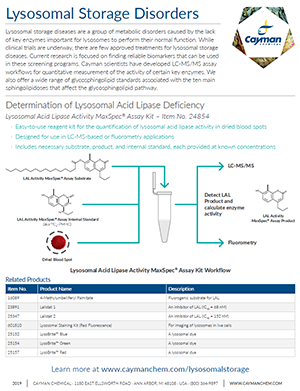
More Lysosomal Storage Disorders Research Tools from Cayman
You May Also Be Interested In…
Gb3 and lyso-Gb3 and Fabry Disease
Sphingomyelin and Lysosphingomyelin: Vital Membrane Components
Biomarker Standards for Fabry Disease Diagnosis and Monitoring
Glucosylsphingosine: A Sensitive and Specific Biomarker for Gaucher Disease
Lysosphingomyelin: A Sensitive and Specific Biomarker for Niemann-Pick Disease
References
1. Krüger, R., Tholey, A., Jakoby, T., et al. Quantification of the Fabry marker lysoGb3 in human plasma by tandem mass spectrometry. J. Chromatogr. B Analyt. Technol. Biomed. Life Sci. 883-884, 128-135 (2012).
2. Rolfs, A., Giese, A.-K., Grittner, U., et al. Glucosylsphingosine is a highly sensitive and specific biomarker for primary diagnostic and follow-up monitoring in Gaucher disease in a non-Jewish, Caucasian cohort of Gaucher disease patients. PLoS One 8(11), e79732 (2013).
3. Vanier, M.T., Gissen, P., Bauer, P., et al. Diagnostic tests for Niemann-Pick disease type C (NP-C): A critical review. Mol. Genet. Metab. 118(4), 244-254 (2016).
4. Hopkin, R.J., Cabrera, G., Charrow, J., et al. Risk factors for severe clinical events in male and female patients with Fabry disease treated with agalsidase beta enzyme replacement therapy: Data from the Fabry registry. Mol. Genet. Metab. 119(1-2), 151-159 (2016).
Contact Info
Cayman Chemical1180 East Ellsworth RoadAnn Arbor, Michigan 48108 USAToll Free: (800) 364-9897(USA and Canada only)Fax: (734) 971-3640


