
News & Announcements
Novel Adamantane-Labeled Sphingolipids
Novel Adamantane-Labeled Sphingolipids
Article from 2017-04-03
This article was originally published in the April 2017 edition of Matreya’s Newsletter for Glyco/Sphingolipid Research (PDF).
Adamantanyl globotriaosylceramide (AdaGb3) is a bioactive sphingolipid and water-soluble form of globotriaosylceramide (Gb3) that contains an adamantanyl group in place of the fatty acyl chain.
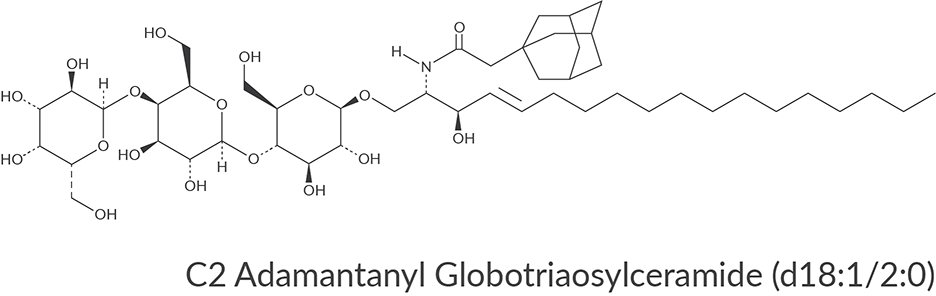
Unlike Gb3, AdaGb3 retains high affinity for verotoxin binding in aqueous solutions and also shares some properties of Gb3-cholesterol complexes in solution, which may relate to several of its bioactivities.1,2 AdaGb3 also functionally mimics Gb3 microdomains, providing a new class of molecular tools for studying the role of glycolipids and lipid rafts in such areas as HIV-1 fusion and other biological processes. AdaGb3 may disrupt HIV gp120-glycolipid interactions, thereby obviating the problem of resistance mutants selected by current antiretroviral treatments and opening a new route for controlling HIV-1 replication in infected individuals.3 AdaGb3 has been proposed as a regulator for multidrug resistance in cancer cells by taking advantage of the interaction between Gb3 and the glycoprotein MDR1, thus modulating the function of MDR1 across the intestinal endothelium.4
Adamantanyl glucosylceramide (AdaGlcCer), at low doses and at pH 7, inhibits glucocerebrosidase, thereby increasing cellular glycosphingolipid levels and making it a useful tool in the study of Gaucher disease. However, at 40 µM AdaGlcCer (which is converted to AdaLacCer in cells) inhibits lactosylceramide synthase, decreasing lactosylceramide and complex glycosphingolipid levels, making it the first cellular lactosylceramide synthase inhibitor.1
Adamantanyl galactosylceramide (AdaGalCer) stimulates glucocerebrosidase at pH 5 (but not at pH 7), reducing glucosylceramide levels in cells. At 40 µM AdaGalCer reduces Gb3 and globoside (Gb4) synthesis in Fabry's disease cells by acting as a substrate for Gb3 synthase. Gb3 synthase converts AdaGalCer to a novel AdaGb2, which is readily lost from cells, making it a "safety valve" to offset Gb3 accumulation in Fabry's disease. AdaGalCer also inhibits cellular sulfatide synthesis.1
You May Also Be Interested In…
Deuterated GD3 as a New Mass Spectrometry Ganglioside Standard
Ganglioside GD2 and Breast Cancer
Functions of the Neuronal Lipid Trisialoganglioside GT1b
References
1. Kamani, M., Mylvaganam, M., Tian, R., et al. Adamantyl glycosphingolipids provide a new approach to the selective regulation of cellular glycosphingolipid metabolism. J. Biol. Chem. 286(24), 21413-21426 (2011).
2. Mylvaganam, M. and Lingwood, C.A. Adamantyl globotriaosyl ceramide: A monovalent soluble mimic which inhibits verotoxin binding to its glycolipid receptor. Biochem. Biophys. Res. Commun. 257(2), 391-394 (1999).
3. Mahfoud, R., Mylvaganam, M., Lingwood, C.A., et al. A novel soluble analog of the HIV-1 fusion cofactor, globotriaosylceramide (Gb3), eliminates the cholesterol requirement for high affinity gp120/Gb3 interaction. J. Lipid Res. 43(10), 1670-1679 (2002).
4. De Rosa, M.F., Ackerley, C., Wang, B., et al. Inhibition of multidrug resistance by adamantylGb3, a globotriaosylceramide analog. J. Biol. Chem. 283(8), 4501-4511 (2008).
Contact Info
Cayman Chemical1180 East Ellsworth RoadAnn Arbor, Michigan 48108 USAToll Free: (800) 364-9897(USA and Canada only)Fax: (734) 971-3640


