
Technical Support & Resources
Information provided in the product description is from published literature. Due to the nature of scientific experimentation, your results (e.g., selectivity and effective concentrations) or specific application for this product may differ. If you have questions about how this product fits your application, please contact our technical support staff.
Visit our FAQ
Contact Us
Toll Free Phone (USA and Canada Only): (888) 526-5351
Direct Phone: (734) 975-3888
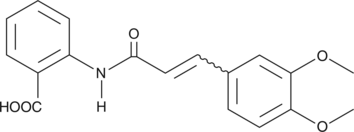
Technical Information
- 3,4-DAA
- N-
(3',4'- Dimethyoxycinnamoyl) Anthranilic Acid - N-5'
- MK 341
- SB 252218
Shipping & Storage Information
Recommended Products
Certificates of Analysis & Batch Specific Data
Provide batch numbers separated by commas to download or request available product inserts, QC sheets, certificates of analysis, data packs, and GC-MS data.
Kinase Resource Center
Discover Products & Resources for Kinase Research
- Kinase inhibitors, screening libraries, assay kits, & more
- Tools to study kinase signaling pathways:
- Growth factor signaling
- PI3K/Akt/mTOR
- MAPKs (ERK, p38, & JNK)
- JAK/STAT signaling
- Articles, resources, & advice
Product Description
Tranilast is an antiallergic agent.1 It inhibits prostaglandin E2 (PGE2; Item No. 14010) and PGD2 (Item No. 12010) production induced by A23187 (Item Nos. 11016 | 22030) in isolated rat peritoneal mast cells when used at a concentration of 100 µM, as well as LPS-stimulated production of PGE2 and thromboxane B2 (TXB2; Item No. 19030) in isolated human monocytes (IC50s = ~3 and ~35 µM, respectively).2,3 Tranilast (500 µM) reduces mast cell degranulation induced by compound 48/80 (Item No. 22173).1 It inhibits VEGF-stimulated proliferation, migration, and tube formation of bovine retinal endothelial cells (IC50s = 22, 18, and 193 µM, respectively).4 Tranilast (200 mg/kg) prevents homologous passive cutaneous anaphylaxis (PCA) in guinea pigs.5 Formulations containing tranilast have been used in the treatment of asthma and keloid and hypertrophic scars.
WARNING This product is not for human or veterinary use.
References & Product Citations
1. Anti-
2. Inhibitory effect of tranilast on prostaglandin D synthetase. Biochem. Pharmacol. 38(16), 2673-2676 (1989).
3. Modulation of human monocyte activities by tranilast, SB 252218, a compound demonstrating efficacy in restenosis. J. Pharmacol. Exp. Ther. 295(3), 1061-1069 (2000).
4. Tranilast inhibits protein kinase C-
5. Inhibition of hypersensitivity reactions by a new drug, N(3’,4’-
Contact Info
Cayman Chemical1180 East Ellsworth RoadAnn Arbor, Michigan 48108 USAToll Free: (800) 364-9897(USA and Canada only)Fax: (734) 971-3640


