
Features
- This product is qualified as a Reference Material that has been manufactured and tested to meet ISO/IEC 17025 and ISO 17034 international standards
- This product is intended to be used as an analytical reference standard
- Bulk material is available for qualified institutions; please contact our sales department for pricing
Technical Support & Resources
Visit our FAQ
Contact Us
Toll Free Phone (USA and Canada Only): (888) 526-5351
Direct Phone: (734) 975-3888
Product Categories
Research Area
Application

Synonyms
- DXO-d3
- d-3-hydroxy-N-Methylmorphinan-d3
Technical Information
Shipping & Storage Information
Recommended Products
Certificates of Analysis & Batch Specific Data
Provide batch numbers separated by commas to download or request available product inserts, QC sheets, certificates of analysis, data packs, and GC-MS data.
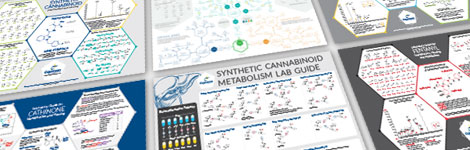
Forensic Lab Guide Wall Posters
Discover our collection of drug identification, naming, and metabolism posters for your lab. We offer all of our posters at no cost to help support the forensic community.
REQUEST YOURSProduct Description
Dextrorphan-d3 (tartrate) (Item No. 15810) is intended for use as an internal standard for the quantification of dextrorphan (Item Nos. 18908 | 15886) by GC- or LC-MS. Dextrorphan is categorized as a morphinan.1 It is an active metabolite of dextromethorphan (Item Nos. ISO60141 | 11157 | 13950).2 Dextrorphan has analgesic activity and induces memory impairments in rats and has anticonvulsant activity and induces hyperlocomotion in mice.1,3,4 It substitutes for phencyclidine (PCP; Item Nos. ISO60194 | 14276) in rhesus monkeys.5 This product is intended for research and forensic applications.
WARNING This product is not for human or veterinary use.
References & Product Citations
1. Dextromethorphan or dextrorphan have a local anesthetic effect on infiltrative cutaneous analgesia in rats. Anesth. Analg. 104(5), 1251-1255 (2007).
2. Neuropsychotoxicity of abused drugs: Potential of dextromethorphan and novel neuroprotective analogs of dextromethorphan with improved safety profiles in terms of abuse and neuroprotective effects. J. Pharmacol. Sci. 106(1), 22-27 (2008).
3. Dextromethorphan and dextrorphan in rats: Common antitussives -
4. Binding of dimemorfan to sigma-
5. Evaluation of the reinforcing properties and phencyclidine-
Contact Info
Cayman Chemical1180 East Ellsworth RoadAnn Arbor, Michigan 48108 USAToll Free: (800) 364-9897(USA and Canada only)Fax: (734) 971-3640


