Filter by TypeClear Filters


Lab Wall Posters (11)
Displaying 1 - 11 of 11 Results

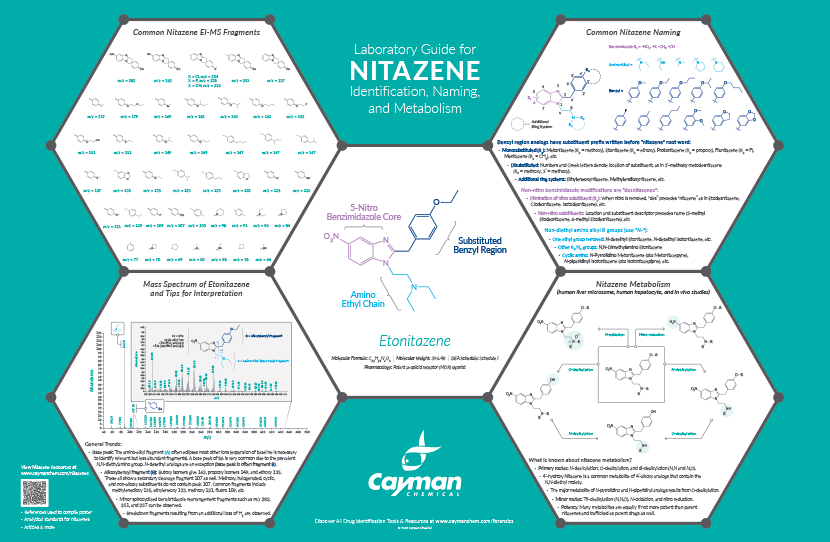
Laboratory Guide for Nitazene Identification, Naming, and Metabolism

Lab Wall Posters


Synthetic opioids of the 2-benzylbenzimidazole structural class began to appear on the illicit drug market as early as 2019, with etonitazene representing the prototypical member of this emerging class of novel psychoactive substances (NPS). Known as nitazenes, this opioid subclass has grown in prevalence across the world and includes a variety of structural modifications. This poster aids the forensic community by describing the common naming conventions that are used for nitazenes, provides common nitazene fragments, tips for mass spectrometry interpretation, and shares a summary of known metabolism pathways.

In this guide for nitazene identification, naming, and metabolism, we cover:
  • Mass Spectrum of Etonitazene and Tips for Interpretation
  • Common Mass Spec Fragments
  • Common Nitazene Naming Conventions
  • Nitazene Metabolism
Discover resources for the lab wall poster here, including references used to compile the Nitazene Identification, Naming, and Metabolism Lab Wall Poster.

To cite this poster: St. Germaine, D.M., Layle, N.K., Pierzynski, H., and Iula, D.M. Laboratory Guide for Nitazene Identification, Naming, and Metabolism. May 2025.
laboratory guide for nitazene identification naming and metabolism

​Laboratory Guide for Lysergamide Identification and Naming

Lab Wall Posters


LSD is the classic member of psychedelic lysergamides. Structural modifications to three main regions of the LSD scaffold have resulted in the emergence of new lysergamides entering the novel psychoactive substances (NPS) market.

To support toxicologists and forensic chemists tasked with the identification of these drugs, this poster describes the common naming conventions used for lysergamides and presents common lysergamide substitutions, fragments, and tips for mass spectrometry interpretation to help the forensic community decipher the structure of new lysergamides.

In this guide for lysergamide identification and naming, we review:

  • Common lysergamide substitutions
  • Common lysergamide MS fragments
  • Proposed mechanism for some fragments
  • Mass spectrum of 1P-LSD and tips for interpretation

Review the list of primary resources used to collate this guide here.

To cite this poster: Watson-Gooden, C., Pierzynski, H., Iula, D.M., and Hering, K.W. Laboratory Guide for Lysergamide Identification and Naming. September 2023.

​The Magic Molecules Behind Psychedelic Mushrooms

Lab Wall Posters


Mushrooms have been used in medicinal and spiritual practices in Indigenous cultures around the world for several millennia. A wide variety of species of gilled mushrooms under the order of Agaricales contain psychoactive alkaloids. The two most studied genera include Psilocybe and Amanita. Because of renewed interest in entheogenic plant molecules as therapeutics, there is a large body of research building around the psychedelic effects of alkaloids found in these mushrooms. Presented here are the biosynthetic and metabolic pathways of psilocybin-containing mushrooms.


Discover additional resources here, including references used to compile the Psychedelic Mushrooms Lab Wall Poster.

To cite this poster: St. Germaine, D.M. The Magic Molecules Behind Psychedelic Mushrooms. June 2023.

Laboratory Guide for Cathinone Identification and Naming

Lab Wall Posters


The cathinone eutylone was first detected in Europe in 2014 and later reported in the US in 2018. Eutylone has since become one of the most prevalent synthetic stimulants identified in forensic casework, and new substituted cathinones continue to emerge on the NPS market. Inconsistent and unstandardized naming of designer drugs in the cathinone structural class presents unique challenges to various stakeholders tasked with the identification of these drugs. In an effort towards clearer communication within the field, this poster describes the common naming conventions used in literature and establishes a standardized approach to naming modifications of the cathinone core structure. Common cathinone fragments, tips for mass spectrometry interpretation, and common substitutions are also presented to help the forensic community decipher the structure of new designer cathinones.  

In this laboratory guide for drug identification and naming, we cover:

  • Common Substitutions
  • Mass Spectrum of Eutylone and Tips for Interpretation
  • Common Mass Spec Fragments
  • A Standardized Alkylphenone Naming System
  • Other Common Naming Conventions
To cite this poster: Pierzynski, H. and Iula, D.M. Laboratory Guide for Cathinone Identification and Naming. October 2021.

​Synthetic Cannabinoid Metabolism Lab Guide

Lab Wall Posters


Synthetic cannabinoids undergo rapid and extensive metabolism to phase I metabolites that can sometimes retain high potency or may even be toxic compared to their parent compounds. Because of this rapid metabolism in vivo, it is typically impossible to detect the parent synthetic cannabinoids in biological samples. Metabolite detection is often the only viable way to determine synthetic cannabinoid exposure. Cayman's scientists have developed this laboratory guide for toxicologists and drug chemists to help identify these clinically relevant metabolites from several major classes of synthetic cannabinoids.

In this guide for synthetic cannabinoid metabolism we review:

  • The Phase I Metabolite Biotransformation Pathway
  • Metabolites of Amide-, Ester-, and Carbonyl-Linked Head Group Classes of Synthetic Cannabinoids
  • Typical Synthetic Cannabinoid Metabolism Patterns
Review the list of primary resources used to collate this guide here

To cite this poster: Schelkun, R.M. and Iula, D.M. ​Synthetic Cannabinoid Metabolism Lab Guide. May 2024.

Benzodiazepine Metabolism Lab Guide

Lab Wall Posters


The basic benzodiazepine scaffold has been modified to create a broad class of compounds differing in potency, how quickly they are absorbed into the body, and what they are used to treat. Cayman's scientists have developed this laboratory guide for toxicologists to help demystify drug screening results by providing likely metabolites that should be encountered during the metabolism of several major classes of benzodiazepines.

In this guide for benzodiazepine metabolism we review:

  • The Phase I and Phase II Metabolite Biotransformation Pathway
  • Likely Metabolites of 7-Halogenated-, 7-Nitro-, Thieno-, and Triazolo- Classes of Benzodiazepines
  • Half-Life of Common Benzodiazepines
  • Benzodiazepine Prodrugs
To cite this poster: Bennett, B.L., Hering, K.W., and Iula, D.M. Benzodiazepine Metabolism Lab Guide. May 2024.

Laboratory Guide for Utopioid Identification, Naming, and Metabolism

Lab Wall Posters


With the recent passing of DEA Drug Code 9850, there has been an increase in the number of U-type opioids being found in street drugs. Also known as U-drugs or U-compounds, utopioids are characterized by a trans-cyclohexanediamine moiety and their substituted phenyl ring, linked together by an amide carbonyl group.

In this guide for drug identification, naming, and metabolism:

  • Common EI-GC-MS Utopioid Fragments
  • Mass Spectrum of U-47700 and Tips for Interpretation
  • Halogen Isotope Patterns
  • Utopioid Naming Conventions
  • Utopioid Metabolism
To cite this poster: Layle, N.K. and Iula, D.M. ​Laboratory Guide for Utopioid Identification, Naming, and Metabolism. September 2020.

Laboratory Guide for Fentanyl Identification, Naming, and Metabolism

Lab Wall Posters


The basic fentanyl scaffold can be modified in four different regions leading to a myriad of new fentanyl varieties. Cayman's scientists have developed this laboratory guide for bench chemists and toxicologists to help identify novel fentanyl analogs.

In this guide for drug identification, naming, and metabolism:

  • Common Fentanyl MS Fragments
  • Mass Spectrum of Fentanyl and Tips for Interpretation
  • Major Predictive Patterns
  • Fentanyl Naming Conventions
  • Fentanyl Metabolism: Typical Phase I Metabolites
To cite this poster: Iula, D.M. and Pierzynski, H. Laboratory Guide for Fentanyl Identification, Naming, and Metabolism. May 2024.

​Phytocannabinoid Guide: Biosynthesis, Naming, and Numbering

Lab Wall Posters


Updated Februrary 2024

More than 100 structurally and physiologically distinct cannabinoid compounds are unique to plants of the genus Cannabis, known collectively as phytocannabinoids. Here we present the biosynthesis and degradation pathways of phytocannabinoids derived from the olivetol, varinol, and orcinol series and explain the conventions that have been adopted for nomenclature and structure numbering systems.

To cite this poster: St. Germaine, D.M. ​and Williams, J.B. Phytocannabinoid Guide: Biosynthesis, Naming, and Numbering. February 2024.

​Laboratory Guide for Synthetic Cannabinoid Identification and Naming

Lab Wall Posters


Updated February 2022

Several novel synthetic cannabinoids have recently emerged in the illicit drug supply after the introduction of a synthetic cannabinoid structural-class regulation implemented by China in July 2021. New cannabimimetic scaffolds observed include the OXIZID series and a new methylene spacer, ABD-FUBIATA. Cayman's scientists have developed this laboratory guide for bench chemists and toxicologists to help identify novel synthetic cannabinoids.

In this guide for drug identification and naming:

  • Common Synthetic Cannabinoid Mass Spec Fragments
  • Mass Spectrum of MMB-FUBINACA and Tips for Interpretation
  • Synthetic Cannabinoid Naming Conventions by Head, Core, and Tail Groups
To cite this poster: Schelkun, R.M. and Iula, D.M. ​​Laboratory Guide for Synthetic Cannabinoid Identification and Naming. February 2022.

​Cannabinoid Receptors

Lab Wall Posters


Updated August 2023

The cannabinoid (CB) receptors are two of the most widely expressed GPCRs in the body. When coupled to Gi/o proteins their activation can negatively regulate adenylate cyclase and/or positively regulate MAPK signaling. Conversely, when coupled through Gs proteins, CB1 activation promotes adenylate cyclase signaling. CB1 also modulates a host of ion channels through Gi/o coupling including A-type inwardly rectifying potassium channels (IRK) and N-type and P/Q-type calcium channels (Cav2.2, Cav2.1). The two major functions of these receptors are neuromodulatory, inhibiting neurotransmitter release through retrograde signaling, and immunomodulatory, regulating cytokine release and immune cell migration.


View a complete list of binding affinity journal articles referenced in this poster here.
Displaying 1 - 11 of 11 Results