
Technical Support & Resources
Information provided in the product description is from published literature. Due to the nature of scientific experimentation, your results (e.g., selectivity and effective concentrations) or specific application for this product may differ. If you have questions about how this product fits your application, please contact our technical support staff.
Visit our FAQ
Contact Us
Toll Free Phone (USA and Canada Only): (888) 526-5351
Direct Phone: (734) 975-3888
Product Categories

Technical Information
- HCQ
- NSC 4375
Shipping & Storage Information
Recommended Products
Certificates of Analysis & Batch Specific Data
Provide batch numbers separated by commas to download or request available product inserts, QC sheets, certificates of analysis, data packs, and GC-MS data.
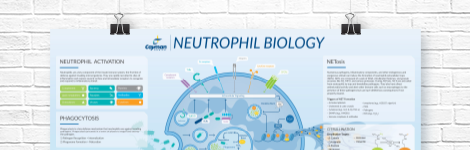
Neutrophil Biology Wall Poster
Explore how neutrophils shape the immune response in health and disease. This poster highlights neutrophil pathogen defense mechanisms, including phagocytosis, degranulation, and NETosis, as well as neutrophil roles in inflammation and NET-associated pathologies.
DOWNLOAD NOWProduct Description
Hydroxychloroquine is an aminoquinoline with antimalarial, anti-inflammatory, and antiviral activities.1,2,3,4 It is active against the chloroquine-sensitive NF54 and D6 strains of P. falciparum (IC50s = 16.3 and 15 nM, respectively) but has decreased activity against chloroquine-resistant P. falciparum strains (IC50s = 422.7-1,735.3 nM).1 Hydroxychloroquine inhibits production of IL-22, IL-17A, and IL-6 induced by phorbol 12-myristate 13-acetate (TPA; Item No. 10008014) and ionomycin (Item No. 10004974) in peripheral blood mononuclear cells (PBMCs) isolated from healthy individuals or patients with systemic lupus erythematosus (SLE) or rheumatoid arthritis (RA).3 It inhibits accumulation of sequestosome-1 (SQSTM1) puncta, a marker of autophagy, in mouse embryonic fibroblasts (MEFs) in a concentration-dependent manner.2 Hydroxychloroquine reduces viral titers of severe acute respiratory syndrome coronavirus 2 (SARS-CoV-2) in the culture supernatant of infected Vero E6 cells but does not reduce SARS-CoV-2 viral titers in an in vitro human airway epithelium model or the respiratory tract of infected cynomolgus macaques.4 Formulations containing hydroxychloroquine have been used in the prevention or treatment of malaria, as well as in the treatment of RA and SLE.
WARNING This product is not for human or veterinary use.
References & Product Citations
1. The activities of current antimalarial drugs on the life cycle stages of Plasmodium: A comparative study with human and rodent parasites. PLoS Med. 9(2), e1001169 (2012).
2. Chloroquine inhibits autophagic flux by decreasing autophagosome-
3. Hydroxychloroquine decreases Th17-
4. Hydroxychloroquine use against SARS-
Krüppel-
Suppression of SARS-
Contact Info
Cayman Chemical1180 East Ellsworth RoadAnn Arbor, Michigan 48108 USAToll Free: (800) 364-9897(USA and Canada only)Fax: (734) 971-3640


