
Technical Support & Resources
Visit our FAQ
Contact Us
Toll Free Phone (USA and Canada Only): (888) 526-5351
Direct Phone: (734) 975-3888
Product Categories
LDL Receptor Polyclonal Antibody - Biotinylated
Item No. 22727
Technical Information
- LDLR
- Low Density Lipoprotein Receptor
Shipping & Storage Information
Recommended Products
Certificates of Analysis & Batch Specific Data
Provide batch numbers separated by commas to download or request available product inserts, QC sheets, certificates of analysis, data packs, and GC-MS data.

Explore Obesity & Metabolic Disease Resources
Discover high-quality research tools to investigate GLP-1 mechanisms and next-generation metabolic targets.
OBESITY RESEARCH SOLUTIONSProduct Description
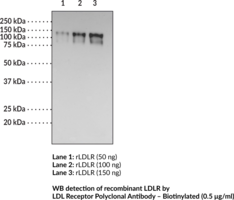
LDL receptor (LDLR) is a cell surface glycoprotein that scavenges LDL from the blood and regulates plasma LDL levels.1 It is composed of an N-terminal signal sequence, a ligand-binding domain, an EGF precursor homology domain, an O-linked glycosylation domain, a transmembrane region, and a C-terminal cytoplasmic tail. LDLR is primarily expressed in the liver but is also found in the adrenal cortex.2 It mediates the endocytosis of LDL by binding to apolipoprotein E (ApoE) or ApoB on the LDL surface, thereby supplying cholesterol to cells.1 Protein levels of LDLR are decreased in HepG2 cells expressing proprotein convertase subtilisin kexin 9 (PCSK9).3 Knockout of Ldlr increases plasma levels of cholesterol and triglycerides and induces the formation of atherosclerotic lesions in mice.4 Mutations in LDLR are associated with familial hypercholesterolemia.5 Cayman's LDL Receptor Polyclonal Antibody - Biotinylated is composed of an LDLR polyclonal antibody conjugated to biotin and can be used for immunocytochemistry (ICC) and Western blot (WB) applications. This antibody recognizes LDLR at approximately 100 to 160 kDa from human, mouse, and rat samples.
WARNING This product is not for human or veterinary use.
References & Product Citations
1. Receptor-
2. Low density lipoprotein receptor-
3. NARC-
4. Acceleration of atherogenesis by COX-
5. Genetic causes of monogenic heterozgous familial hypercholesterolemia: A HuGE prevalence review. Am. J. Epidemiol. 160(5), 407-420 (2004).
Contact Info
Cayman Chemical1180 East Ellsworth RoadAnn Arbor, Michigan 48108 USAToll Free: (800) 364-9897(USA and Canada only)Fax: (734) 971-3640


