
Technical Support & Resources
Information provided in the product description is from published literature. Due to the nature of scientific experimentation, your results (e.g., selectivity and effective concentrations) or specific application for this product may differ. If you have questions about how this product fits your application, please contact our technical support staff.
Visit our FAQ
Contact Us
Toll Free Phone (USA and Canada Only): (888) 526-5351
Direct Phone: (734) 975-3888
Product Categories
Product Type
Research Area

Technical Information
- 1-Hydrazinophthalazine
Shipping & Storage Information
Recommended Products





Certificates of Analysis & Batch Specific Data
Provide batch numbers separated by commas to download or request available product inserts, QC sheets, certificates of analysis, data packs, and GC-MS data.
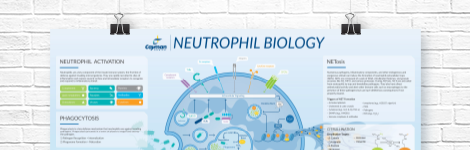
Neutrophil Biology Wall Poster
Explore how neutrophils shape the immune response in health and disease. This poster highlights neutrophil pathogen defense mechanisms, including phagocytosis, degranulation, and NETosis, as well as neutrophil roles in inflammation and NET-associated pathologies.
DOWNLOAD NOWProduct Description
Hydralazine is an orally bioavailable vasodilator and antihypertensive agent.1 It decreases DNA methylation in Jurkat cells at a concentration of 10 μM and inhibits extracellular and intracellular production of reactive oxygen species (ROS) in rat macrophages activated by phorbol 12-myristate 13-acetate (PMA; Item No. 10008014) at a concentration of 100 μM.2,3 Hydralazine (100 μM) also decreases nitric oxide production and mRNA expression of inducible nitric oxide synthase (iNOS) in rat macrophages activated by LPS (Item Nos. 19660| 19661) and interferon-γ (IFN-γ).3 It reduces contraction of rat aortic arterial strips induced by potassium and norepinephrine (Item No. 16673; IC50s = 2.2 and 3.06 mM, respectively).4 Hydralazine (2.6 mg/kg) lowers mean arterial blood pressure (MAP) by 41.76% in conscious rats.5 Formulations containing hydralazine have been used in the treatment of high blood pressure and heart failure.
WARNING This product is not for human or veterinary use.
References & Product Citations
1. Direct-
2. Hydralazine and procainamide inhibit T cell DNA methylation and induce autoreactivity. J. Immunol. 140(7), 2197-2200 (1988).
3. Antioxidant activity and inhibitory effects of hydralazine on inducible NOS/COX-
4. Comparison of the effects of hydralazine and nifedipine on contractions and 45Ca influx of rat aorta. J. Pharm. Pharmacol. 43(5), 356-359 (1991).
5. Triazole incorporated pyridazinones as a new class of antihypertensive agents: Design, synthesis and in vivo screening. Bioorg. Med. Chem. Lett. 21(3), 1023-1026 (2011).
Contact Info
Cayman Chemical1180 East Ellsworth RoadAnn Arbor, Michigan 48108 USAToll Free: (800) 364-9897(USA and Canada only)Fax: (734) 971-3640


