
A neuropeptide hormone
Technical Support & Resources

Information provided in the product description is from published literature. Due to the nature of scientific experimentation, your results (e.g., selectivity and effective concentrations) or specific application for this product may differ. If you have questions about how this product fits your application, please contact our technical support staff.

Visit our FAQ

Contact Us

Toll Free Phone (USA and Canada Only): (888) 526-5351
Direct Phone: (734) 975-3888

Request Technical Support

Technical Support Request

To streamline the process attach the appropriate questionnaire to your inquiry.

Download IHC QuestionnaireDownload WB Questionnaire

View Our Privacy Statement for details on how we use and protect your data. In addition, this site is protected by hCaptcha and its Privacy Policy and Terms of Service apply.

Urocortin (human) (trifluoroacetate salt)

Item No. 24744
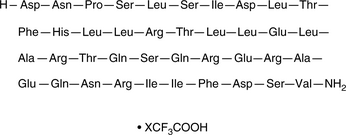
Technical Information
Formal Name
L-α-aspartyl-L-asparaginyl-L-prolyl-L-seryl-L-leucyl-L-seryl-L-isoleucyl-L-α-aspartyl-L-leucyl-L-threonyl-L-phenylalanyl-L-histidyl-L-leucyl-L-leucyl-L-arginyl-L-threonyl-L-leucyl-L-leucyl-L-α-glutamyl-L-leucyl-L-alanyl-L-arginyl-L-threonyl-L-glutaminyl-L-seryl-L-glutaminyl-L-arginyl-L-α-glutamyl-L-arginyl-L-alanyl-L-α-glutamyl-L-glutaminyl-L-asparaginyl-L-arginyl-L-isoleucyl-L-isoleucyl-L-phenylalanyl-L-α-aspartyl-L-seryl-L-valinamide, trifluoroacetate salt
Molecular Formula
C204H337N63O64 • XCF3COOH
Formula Weight
Purity
≥95%
A lyophilized powder
Formic Acid: 1 mg/ml
SMILES
NC([C@H](C(C)C)NC([C@H](CO)NC([C@@H](NC([C@@H](NC([C@@]([C@H](CC)C)([H])NC([C@@]([C@H](CC)C)([H])NC([C@H](CCCNC(N)=N)NC([C@H](CC(N)=O)NC([C@H](CCC(N)=O)NC([C@H](CCC(O)=O)NC([C@@H](NC([C@H](CCCNC(N)=N)NC([C@H](CCC(O)=O)NC([C@H](CCCNC(N)=N)NC([C@H](CCC(N)=O)NC([C@H](CO)NC([C@H](CCC(N)=O)NC([C@@]([C@@H](C)O)([H])NC([C@H](CCCNC(N)=N)NC([C@@H](NC([C@H](CC(C)C)NC([C@H](CCC(O)=O)NC([C@H](CC(C)C)NC([C@H](CC(C)C)NC([C@@]([C@@H](C)O)([H])NC([C@H](CCCNC(N)=N)NC([C@H](CC(C)C)NC([C@H](CC(C)C)NC([C@@H](NC([C@@H](NC([C@@]([C@@H](C)O)([H])NC([C@H](CC(C)C)NC([C@@H](NC([C@@]([C@H](CC)C)([H])NC([C@H](CO)NC([C@H](CC(C)C)NC([C@H](CO)NC([C@@H]1CCCN1C([C@H](CC(N)=O)NC([C@@H](N[H])CC(O)=O)=O)=O)=O)=O)=O)=O)=O)CC(O)=O)=O)=O)=O)CC2=CC=CC=C2)=O)CC3=CN=CN3)=O)=O)=O)=O)=O)=O)=O)=O)=O)C)=O)=O)=O)=O)=O)=O)=O)=O)=O)C)=O)=O)=O)=O)=O)=O)=O)CC4=CC=CC=C4)=O)CC(O)=O)=O)=O)=O.FC(F)(C(O)=O)F
InChi Code
InChI=1S/C204H337N63O64.C2HF3O2/c1-28-100(20)154(262-191(323)140(90-271)257-180(312)127(75-96(12)13)247-189(321)138(88-269)259-192(324)141-52-42-70-267(141)199(331)136(83-146(210)279)255-163(295)111(205)81-150(286)287)193(325)254-135(85-152(290)291)185(317)246-129(77-98(16)17)187(319)266-159(107(27)274)198(330)253-131(79-109-45-35-32-36-46-109)181(313)248-132(80-110-86-222-91-228-110)183(315)245-126(74-95(10)11)178(310)243-124(72-93(6)7)176(308)235-116(51-41-69-227-204(220)221)174(306)265-158(106(26)273)197(329)251-128(76-97(14)15)179(311)244-125(73-94(8)9)177(309)239-122(58-64-149(284)285)170(302)242-123(71-92(4)5)175(307)230-104(24)161(293)231-114(49-39-67-225-202(216)217)173(305)264-157(105(25)272)196(328)241-119(55-61-144(208)277)171(303)256-137(87-268)188(320)240-117(53-59-142(206)275)166(298)234-113(48-38-66-224-201(214)215)165(297)238-121(57-63-148(282)283)168(300)233-112(47-37-65-223-200(212)213)164(296)229-103(23)162(294)232-120(56-62-147(280)281)167(299)237-118(54-60-143(207)276)169(301)249-133(82-145(209)278)184(316)236-115(50-40-68-226-203(218)219)172(304)261-156(102(22)30-3)195(327)263-155(101(21)29-2)194(326)252-130(78-108-43-33-31-34-44-108)182(314)250-134(84-151(288)289)186(318)258-139(89-270)190(322)260-153(99(18)19)160(211)292;3-2(4,5)1(6)7/h31-36,43-46,86,91-107,111-141,153-159,268-274H,28-30,37-42,47-85,87-90,205H2,1-27H3,(H2,206,275)(H2,207,276)(H2,208,277)(H2,209,278)(H2,210,279)(H2,211,292)(H,222,228)(H,229,296)(H,230,307)(H,231,293)(H,232,294)(H,233,300)(H,234,298)(H,235,308)(H,236,316)(H,237,299)(H,238,297)(H,239,309)(H,240,320)(H,241,328)(H,242,302)(H,243,310)(H,244,311)(H,245,315)(H,246,317)(H,247,321)(H,248,313)(H,249,301)(H,250,314)(H,251,329)(H,252,326)(H,253,330)(H,254,325)(H,255,295)(H,256,303)(H,257,312)(H,258,318)(H,259,324)(H,260,322)(H,261,304)(H,262,323)(H,263,327)(H,264,305)(H,265,306)(H,266,319)(H,280,281)(H,282,283)(H,284,285)(H,286,287)(H,288,289)(H,290,291)(H4,212,213,223)(H4,214,215,224)(H4,216,217,225)(H4,218,219,226)(H4,2
InChi Key
MSZWJDXFFRAJNC-BELMYTGDSA-N
Shipping & Storage Information
Storage
-20°C
Shipping
Room temperature in continental US; may vary elsewhere
Recommended Products

Certificates of Analysis & Batch Specific Data

Provide batch numbers separated by commas to download or request available product inserts, QC sheets, certificates of analysis, data packs, and GC-MS data.

    Add

    Add

    Product Description

    Urocortin is a neuropeptide hormone and member of the corticotropin-releasing factor (CRF) family which includes mammalian CRF, urocortin II (Item Nos. 24746 | 24747), urocortin III (Item Nos. 24748 | 24749 | 24750), frog sauvagine, and piscine urotensin I.1 Human urocortin shares 95% sequence homology with rat urocortin (Item No. 24745). Urocortin binds to type 1 and 2 CRF receptors as well as CRF binding protein (CRF-BP) with Ki values of 0.41, 1.8, 1.5, and 0.22 nM for human CRF1, rat CRF, mouse CRF, and human CRF-BP, respectively. It induces cAMP production in CHO cells expressing human CRF1, rat CRF, and mouse CRF receptors (EC50s = 0.22, 0.32, and 0.13 nM, respectively). Urocortin induces secretion of adrenocorticotropic hormone (ACTH) by rat anterior pituitary cells in a concentration-dependent manner, an effect that can be inhibited by human CRF-BP. It inhibits migration and proliferation of human vascular smooth muscle cells (VSMCs) and reduces LDL-induced foam cell formation in vitro.2 In vivo, urocortin slows development of aortic atherosclerotic lesions in Apoe-/- mice. Urocortin also decreases food intake in food-deprived and non-deprived rats as well as water intake in water-deprived rats in a dose-dependent manner.3

    WARNING This product is not for human or veterinary use.

    References & Product Citations
    Product Description References

    1. Donaldson, C.J., Sutton, S.W., Perrin, M.H., et alCloning and characterization of human urocortin. Endocrinology 137(5), 2167-2170 (1996).

    2. Hasegawa, A., Sato, K., Shirai, R., et alVasoprotective effects of urocortin 1 against atherosclerosis in vitro and in vivo. PLoS One 9(12):e110866, (2014).

    3. Spina, M.G., Merlo-Pich, E., Chan, R.K.W., et alAppetite-suppressing effects of urocortin, a CRF-related neuropeptide. Science 273(5281), 1561-1564 (1996).

