
Technical Support & Resources
Information provided in the product description is from published literature. Due to the nature of scientific experimentation, your results (e.g., selectivity and effective concentrations) or specific application for this product may differ. If you have questions about how this product fits your application, please contact our technical support staff.
Visit our FAQ
Contact Us
Toll Free Phone (USA and Canada Only): (888) 526-5351
Direct Phone: (734) 975-3888
Product Categories
Research Area
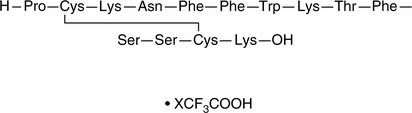
Cortistatin-14 (trifluoroacetate salt)
Item No. 25074
Technical Information
Shipping & Storage Information
Recommended Products
Certificates of Analysis & Batch Specific Data
Provide batch numbers separated by commas to download or request available product inserts, QC sheets, certificates of analysis, data packs, and GC-MS data.
Product Description
Cortistatin-14 is an endogenous neuropeptide agonist of somatostatin receptors (IC50s = 0.5-18.2 nM for human SST1-SST5 receptors expressed in CCL39 cells).1,2 It is expressed in GABAergic interneurons in the cortex and hippocampus.2,3 Cortistatin-14 competitively inhibits hexarelin binding to human growth hormone secretagogue receptors (GHS-R) in pituitary membranes (Ki = 0.54 μM).4 It also activates the human Mas-related gene receptor MrgX2 expressed in HEK293 cells leading to quantifiable GTP-γS binding to the G protein subunit Gαο (EC50 = 1.3 μM).5 Cortistatin-14 (0.01-1 μM), similarly to somatostatin-14 (Item No. 20809), completely inhibits thyrotropin-releasing hormone (TRH; Item No. 22917), and partially inhibits vasoactive intestinal peptide (VIP; Item No. 24996), stimulation of cAMP production in GH4 cells.3 In mice, cortistatin-14 dose-dependently (0.05-5 μg, i.c.v.) impairs memory retention when administered after foot shock avoidance training.6 Cortistatin-14 (40-320 μg/kg, s.c.) dose-dependently reduces growth hormone secretion in rats by greater than 80% after 10 minutes when administered at doses of 40-320 µg/kg.7
WARNING This product is not for human or veterinary use.
References & Product Citations
1. Structural and compositional determinants of cortistatin activity. J. Neurosci. Res. 56(6), 611-619 (1999).
2. Cortistatin: A member of the somatostatin neuropeptide family with distinct physiological functions. Brain Res. Brain Res. Rev. 33(2-3), 228-241 (2000).
3. A cortical neuropeptide with neuronal depressant and sleep-
4. Cortistatin, but not somatostatin, binds to growth hormone secretagogue (GHS) receptors of human pituitary gland. J. Endocrinol. Invest. 24(1), RC1-RC3 (2001).
5. Characterization of the Mas-
6. The cortical neuropeptide, cortistatin-
7. Growth hormone-
Contact Info
Cayman Chemical1180 East Ellsworth RoadAnn Arbor, Michigan 48108 USAToll Free: (800) 364-9897(USA and Canada only)Fax: (734) 971-3640


