
Technical Support & Resources
Visit our FAQ
Contact Us
Toll Free Phone (USA and Canada Only): (888) 526-5351
Direct Phone: (734) 975-3888
Product Categories
Research Area
Technical Information
- Citrullinated Protein
- Pan-citrulline
- Peptidyl-citrulline
Shipping & Storage Information
Recommended Products
Certificates of Analysis & Batch Specific Data
Provide batch numbers separated by commas to download or request available product inserts, QC sheets, certificates of analysis, data packs, and GC-MS data.

Visit Our Cancer Resource Center
Find Tools & Resources to Study the Hallmarks of Cancer
- Cancer cell signaling & regulation
- Cancer metabolism
- Tumor microenvironment
Product Description
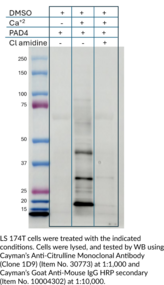
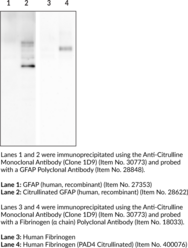
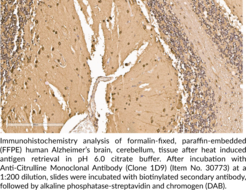
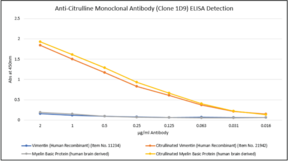
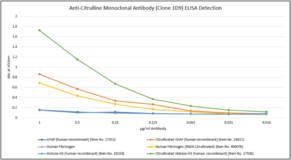
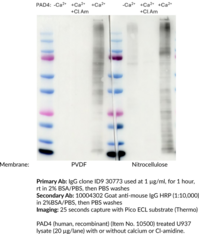
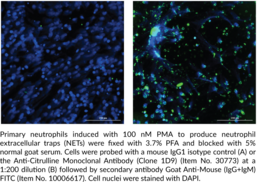
Citrulline is a noncoding amino acid that is produced by deimination of arginine through the post-translational modification citrullination.1 Citrullination is catalyzed by protein arginine deiminases (PADs) that convert positively charged arginine to electrically neutral citrulline, decreasing the isoelectric point of the protein, altering the native protein structure, and influencing protein ionic interactions.2 Protein citrullination has roles in many physiological and pathological processes, including autoimmunity, cancer, and neurodegenerative disorders.3 Citrullination of arginine 26 on histone H3 by PAD2 (Item No. 10785) displaces histone H3 from chromatin, resulting in chromatin decondensation and estrogen receptor α (ERα) transcriptional activation in a reporter assay.4 Citrullinated histones are also a component of neutrophil extracellular traps (NETs), a network of decondensed DNA and intracellular proteins secreted by neutrophils as a pathogen defense mechanism that is also a source of citrullinated autoantigens.5 Increased levels of antibodies to citrullinated protein antigens (ACPAs) are associated with increased disease severity in patients with rheumatoid arthritis.6,7 Plasma levels of citrullinated histone H3 are increased in patients with advanced cancer, and citrullinated glial fibrillary acidic protein (citGFAP; Item No. 28622) has been found in postmortem hippocampus from patients with Alzheimer's disease.8,9 Cayman's Anti-Citrulline Monoclonal Antibody (Clone 1D9) can be used for ELISA, immunofluorescence (IF), immunohistochemistry (IHC), immunoprecipitation (IP), and Western blot (WB) applications.
WARNING This product is not for human or veterinary use.
References & Product Citations
1. Citrullination in cancer. Cancer Res. 79(7), 1274-1284 (2019).
2. Citrullination: A posttranslational modification in health and disease. Int. J. Biochem. Cell Biol. 38(10), 1662-1677 (2006).
3. Mining the human tissue proteome for protein citrullination. Mol. Cell Proteomics 17(7), 1378-1391 (2018).
4. Peptidylarginine deiminase 2-
5. Identifying mechanism-
6. Antibodies to citrullinated protein antigens (ACPAs): Clinical and pathophysiologic significance. Curr. Rheumatol. Rep. 13(5), 421-430 (2011).
7. Oral mucosal breaks trigger anti-
8. Citrullinated histone H3 as a novel prognostic blood marker in patients with advanced cancer. PLoS One 13(1), e0191231 (2018).
9. Mass spectrometric identification of citrullination sites and immunohistochemical detection of citrullinated glial fibrillary acidic protein in Alzheimer’s disease brains. J. Neurosci. Res. 93(11), 1664-1674 (2015).
Citrullination profile analysis reveals peptidylarginine deaminase 3 as an HSV-
Contact Info
Cayman Chemical1180 East Ellsworth RoadAnn Arbor, Michigan 48108 USAToll Free: (800) 364-9897(USA and Canada only)Fax: (734) 971-3640


