
Technical Support & Resources
Visit our FAQ
Contact Us
Toll Free Phone (USA and Canada Only): (888) 526-5351
Direct Phone: (734) 975-3888
Product Categories
Product Type
Research Area
Application
CISD1 Cytosolic Domain (human, recombinant)
Item No. 32034
Technical Information
- CDGSH Iron Sulfur Domain 1
- C10orf70
- MitoNEET
- ZCD1
Shipping & Storage Information
Recommended Products
Certificates of Analysis & Batch Specific Data
Provide batch numbers separated by commas to download or request available product inserts, QC sheets, certificates of analysis, data packs, and GC-MS data.

Explore Obesity & Metabolic Disease Resources
Discover high-quality research tools to investigate GLP-1 mechanisms and next-generation metabolic targets.
OBESITY RESEARCH SOLUTIONSProduct Description
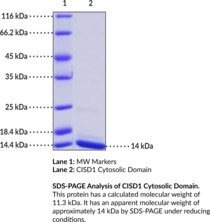
CDGSH iron sulfur domain 1 (CISD1), also known as mitoNEET, is an iron-sulfur outer mitochondrial membrane protein and member of the NEET protein family with roles in redox sensing, iron uptake, and respiratory capacity.1,2 It is a homodimeric protein comprised of a β-cap domain and a cluster binding domain with each monomer consisting of an N-terminal in-organelle domain, a transmembrane domain, and a C-terminal cytosolic domain.1 The CISD1 C-terminal domain houses the [2Fe-2S] cluster binding site which has roles in tuning redox properties of the protein in response to environmental conditions. CISD1 mRNA expression is induced by the ferroptosis inducer erastin (Item No. 17754) in HepG2 cells in an iron-dependent manner and stabilization of the CISD1 [2Fe-2S] cluster by pioglitazone (Item Nos. 71745 | 22263 | 10028) inhibits mitochondrial iron uptake, lipid peroxidation, and subsequent ferroptosis in the same cells.2 Overexpression of CISD1 decreases oxidative stress-induced apoptosis in an HL-1 cardiomyocyte model of hypoxia and reoxygenation injury.3 Levels of CISD1 mRNA are decreased in subcutaneous and visceral adipose tissue isolated from patients with obesity and visceral adipose tissue levels of CISD1 mRNA are positively correlated with insulin sensitivity in patients with morbid obesity.4 Knockdown of Cisd1 in mice induces mitochondrial dysfunction and increased levels of mitochondrial reactive oxygen species (ROS), as well as a loss of striatal dopamine, shortened stride length in a gait analysis, and decreased latency to fall in the rotarod test, all of which serve as markers of a Parkinsonian phenotype.5 Cayman's CISD1 Cytosolic Domain (human, recombinant) protein consists of 95 amino acids and has a calculated molecular weight of 11.3 kDa. By SDS-PAGE, under reducing conditions, the apparent molecular mass is approximately 14 kDa.
WARNING This product is not for human or veterinary use.
References & Product Citations
1. The unique fold and lability of the [2Fe-
2. CISD1 inhibits ferroptosis by protection against mitochondrial lipid peroxidation. Biochem. Biophys. Res. Commun. 478(2), 838-844 (2016).
3. MitoNEET protects HL-
4. CISD1 in association with obesity-
5. MitoNEET (CISD1) knockout mice show signs of striatal mitochondrial dysfunction and a Parkinson’s disease phenotype. ACS Chem. Neurosci. 8(12), 2759-2765 (2017).
Contact Info
Cayman Chemical1180 East Ellsworth RoadAnn Arbor, Michigan 48108 USAToll Free: (800) 364-9897(USA and Canada only)Fax: (734) 971-3640


