
Technical Support & Resources
Visit our FAQ
Contact Us
Toll Free Phone (USA and Canada Only): (888) 526-5351
Direct Phone: (734) 975-3888
Product Categories
Product Type
Application
Technical Information
- CD172A
- CD172 Antigen-like Family Member A
- MyD-1 Antigen
- SHPS-1
- SHP Substrate 1
- Signal Regulatory Protein α
Shipping & Storage Information
Recommended Products
Certificates of Analysis & Batch Specific Data
Provide batch numbers separated by commas to download or request available product inserts, QC sheets, certificates of analysis, data packs, and GC-MS data.

Visit Our Cancer Resource Center
Find Tools & Resources to Study the Hallmarks of Cancer
- Cancer cell signaling & regulation
- Cancer metabolism
- Tumor microenvironment
Product Description
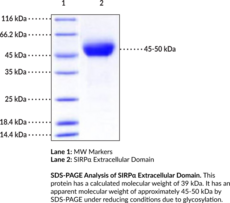
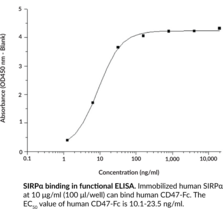
Signal regulatory protein α (SIRPα) is an inhibitory transmembrane receptor encoded by SIRPA in humans.1,2 It is composed of three extracellular immunoglobulin-like (Ig-like) domains, a single transmembrane region, and a cytoplasmic domain that contains four tyrosine residues with immunoreceptor tyrosine-based inhibitory motifs (ITIMs) that are essential to SIRPα interaction with the Src homology region 2 (SH2) domain-containing phosphatases SHP-1 and SHP-2.2 SIRPα is expressed on monocytes, macrophages, granulocytes, subsets of dendritic cells in lymphoid tissues, some bone marrow progenitor cells, and neurons. Binding of CD47 (Item No. 32085), a receptor expressed on healthy cells but often overexpressed in cancer cells, to SIRPα induces phosphorylation of the SIRPα ITIMs, coupling to SHP-1 or SHP-2, and repression of immune cell activation and phagocytosis.1,2 Knockout of Sirpa increases dopaminergic neuronal loss in the substantia nigra pars compacta and enhances striatal microglia activation in a mouse model of MPTP-induced Parkinson's disease.3 Sirpa-/- mice exhibit increased age-related podocyte injury and proteinuria compared with wild-type mice.4 SIRPA expression is decreased in patients with focal segmental glomerular sclerosis and in mouse models of renal injury induced by puromycin aminonucleoside (Item No. 15509), doxorubicin (Item No. 15007), or streptozotocin (Item No. 13104). Cayman's SIRPα Extracellular Domain (human, recombinant) protein can be used for ELISA. This protein consists of 351 amino acids, has a calculated molecular weight of 39 kDa, and a predicted N-terminus of Glu31 after signal peptide cleavage. By SDS-PAGE, under reducing conditions, the apparent molecular mass of this protein is 45 to 50 kDa due to glycosylation.
WARNING This product is not for human or veterinary use.
References & Product Citations
1. SIRPα-
2. The interaction between signal regulatory protein alpha (SIRPα) and CD47: Structure, function, and therapeutic target. Annu. Rev. Immunol. 32, 25-50 (2014).
3. SIRPα deficiency accelerates the pathologic process in models of Parkinson disease. Glia 67(12), 2343-2359 (2019).
4. Signal regulatory protein α protects podocytes through promotion of autophagic activity. JCI Insight 5(9), e124747 (2019).
Contact Info
Cayman Chemical1180 East Ellsworth RoadAnn Arbor, Michigan 48108 USAToll Free: (800) 364-9897(USA and Canada only)Fax: (734) 971-3640


