
Technical Support & Resources
Visit our FAQ
Contact Us
Toll Free Phone (USA and Canada Only): (888) 526-5351
Direct Phone: (734) 975-3888
Technical Information
- Activin Receptor-like Kinase 2
- Activin Receptor Type I
- ACTR-I
- ACVR1
- Serine/threonine-protein Kinase Receptor R1
- TGF-β Superfamily Receptor Type I
- TSR-I
Shipping & Storage Information
Recommended Products
Certificates of Analysis & Batch Specific Data
Provide batch numbers separated by commas to download or request available product inserts, QC sheets, certificates of analysis, data packs, and GC-MS data.
Kinase Resource Center
Discover Products & Resources for Kinase Research
- Kinase inhibitors, screening libraries, assay kits, & more
- Tools to study kinase signaling pathways:
- Growth factor signaling
- PI3K/Akt/mTOR
- MAPKs (ERK, p38, & JNK)
- JAK/STAT signaling
- Articles, resources, & advice
Product Description
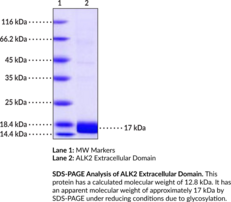
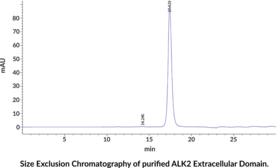
Activin receptor-like kinase 2 (ALK2) is a type I receptor kinase and member of the bone morphogenetic protein (BMP) receptor family.1,2 It is composed of a ligand-binding extracellular domain, a transmembrane domain, a membrane-associated glycine/serine-rich (GS) domain, and an intracellular kinase domain. ALK2 is expressed primarily in the heart, liver, intestine, and kidneys but is found at low levels in the brain and lung.3 Upon ligand binding, ALK2 is activated by type II BMP receptors via phosphorylation of the GS domain, which then activates SMAD or MAPK signaling.1,2 SNPs in ACVR1, the gene encoding ALK2, are associated with fibrodysplasia ossificans progressiva (FOP), congenital heart defects, and diffuse intrinsic pontine glioma.4,5,6 Cayman’s ALK2 Extracellular Domain (human, recombinant) protein consists of 114 amino acids, has a calculated molecular weight of 12.8 kDa, and a predicted N-terminus of Met21 after signal peptide cleavage. By SDS-PAGE, under reducing conditions, the apparent molecular mass of the protein is 17 kDa due to glycosylation.
WARNING This product is not for human or veterinary use.
References & Product Citations
1. Targeting heterotopic ossification by inhibiting activin receptor‑like kinase 2 function (Review). Mol. Med. Rep. 20(4), 2979-2989 (2019).
2. Accumulated knowledge of activin receptor-
3. A widely expressed transmembrane serine/threonine kinase that does not bind activin, inhibin, transforming growth factor β, or bone morphogenic factor. The Journal of Biological Chemisty 268(17), 12719-12723 (1993).
4. A recurrent mutation in the BMP type I receptor ACVR1 causes inherited and sporadic fibrodysplasia ossificans progressiva. Nat. Genet. 38(5), 525-527 (2006).
5. Dominant-
6. Targeting ALK2: An open science approach to developing therapeutics for the treatment of diffuse intrinsic pontine glioma. J. Med. Chem. 63(9), 4978-4996 (2020).
Contact Info
Cayman Chemical1180 East Ellsworth RoadAnn Arbor, Michigan 48108 USAToll Free: (800) 364-9897(USA and Canada only)Fax: (734) 971-3640


