
Technical Support & Resources
Information provided in the product description is from published literature. Due to the nature of scientific experimentation, your results (e.g., selectivity and effective concentrations) or specific application for this product may differ. If you have questions about how this product fits your application, please contact our technical support staff.
Visit our FAQ
Contact Us
Toll Free Phone (USA and Canada Only): (888) 526-5351
Direct Phone: (734) 975-3888
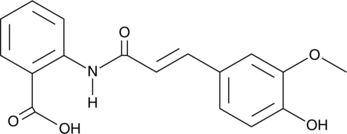
Technical Information
- Avenanthramide 1f
- AVN-E
Shipping & Storage Information
Recommended Products
Certificates of Analysis & Batch Specific Data
Provide batch numbers separated by commas to download or request available product inserts, QC sheets, certificates of analysis, data packs, and GC-MS data.
Kinase Resource Center
Discover Products & Resources for Kinase Research
- Kinase inhibitors, screening libraries, assay kits, & more
- Tools to study kinase signaling pathways:
- Growth factor signaling
- PI3K/Akt/mTOR
- MAPKs (ERK, p38, & JNK)
- JAK/STAT signaling
- Articles, resources, & advice
Product Description
Avenanthramide E is a phenolic alkaloid that has been found in A. sativa and has diverse biological activities.1,2,3,4,5 It is also an active metabolite of the antiallergic agent tranilast (Item Nos. 13044 | 46383).6 Avenanthramide E reduces lipid peroxidation in a cell-free assay at 40 µM, scavenges DPPH (Item No. 14805) radicals in a cell-free assay, reduces ferric to ferrous iron in a ferric reducing antioxidant power (FRAP) assay, and inhibits hydrogen peroxide-induced DNA damage in HT-29 cells (EC50 = 1.1 µM).2,3 It inhibits the replication of monkeypox virus in infected Vero cells (EC50 = 8.1 µM).4 Avenanthramide E (100 µM) also inhibits TGF-β-induced collagen production by 50% in cultured renal mesangial cells.5
WARNING This product is not for human or veterinary use.
References & Product Citations
1. Oat phenolics: Avenanthramides, novel substituted N-
2. Avenanthramides in oats (Avena sativa L.) and structure-
3. In vitro antioxidant activity and antigenotoxic effects of avenanthramides and related compounds. J. Agric. Food Chem. 57(22), 10619-10624 (2009).
4. Structural modification of tranilast against poxvirus based on α, β-
5. Evaluation and optimization of antifibrotic activity of cinnamoyl anthranilates. Bioorg. Med. Chem. Lett. 19(24), 7003-7006 (2009).
6. Simultaneous determination of tranilast and metabolites in plasma and urine using high-
Contact Info
Cayman Chemical1180 East Ellsworth RoadAnn Arbor, Michigan 48108 USAToll Free: (800) 364-9897(USA and Canada only)Fax: (734) 971-3640


