
Technical Support & Resources
Information provided in the product description is from published literature. Due to the nature of scientific experimentation, your results (e.g., selectivity and effective concentrations) or specific application for this product may differ. If you have questions about how this product fits your application, please contact our technical support staff.
Visit our FAQ
Contact Us
Toll Free Phone (USA and Canada Only): (888) 526-5351
Direct Phone: (734) 975-3888
Product Categories
Technical Information
- Palmidrol
- Palmityl Ethanolamide
- PEA
Shipping & Storage Information
Recommended Products
Certificates of Analysis & Batch Specific Data
Provide batch numbers separated by commas to download or request available product inserts, QC sheets, certificates of analysis, data packs, and GC-MS data.
Lipid Resource Center
Discover Products & Resources for Lipid Research
- High-purity lipid standards
- Lipid roles in biology
- Lipids in health & disease
- Lipids for pharmaceutical development
- Protocols, advice, & resources
Product Description
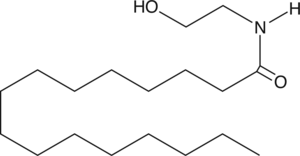
Palmitoyl ethanolamide (PEA) is an endogenous fatty N-acyl ethanolamine and a derivative of the endocannabinoid arachidonoyl ethanolamide (AEA; Item No. 90050).1,2 It selectively activates peroxisome proliferator-activated receptor α (PPARα; EC50 = 3.1 µM) over PPARβ/δ and PPARγ in HeLa cells expressing the human receptors.3 PEA binds to RBL-2H3 basophil membranes (IC50 = 1 nM), which endogenously express cannabinoid 2 (CB2), but not CB1, receptors, and inhibits antigen-induced serotonin release from RBL-2H3 cells (EC50 = 0.27 µM).2 It prevents decreases in paw withdrawal latency in a radiant heat hypersensitivity test, an effect that can be reversed by the CB1 receptor antagonist SR141716 (rimonabant; Item No. 9000484), PPARγ antagonist GW 9662 (Item No. 70785), and transient receptor potential vanilloid 1 (TRPV1) antagonist capsazepine (Item No. 10007518), in a mouse model of neuropathic pain induced by chronic constriction injury of the sciatic nerve.4 PEA (10 mg/kg) decreases carrageenan-induced paw edema in wild-type, but not Ppara-/-, mice.3 It inhibits tonic convulsions induced by pentylenetetrazole (PTZ; Item No. 18682) in rats when administered at a dose of 40 mg/kg.5 Formulations containing palmitoyl ethanolamide have been used as dietary supplements.
WARNING This product is not for human or veterinary use.
References & Product Citations
1. Fatty acid amides of ethanolamine in mammalian tissues. The Journal of Biological Chemisty 240, 1019-1024 (1965).
2. Mast cells express a peripheral cannabinoid receptor with differential sensitivity to anandamide and palmitoylethanolamide. Proc. Natl. Acad. Sci. USA 92(8), 3376-3380 (1995).
3. The nuclear receptor peroxisome proliferator-
4. The endogenous fatty acid amide, palmitoylethanolamide, has anti-
5. Selective antiepileptic effects of N-
Quantitative profiling of endocannabinoids and related N-
Characterisation of (R)-
The endogenous fatty acid amide, palmitoylethanolamide, has anti-
Contact Info
Cayman Chemical1180 East Ellsworth RoadAnn Arbor, Michigan 48108 USAToll Free: (800) 364-9897(USA and Canada only)Fax: (734) 971-3640


