
News & Announcements
Fully Synthetic Glycosphingolipids Offer More Uniformity
Fully Synthetic Glycosphingolipids Offer More Uniformity
Article from 2016-06-06
This article was originally published in the June 2016 edition of Matreya’s Newsletter for Glyco/Sphingolipid Research (PDF).
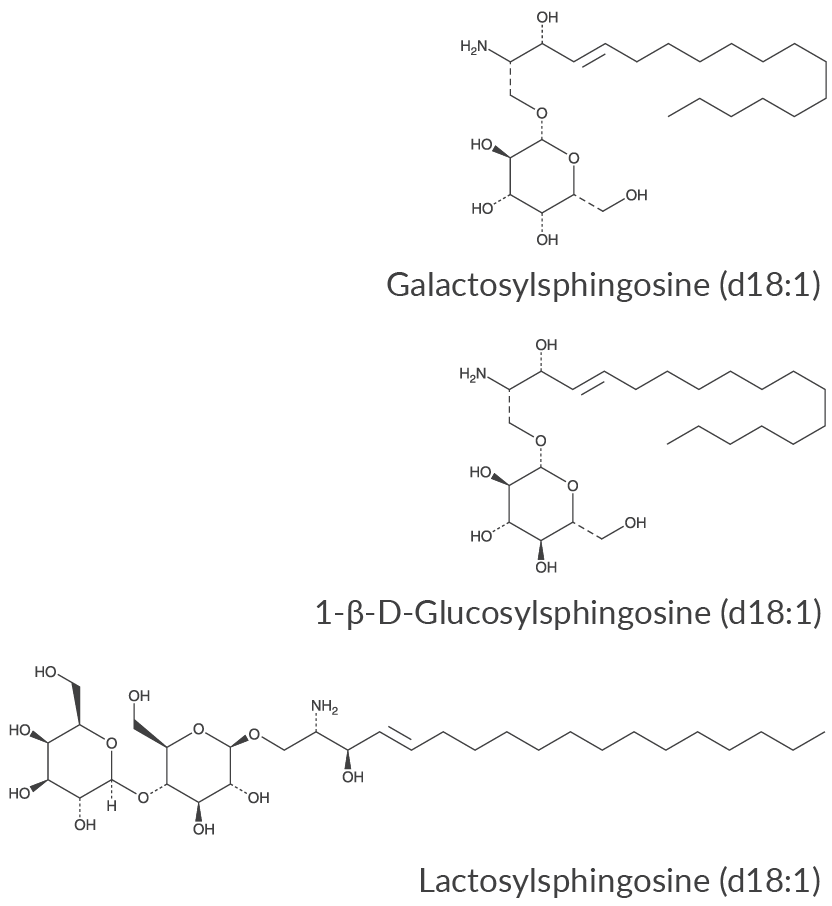
One of the major drawbacks with natural glycosphingolipid standards is that each category of lipid is comprised of a heterogeneous mixture of compounds. This can result in multiple peaks by GC, HPLC, or MS analysis. By utilizing fully synthetic glycosphingolipids, researchers can be assured that only one isomer of the lipid of interest is present. Cayman offers fully synthetic galactosylsphingosine (psychosine), glucosylsphingosine, and lactosylsphingosine (lyso-lactosylceramide). While natural lipids are crucial for some applications, such as to observe the effect of heterogeneous mixtures of compounds, analytical methods require uniform standards to eliminate interfering peaks in the chromatogram. Cayman's well-defined and fully synthetic glycosphingolipids are designed to give the best analytical results and simplest chromatograms possible. Fully synthetic lipids are also often more consistent from lot to lot. Natural biomolecules can vary drastically as a result of the age of the source, time of year, diet, and environmental conditions. These are all factors that can be extremely difficult or impossible to control. In addition, natural biochemicals are subject to less control in source handling and extraction conditions. With synthetic glycosphingolipids the starting materials and synthesis conditions are precisely managed. Read on to learn more about the biological functions of galactosylsphingosine, glucosylsphingosine, and lactosylsphingosine.
Galactosylsphingosine as a Krabbe Disease Biomarker
Krabbe disease is characterized by an accumulation of galactosylceramide and galactosylsphingosine due to a lack in activity of the lysosomal enzyme β-galactosidase.1 Therefore, galactosylsphingosine can be a useful biomarker for the detection of Krabbe disease. Galactosylsphingosine is an intermediate in the biosynthesis of galatosylceramide, the largest single component of the myelin sheath of nerves. It is formed biologically by the reaction of sphingosine with UDP-galactose followed by acylation with a fatty acid. Galactosylsphingosine induces cell apoptosis, cytokine activation, phospholipase activation, peroxisomal dysfunction, and alters calcium homeostasis.2 The accumulation of these lipids negatively affects the myelin of the nerve cells, causing severe nervous system deterioration. Galactosylsphingosine is highly cytotoxic and may significantly contribute to the degeneration of axons, causing oligodendrocyte death, astrocyte activation, and the formation of multinuclear globoid-like cells.3 Although GM1 gangliosidase can degrade galactosylceramide, it cannot degrade galactosylsphingosine.4 Bone marrow transplantation may be an effective therapeutic approach to slow down the disease in cases of early detection.
Glucosylsphingosine as a Gaucher Disease Biomarker
Gaucher disease is characterized by an accumulation of glucosylceramides due to a deficiency in the enzyme glucocerebrosidase. It has been found that glucosylsphingosine also accumulates in this disease.5 This accumulation of glucosylsphingosine contributes to neuronal dysfunction and destruction in patients with neuronopathic Gaucher disease.6 Glucosylsphingosine is a potent inhibitor of glucocerebrosidase. At least some of Gaucher disease patients also have a deficiency in the activity of glucosylsphingosine β-glucosidase, the enzyme responsible for cleaving off the glucose of glucosylsphingosine and glucoscylceramide. Like glucoscylceramide and galactoscylceramide, glucosylsphingosine can increase calcium mobilization from intracellular stores, although it uses a different mechanism.7 Conduritol B epoxide (CBE), an inhibitor of β-glucosidase, and eliglustat, an inhibitor of glucosylceramide synthase, can decrease glucosylsphingosine and glucosylceramide accumulation in animal models of Gaucher disease.8
Lactosylsphingosine as a Lactosylceramidosis Biomarker
A deficiency in the enzyme responsible for hydrolyzing the galactose of lactosylceramide leads to lactosylceramidosis, which is characterized by an accumulation of lactosylceramide that causes a primary neurological disorder.9 Lactosylceramide is also important in the activation of platelet endothelial cell adhesion molecule-1, which causes adhesion and diapedesis of monocytes and lymphocytes.10 In animals, neutral lyso-glycosphingolipids occur naturally in small amounts. lyso-Lactosylceramide can release calcium from microsomal stores in the brain cortex and cerebellum.11 Other lyso-glycosphingolipids also release calcium, but in a mechanism different from lactosylsphingosine.
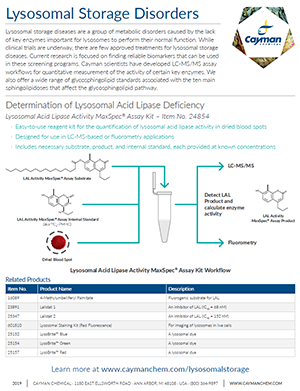
More Lysosomal Storage Disorders Research Tools from Cayman
You May Also Be Interested In…
Glucosylsphingosine: A Sensitive and Specific Biomarker for Gaucher Disease
D-PDMP Demonstrates Important Implications of Glucosylceramides and Lactosylceramides
Glycinated Lyso-Glycosphingolipids as New Mass Spectrometry Internal Standards
References
1. Giri, S., Khan, M., Rattan, R., et al. Krabbe disease: Psychosine-mediated activation of phospholipase A2 in oligodendrocyte cell death. J. Lipid Res. 47(7), 1478-1492 (2006).
2. Jiang, X., Yang, K., and Han, X. Direct quantitation of psychosine from alkaline-treated lipid extracts with a semi-synthetic internal standard. J. Lipid Res. 50(1), 162-172 (2009).
3. Deane J.E., Graham, S.C., Kim, N.N., et al. Insights into Krabbe disease from structures of galactocerebrosidase. Proc. Natl. Acad. Sci. USA 108(37), 15169-15173 (2011).
4. van der Knaap, M.S. and Valk, Magnetic resonance of myelination and myelin disorders. 3rd ed., Springer-Verlag Berlin Heidelberg, (2005).
5. Orvisky, E., Park, J.K., LaMarca, M.E., et al. Glucosylsphingosine accumulation in tissues from patients with Gaucher disease: Correlation with phenotype and genotype. Mol. Genet. Metab. 76(4), 262-270 (2002).
6. Schueler, U.H., Kolter, T., Kaneski, C.R., et al. Toxicity of glucosylsphingosine (glucopsychosine) to cultured neuronal cells: A model system for assessing neuronal damage in Gaucher disease type 2 and 3. Neurobiol. Dis. 14(3), 595-601 (2003).
7. Lloyd-Evans, E., Pelled, D., Riebeling, C., et al. Glucosylceramide and glucosylsphingosine modulate calcium mobilization from brain microsomes via different mechanisms. J. Biol. Chem. 278(26), 23594-23599 (2003).
8. Sillence, D.J., Puri, V., Marks, D.L., et al. Glucosylceramide modulates membrane traffic along the endocytic pathway. J. Lipid Res. 43(11), 1837-1845 (2002).
9. Dawson, G. Glycosphingolipid levels in an unusual neurovisceral storage disease characterized by lactosylceramide galactosyl hydrolase deficiency: Lactosylceramidosis. J. Lipid Res. 13(2), 207-219 (1972).
10. Gong, N., Wei, H., Chowdhury, S.H., et al. Lactosylceramide recruits PKCα/ε and phospholipase A2 to stimulate PECAM-1 expression in human monocytes and adhesion to endothelial cells. Proc. Natl. Acad. Sci. USA 101(17), 6490-6495 (2004).
11. Lloyd-Evans, E., Pelled, D., Riebeling, C., et al. Lyso-glycosphingolipids mobilize calcium from brain microsomes via multiple mechanisms. Biochem. J. 375(Pt 3), 561-565 (2003).
.
Contact Info
Cayman Chemical1180 East Ellsworth RoadAnn Arbor, Michigan 48108 USAToll Free: (800) 364-9897(USA and Canada only)Fax: (734) 971-3640


