
News & Announcements
Characterization of Nitazene Synthetic Opioids
Article from 2021-03-24
Cayman's Forensic Division chemists synthesize reference standards and collaborate with Ghent University researchers to characterize emerging nitazenes and metabolites.
Several novel 2-benzylbenzimidazole opioids described as nitazenes have begun to emerge on the illicit market as novel psychoactive substances (NPS). These compounds are structurally different from fentanyl and most are not well characterized, but some have been reported to cause physiological effects similar to heroin, fentanyl, and other opioids. This study details the generic synthesis, analytical characterization, and µ-opioid receptor activity of 14 nitazenes (including metabolites).
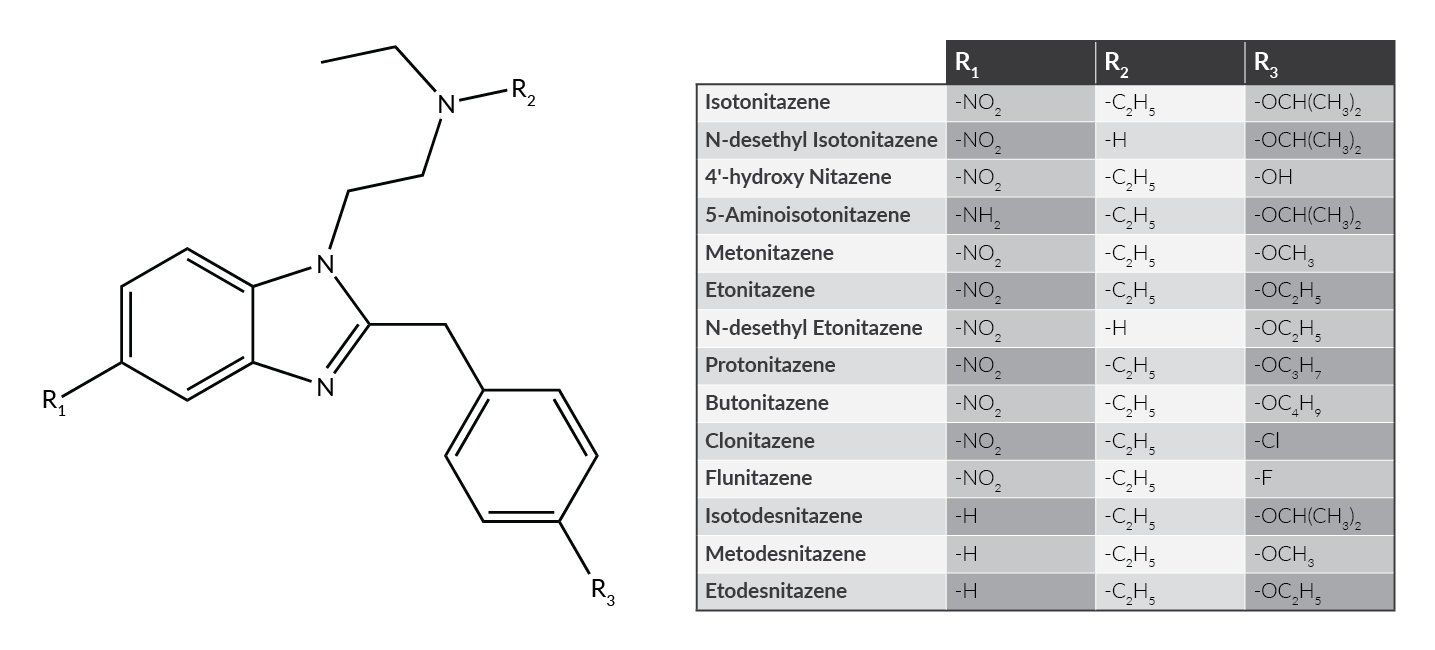
These fourteen nitazenes were characterized and reported in Vandeputte, M., Van Uytfanghe, K., Layle, N., et al. Synthesis, chemical characterization, and µ-opioid receptor activity assessment of the emerging group of nitazene new synthetic opioids. ACS Chem. Neurosci. (2021).
Fragments found by QTOF-MS for the emerging nitazenes are reported. Using chromatography coupled to MS, isomers can be distinguished based on differences in retention times and/or specific fragments. For most compounds, a combination of a specific parent/fragment mass can be made.
In vitro data to assess activity at the µ-opioid receptor (MOR) suggest that nitazenes are generally highly active, with potencies of several analogs exceeding that of fentanyl. The length of the alkoxy chain, the type of para-benzyl substituent, and the presence of a 5-nitro group all affect the potency of these compounds. A relatively short or more compact alkoxy tail, lack of halogenation, and addition of a 5-nitro group are optimal for MOR activation.
Read the Article
To help laboratories identify these emerging nitazenes, Cayman has produced a range of reference materials and analytical standards, covering both parent compounds and metabolites, as well as three isotopically labeled products for use as internal standards. Below are the reference standards used in this publication but many more can be found on our website.
Reference Standards Used in this Publication
Isotonitazene
N-desethyl Isotonitazene (hydrochloride)
4'-hydroxy Nitazene
5-Aminoisotonitazene
Metonitazene
Etonitazene
N-desethyl Etonitazene
Protonitazene (hydrochloride)
Butonitazene
Clonitazene
Flunitazene (hydrochloride)
Isotodesnitazene (citrate)
Metodesnitazene (hydrochloride)
Etodesnitazene (citrate)
See all nitazene reference standards
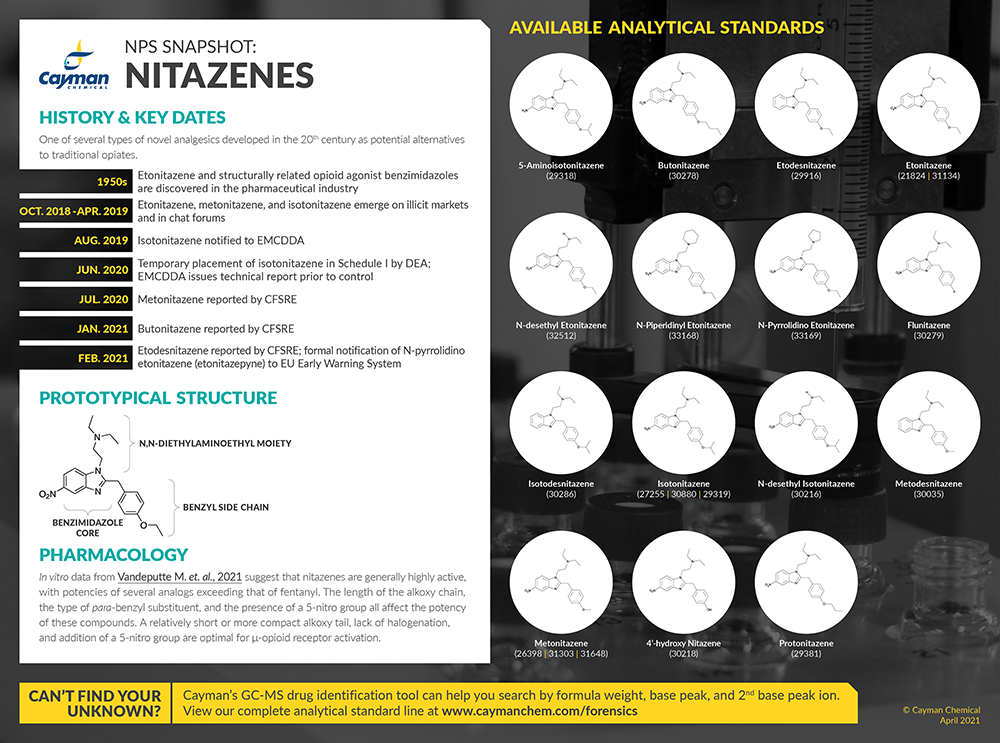
We have collated these products on our Nitazene Snapshot, a guide that summarizes the structures of the various nitazene compounds as well as key historical dates, prototypical structure, and known pharmacology.
You May Also Be Interested In
 Video: Nitazenes - Emerging Benzimidazole Opioids |  Isotonitazene: The Latest Substance to Be Banned in the European Union |
Contact Info
Cayman Chemical1180 East Ellsworth RoadAnn Arbor, Michigan 48108 USAToll Free: (800) 364-9897(USA and Canada only)Fax: (734) 971-3640


