
News & Announcements
Off-Patent Drugs as Inspiration for New Therapies
Article from 2025-10-24
By Christine R. Barillas, Ph.D. - Technical Writer, Cayman Chemical
Drug repurposing, also known as drug repositioning, is a strategy to discover novel indications for approved drugs.1-3 Repurposed drugs save 5-7 years in development time and cost $300 million on average compared with newly discovered drugs, which take 10-15 years to be developed and approved by the US Food and Drug Administration (FDA) and can cost $2-3 billion. Approximately one-third of new FDA approvals are for repurposed drugs, highlighting their significant contribution to modern medicine.4 The development timeline is faster due to safety already having been established (i.e., phase I trials are not needed) and preclinical optimization of the biological, pharmacokinetic, physicochemical, and other properties already having been completed (Figure 1).4,5 Combined, these factors lead to decreased risk and cost for both drug developers and patients.
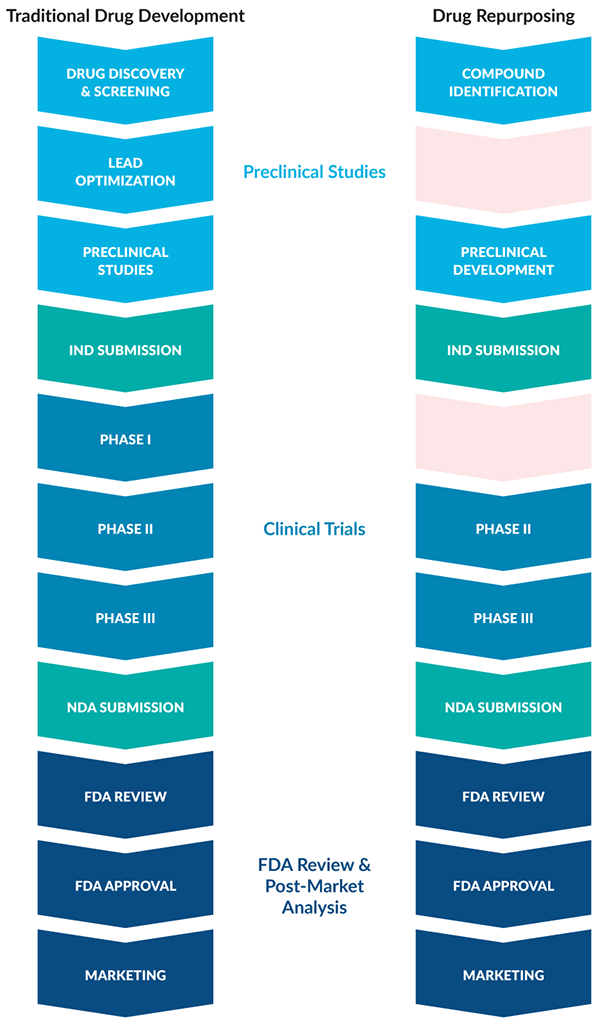
Figure 1. Comparison of traditional drug discovery and drug repurposing regulatory processes. Figure adapted from Srikanth, G.D., Beda, D.P., and Kumar, N.P. Repurposed drugs: Current trends in drug discovery. Repurposed Drugs – Current State and Future Perspectives (2024) and Hua, Y., Dai, X., Xu, Y., et al. Drug repositioning: Progress and challenges in drug discovery for various diseases. Eur. J. Med. Chem. 234, 114239 (2022).
Advantages and Strategies of Using Off-Patent Drugs for Drug Repurposing
There are several advantages to pursuing off-patent, also known as generic, drugs as novel treatments in addition to the faster development timelines and cost savings discussed above.3 Generic drugs are commercially available, have established safety profiles, and are easily accessible for preclinical and clinical development. Furthermore, off-patent drugs, by definition, no longer have intellectual property protecting their original use. Repurposing of generic drugs can be achieved through various methods6,7:
Repurposing the known biological activity via a new formulation, dose, or route of administration
Combining the drug with others to produce a synergistic or additive effect and/or reduce toxicity
Taking advantage of discovered side effects
Extended-Release Formulations
Reformulating a drug to change the delivery from immediate release to extended release can improve efficacy and/or reduce adverse side effects, which can increase drug compliance.8 Amantadine, valproic acid, and methylphenidate were all successfully repurposed to extended-release formulations.5,8
Combination Therapies
Drug combination therapy is a strategy that addresses some pitfalls of the "one target, one drug, one disease" mindset of traditional drug discovery.7,9,10 This is especially true in the context of diseases with complex pathophysiology, such as cancer and neurodegenerative diseases.7 Antibiotic resistance is another field that has benefited from combination approaches.9 Overcoming antibiotic resistance has been accomplished through the combination of multiple antibiotics with different mechanisms of action and antibiotics with adjuvants that combat resistance mechanisms (e.g., efflux pump and β-lactamase inhibitors). While pursuing combination therapies for drug repurposing has several advantages, it is also met with challenges, such as the potential for drug-drug interactions (Table 1).
| Advantages | Disadvantages |
|
|
Table 1. Advantages and disadvantages of drug combination therapies
Examples of drugs that have been repurposed1,2,4,6
| Drug | Structure | Discovered/Original Indication(s) | Repurposed Indication(s) |
| Aspirin | | NSAID | Stroke and myocardial infarction prevention |
| Thalidomide | | Morning sickness (withdrawn due to teratogenicity) | Erythema nodosum leprosum, multiple myeloma |
| Sildenafil | | Angina pectoris | Erectile dysfunction, pulmonary arterial hypertension |
| Dapoxetine | | Analgesia, depression | Premature ejaculation |
| Raloxifene | | Osteoporosis | Breast cancer |
| Rapamycin | | Transplant rejection | Autoimmune lymphoproliferative syndrome |
| Minoxidil | | Hypertension | Hair loss |
| Celecoxib | | NSAID | Familial adenomatous polyps |
| Zidovudine | | Cancer | HIV/AIDS |
| Fingolimod | | Transplant rejection | Multiple sclerosis |
High-Throughput Screening for Off-Patent Drugs
High-throughput screening (HTS) is one of many approaches used in drug repurposing and is becoming more popular due to increased drug library availability and improved screening technologies.1-3,7 HTS enables the automated screening of large compound libraries against a phenotypic or biological target of interest. Assays for HTS can be selected to screen for various endpoints, including biochemical activity, cell cytotoxicity, protein-protein interactions, and gene expression. Drug repurposing HTS typically involves small libraries, which allow for more complex assays to be used and results in hits that can be advanced directly into preclinical disease models instead of requiring several rounds of medicinal chemistry to optimize (Figure 1).3,7
Cayman's Off-Patent Drug Screening Library
Cayman's Off-Patent Drug Screening Library is a collection of over 600 FDA-approved drugs no longer covered under composition-of-matter patents in the US.
The library contains small molecules from a variety of therapeutic areas (Figure 2) that cover a wide range of targets, including histamine receptors, penicillin-binding proteins, α- and β-adrenergic receptors, and cyclooxygenases (Figure 3). In addition to the 180+ unique targets, compounds whose mechanisms of action are not yet completely understood are also included.
Figure 2.The library comprises drugs from more than 15 therapeutic areas.
Figure 3. Most common targets in Cayman's Off-Patent Drug Screening Library.
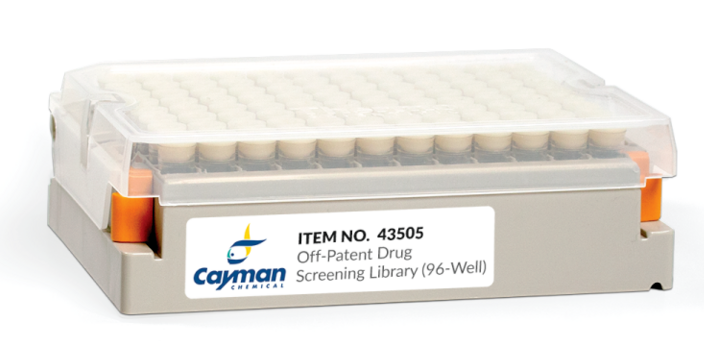
Key Features of Cayman’s Off-Patent Drug Screening Library
Contains ~607 compounds
- Designed as a focused library to streamline further characterization and validation studies for drug repurposing
- High-quality standards ensure purity and identity confirmation for individual components
- All compounds are available as single components for further evaluation of hits
- A plate map includes compound details, physical characteristics, and biological characteristics for each compound (i.e., product name, individual component item number, description, synonyms, CAS number, formula weight, molecular formula, solubility, and biological characteristics based on literature reports)
- A supplemental document provides detailed clinical and regulatory information about each drug, including:
- Therapeutic areas
- Active and inactive indications
- Drug synonyms and brand names
- Milestone tracking (e.g., clinical trial phases)
- Original pharmaceutical company and active and inactive pharmaceutical companies
- Regulatory designation (e.g., Orphan Drug, Fast Track, etc.)
- Approval date
- US expired patent numbers
- Patent numbers, legal status, and location of expired and active composition-of-matter patents outside the US
Configuration
- Consists of 8 plates in a 96-well Matrix™ tube rack format
- 50 µl of each compound is provided as a 10 mM stock solution in DMSO
- Certain customizations available
- Contact sales@caymanchem.com to inquire about customization
HTS Resources Available from Cayman
Cayman has compound libraries and HTS services available to support hit identification and lead discovery.
Compound Libraries
Cayman offers several small molecule screening libraries for cell biology, drug discovery, and drug identification.
Learn more about Cayman's compound libraries
View all compound libraries available from Cayman
High-Throughput Screening Services
As part of a medicinal chemistry or drug discovery program, our HTS services can aid in hit identification and lead discovery, SAR studies, and hit-to-lead optimization.
Learn more about Cayman's HTS services
Post-HTS Resources Available from Cayman
We offer a wide range of products and services to support further studies after hit identification.
Assay Kits
Over 800 assay kits to monitor target analytes, assess cellular function and health, determine receptor activation or inhibition, and measure enzyme activity or inhibition.
Custom Assay Development
Along with our extensive catalog of commercial assays, Cayman offers custom assay development. We can build robust quantitative assays on a variety of detection platforms to suit your specific target and application.
Learn more about Cayman's assay development services
References
1. Parvathaneni, V., Kulkarni, N.S., Muth, A. et al. Drug repurposing: A promising tool to accelerate the drug discovery process. Drug Discov. Today 24(10), 2076-2085 (2019).
2. Pushpakom, S., Iorio, F., Eyers, P.A. et al. Drug repurposing: Progress, challenges and recommendations. Nat. Rev. Drug Discov. 18(1), 41-58 (2019).
3. Cha, Y., Erez, T., Reynolds, I.J. et al. Drug repurposing from the perspective of pharmaceutical companies. Br. J. Pharmacol. 175(2), 168-180 (2018).
4. Srikanth, G., Beda, D.P., and Kumar, N.P. Repurposed drugs: Currents trends in drug discovery. Repurposed drugs – Current state and future perspectives. Engin, S., editor, IntechOpen (2024).
5. Hua, Y., Dai, X., Xu, Y. et al. Drug repositioning: Progress and challenges in drug discovery for various diseases. Eur. J. Med. Chem. 234, 114239 (2022).
6. Jourdan, J.-P., Bureau, R., Rochais, C. et al. Drug repurposing: A brief overview. J. Pharm. Pharmacol. 72(9), 1145-1151 (2020).
7. Sun, W., Sanderson, P.E., and Zhang W. Drug combination therapy increases successful drug repurposing. Drug Discov. Today 21(7), 1189-1195 (2016).
8. Low, Z.Y., Farouk, I.A., and Lal, S.K. Drug repositioning: New approaches and future prospects for life-debilitating diseases and the COVID-19 pandemic outbreak. Viruses 12(9), 1058 (2020).
9. Jie, A.K.J., Hussein, M., Rao, G.G. et al. Drug repurposing approaches towards defeating multidrug-resistant Gram-negative pathogens: Novel polymyxin/non-antibiotic combinations. Pathogens 11(12), 1420 (2022).
10. Ambreen, S., Umar, M., Noor, A. et al. Advanced AI and ML frameworks for transforming drug discovery and optimization: With innovative insights in polypharmacology, drug repurposing, combination therapy and nanomedicine. Eur. J. Med. Chem. 284, 117164 (2025).
Contact Info
Cayman Chemical1180 East Ellsworth RoadAnn Arbor, Michigan 48108 USAToll Free: (800) 364-9897(USA and Canada only)Fax: (734) 971-3640


