
News & Announcements
Psychedelic Therapies Webinar Highlights
Article from 2023-12-14
Three Key Insights from The Mind-Bending Mushroom: Expanding Consciousness and Cultural Acceptance of Psychedelic Alkaloids as Medicinal Tools
Danielle St. Germaine, synthetic organic chemistry in the Forensic Chemistry Division at Cayman Chemical, discussed the pharmacology and chemistry of tryptamines, β-carbolines, isoxazoles and ergolines classes of alkaloids and their use in psychedelic medicine in a recent webinar. We have summarized the top three insights from this webinar below.
Key Takeaways
1. Psychoactive fungi and their derivatives have a rich history in spiritual practices, medicine, and pop culture.
Mushrooms have been used in medicinal and spiritual practices by Indigenous cultures around the world for several millennia. Because of renewed interest in entheogenic plant molecules as therapeutics, there is a large body of research building around psychedelic alkaloids found in fungi. The three most studied genera include Psilocybe, Amanita, and Claviceps, and each has its own infamous history.
Amanita is a genus of mushroom with certain species that contain isoxazole alkaloids, most notably, ibotenic acid and muscimol. Amanita muscaria (also known as fly agaric) is a cultural icon renowned for its vibrant red cap, white gills, and white spots. Multiple records of its consumption for shamanic purposes were recorded in Western Siberia between the years 1650 and 1750. Since then, Amanitamuscaria have become the face of mushrooms and pop culture, appearing in Alice in Wonderland and the Super Mario Brothers video games, amongst others.
View all Amanita research tools available from Cayman |
Claviceps is a species of fungi that infects cereal grains and wild grasses, causing a fungal disease in plants called ergot. The fungus produces ergot alkaloids, which have a wide range of effects. Ingestion of ergot alkaloids through consumption leads to ergotism, which can result in hallucinations, convulsions, gangrene, and death. Infested grain was first described in Mesopotamia dating back to 1900-1700 BCE, and ergotism is suspected to be a contributing factor in the events that led to the Salem Witch Trials in 1692. More recently, ergot alkaloids, in particular ergoamides, also known as lysergic acid amides, have gained notoriety through their use as synthetic precursors for lysergic acid diethylamide (LSD). LSD was first synthesized in 1938 by Albert Hofmann. It has a deep history as a psychedelic, ranging from its influence in 1960s American counterculture movement to mind control attempts by the US Central Intelligence Agency (CIA).
View all lysergamides available from Cayman |
Psilocybe is a genus of mushroom that contains tryptamine alkaloids. The most notorious Psilocybe tryptamine alkaloid is psilocybin, the parent compound of the active metabolite psilocin. Psilocybe mushrooms have been depicted for millennia, with religious practices in Central America describing them as early as 2000 BCE. After an infamous photo essay appeared in Life Magazine in 1957, public interest in Psilocybe mushrooms soared. In 1958, Albert Hofmann and R. Heim isolated psilocybin from P. Mexicana and performed its total synthesis the following year.
| | View all Psilocybe research tools available from Cayman |
The culture war of the 1960s ushered in negative public sentiment towards psychedelics, and in response, the United States passed the Controlled Substances Act, with the United Nations passing the Convention of Psychotropic Substances in 1971. This international prohibition brought research into psychedelics to a near-standstill. As attitudes have softened over time, renewal of psychedelic research sparked worldwide.
2. Psychoactive alkaloids are structurally similar to endogenous neurotransmitters. Accordingly, they have inspired current and historical pharmaceuticals.
Many psychoactive alkaloids being pursued as therapies are structurally similar to neurotransmitters and mediate their effects through receptors for these endogenous ligands.
Ibotenic acid is structurally similar to glutamate, an excitatory neurotransmitter. It acts as a glutamate receptor agonist at NMDA and metabotropic glutamate receptors (mGluRs), leading to an excitatory state, confusion, agitation, and delirium/euphoria. Ibotenic acid is toxic at high doses, and it has been used to induce neurotoxicity in experimental models.
Muscimol is structurally similar to GABA, an inhibitory neurotransmitter. It is a potent GABAA receptor agonist and GABAC partial agonist. GABAA agonists increase GABA concentration which causes sedation, lowered heart rate, and decreased blood pressure. Muscimol has been investigated for drug-resistant epilepsy, and gaboxadol, a muscimol derivative, has been explored for the treatment of insomnia.
Ergot alkaloids have an ergoline scaffold. The ergoline scaffold contains indole, cyclohexyl, and piperidine groups, which play an important role in the pharmacology of ergoline-based compounds. The ergoline scaffold has considerable structural overlap with serotonin (5-HT), dopamine, and norepinephrine, and is a core component of LSD.
Figure adapted from Haarmann, T., Rolke, Y., Giesbert, S., and Tudzynski, P. Ergot: From witchcraft to biotechnology. Mol. Plant Pathol. 10(4), 563-577 (2009).
Many current and historical pharmaceuticals utilize the ergoline scaffold to target the receptors for these endogenous ligands with ergoline derivatives. Pharmaceutical preparations inspired by ergot alkaloids have been used to prevent and/or treat several conditions, ranging from postpartum hemorrhage and migraine headaches to Parkinson’s disease and vascular dementia.
Ergoline-based Therapies | Item No. | Description |
| Bromocriptine (mesylate) | 14598 | A dopamine receptor agonist |
| Cabergoline | 23934 | A potent and selective dopamine D2 receptor agonist |
| Dihydroergotamine (mesylate) | 23847 | An agonist of 5-HT1B and 5-HT1D receptors |
| Nicergoline | 31573 | An α1-AR antagonist |
| Pergolide (mesylate) | 26085 | A dopamine D1 and D2 receptor agonist |
Psilocybin is structurally similar to tryptamine, an intermediate in the biosynthesis of serotonin. Psilocybin undergoes first-pass metabolism to produce the active metabolite, psilocin. It was marketed in the 1950s as a short-acting alternative to LSD but was pulled from the market after the passage of the Controlled Substances Act.
The psychedelic effects of psilocin and LSD are attributed to its interaction with the serotonin 5-HT receptor subtype 5-HT2A, though studies suggest that other receptors are also involved. Serotonin has roles in mood, cognition, memory, and learning-reward behaviors. Accordingly, psychedelic therapies are emerging as promising therapies in the treatment of various neurological and psychiatric conditions.
3. A large body of evidence supports the revival of psychoactive alkaloids as therapies for a wide range of conditions.
Though psychedelics are controlled substances in most countries, clinical trials exploring the use of psychedelics are underway. Psychedelic therapies, including psilocybin and LSD, are promising agents for the treatment of depression and may also have potential in the treatment of anxiety, substance use disorders, cluster headaches, as well as psychological distress associated with end of life, amongst other conditions.
While the number of clinical trials has rapidly increased, there are still significant barriers to conducting these studies, mostly due to the regulatory status of these compounds. Institutions must have the correct DEA licensing and acquire their materials from suppliers who are also appropriately licensed. Those suppliers must also be able to produce GMP-grade active pharmaceutical ingredients (APIs) for human clinical studies, which makes those suppliers even more difficult to locate.
Available from Cayman
Reference Standards
Cayman has a range of reference standards available as parent drugs, metabolites, degradants, and structurally related compounds in both their native and stable isotope forms. Our chemists manufacture both well-known and novel compounds in our DEA-regulated facilities.
GMP APIs
We also offer GMP API production of psilocybin and psilocin.
You May Also Be Interested In
 | 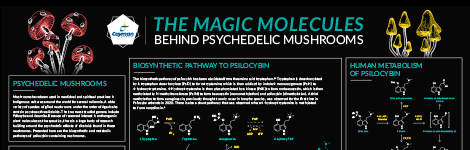 The Magic Molecules Behind Psychedelic Mushrooms Lab Wall Poster |
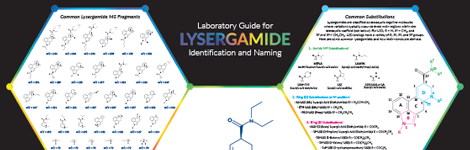 Laboratory Guide for Lysergamide Identification and Naming Lab Wall Poster |  |
Contact Info
Cayman Chemical1180 East Ellsworth RoadAnn Arbor, Michigan 48108 USAToll Free: (800) 364-9897(USA and Canada only)Fax: (734) 971-3640


