For immunochemical detection of COX-2
Technical Support & Resources

Visit our FAQ

Contact Us

Toll Free Phone (USA and Canada Only): (888) 526-5351
Direct Phone: (734) 975-3888

Request Technical Support

Technical Support Request

To streamline the process attach the appropriate questionnaire to your inquiry.

Download IHC QuestionnaireDownload WB Questionnaire

View Our Privacy Statement for details on how we use and protect your data. In addition, this site is protected by hCaptcha and its Privacy Policy and Terms of Service apply.

COX-2 (human) Monoclonal Antibody (Clone CX229)

Item No. 160112

Technical Information
Synonyms
  • Cyclooxygenase 2
  • PGHS-2
  • Prostaglandin H Synthase 2
Immunogen
Synthetic peptide from the C-terminal region of human protein COX-2
Clone Designation
CX229
50 µg of protein G-purified monoclonal antibody
Storage Buffer
PBS, pH 7.2, with 50% glycerol and 0.02% sodium azide
Host
Mouse
Isotype
IgG1
Applications
IHC, WB
Cross Reactivity
(-) COX-1
Species Reactivity
(+) Human(+) Ovine(-) Mouse(-) Rat
Shipping & Storage Information
Storage
-20°C
Shipping
Wet ice in continental US; may vary elsewhere
Recommended Products

Certificates of Analysis & Batch Specific Data

Provide batch numbers separated by commas to download or request available product inserts, QC sheets, certificates of analysis, data packs, and GC-MS data.

    Add

    Lipid Resource Center
    Discover Products & Resources for Lipid Research
    • High-purity lipid standards
    • Lipid roles in biology
    • Lipids in health & disease
    • Lipids for pharmaceutical development
    • Protocols, advice, & resources
    EXPLORE NOW
    Product Description

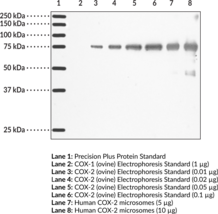
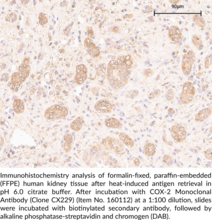
    Cyclooxygenase 2 (COX-2) is a bifunctional enzyme that exhibits both COX and peroxidase activities and catalyzes the first step in the biosynthesis of prostaglandins, thromboxanes, and prostacyclins.1,2 The COX component converts arachidonic acid (Item Nos. 90010 | 90010.1 | 10006607) to the hydroperoxy endoperoxide prostaglandin G2 (PGG2; Item No. 17010), and the peroxidase component reduces the endoperoxide to the corresponding alcohol PGH2 (Item No. 17020). COX2 expression is induced by a variety of stimuli, including phorbol esters, LPS, and cytokines and is responsible for the biosynthesis of PGs under acute inflammatory conditions.3,4 Thus, COX-2 has been the focus of attention for nonsteroidal anti-inflammatory drug (NSAID) development. Cayman's COX-2 (human) Monoclonal Antibody (Clone CX229) can be used for immunohistochemistry (IHC) and Western blot (WB) applications. The antibody recognizes a unique C-terminal region of COX-2 that is not present in COX-1, specifically detecting COX-2 ~70 kDa from human and ovine samples.

    WARNING This product is not for human or veterinary use.

    References & Product Citations
    Product Description References

    1. Nugteren, D.H., and Hazelhof, E. Isolation and properties of intermediates in prostaglandin biosynthesis. Biochim. Biophys. Acta 326(3), 448-461 (1973).

    2. Hamberg, M., and Samuelsson, B. Detection and isolation of an endoperoxide intermediate in prostaglandin biosynthesis. Proc. Natl. Acad. Sci. USA 70(3), 899-903 (1973).

    3. Kang, Y.-J., Mbonye, U.R., DeLong, C.J., et alRegulation of intracellular cyclooxygenase levels by gene transcription and protein degradation. Prog. Lipid Res. 46(2), 108-125 (2007).

    4. Blobaum, A.L., and Marnett, L.J. Structural and functional basis of cyclooxygenase inhibition. J. Med. Chem. 50(7), 1425-1441 (2007).

    Product Citations

    Janmaat, V.T., van Olphen, S.H., Biermann, K.E., et alUse of immunohistochemical biomarkers as independent predictor of neoplastic progression in Barrett’s oesophagus surveillance: A systematic review and meta-analysis. PLoS One 12(10), e0186305 (2017).

    Xu, F., Li, M., Zhang, C., et alClinicopathological and prognostic significance of COX-2 immunohistochemical expression in breast cancer: A meta-analysis. Oncotarget 8, 6003-6012 (2017).

    Sundar, I.K., Javed, F., Romanos, G.E., et alE-cigarettes and flavorings induce inflammatory and pro-senescence responses in oral epithelial cells and periodontal fibroblasts. Oncotarget 7(47), 77196-77204 (2016).

    Chen, W.-C., Tseng, C.-K., Chen, B.-H., et alGrape seed extract attenuates hepatitis C virus replication and virus-induced inflammation. Front. Pharmacol. 7(490), (2016).

    Uno, G., Ishimura, N., Tada, Y., et alSimplified classification of capillary pattern in Barrett esophagus using magnifying endoscopy with narrow band imaging: Implications for malignant potential and interobserver agreement. Medicine (Baltimore) 94(3), e405 (2015).

    Chen, W.-C., Tseng, C.-K., Chen, Y.-H., et alHCV NS5A up-regulates COX-2 expression via IL-8-mediated activation of the ERK/JNK MAPK pathway. PLoS One 10(7), e0133264 (2015).

    van Roosmalen, I.A.M., Reis, C.R., Setroikromo, R., et alThe ER stress inducer DMC enhances TRAIL-induced apoptosis in glioblastoma. SpringerPlus 3, 495 (2014).

    Urban, J., and Kuźbicki, Ł. Stromal, rather than epithelial cyclooxygenase-2 (COX-2) expression is associated with overall survival of breast cancer patients. BMC Cancer 14, 732 (2014).

    Lyons, T.R., Borges, V.F., Betts, C.B., et alCyclooxygenase-2-dependent lymphangiogenesis promotes nodal metastasis of postpartum breast cancer. J. Clin. Invest. 124(9), 3901-3912 (2014).

    Fornetti, J., Jindal, S., Middleton, K.A., et alPhysiological COX-2 expression in breast epithelium associates with COX-2 levels in ductal carcinoma in situ and invasive breast cancer in young women. Am. J. Pathol. 184(4), 1219-1229 (2014).

    Tsai, C.-H., Yang, C.-W., Wang, J.-Y., et alTimosaponin AIII suppresses hepatocyte growth factor-induced invasive activity through sustained ERK activation in breast cancer MDA-MB-231 cells. Evid. Based Complement. Altnernat. Med. 2013, 421051 (2013).

    Lin, Y.-T., Wu, Y.-H., Tseng, C.-K., et alGreen tea phenolic epicatechins inhibit hepatitis C virus replication via cycloxygenase-2 and attenuate virus-induced inflammation. PLoS One 8(1), e54466 (2013).

    Zhou, J., Joplin, D.G., Cross, J.V., et alSulforaphane inhibits prostaglandin E2 synthesis by suppressing microsomal prostaglandin E synthase 1. PLoS One 11, e49744 (2012).

    Prins, M.J., Verhage, R.J., ten Kate, F.J., et alCyclooxygenase isoenzyme-2 and vascular endothelial growth factor are associated with poor prognosis in esophageal adenocarcinoma. J. Gastrointest. Surg. 16(5), 956-966 (2012).

    McMillan, D.H., Baglole, C.J., Thatcher, T.H., et alLung-targeted overexpression of the NF-κB member RelB inhibits cigarette smoke-induced inflammation. Am. J. Pathol. 179(1), 125-133 (2011).

    Capaccio, D., Ciccodicola, A., Sabatino, L., et alA novel germline mutation in peroxisome proliferator-activated receptor g gene associated with large intestine polyp formation and dyslipidemia. Biochim. Biophys. Acta 1802, 572-581 (2010).

    Young, L.E., Sanduja, S., Bemis-Standoli, K., et alThe mRNA binding proteins HuR and tristetraprolin regulate cyclooxygenase 2 expression during colon carcinogenesis. Gastroenterology 136(5), 1669-1679 (2009).

    Tuynman, J.B., Lagarde, S.M., Ten Kate, F.J., et alMet expression is an independent prognostic risk factor in patients with oesophageal adenocarcinoma. Br. J. Cancer. 98(6), 1102-1108 (2008).

    Wobst, I., Schiffmann, S., Birod, K., et alDimethylcelecoxib inhibits prostaglandin E2 production. Biochem. Pharmacol. 76(1), 62-69 (2008).

    Singh, B., Berry, J.A., Shoher, A., et alCOX-2 involvement in breast cancer metastasis to bone. Oncogene 26(26), 3789-3796 (2007).

    Joo, Y.E., Chung, I.J., Park, Y.K., et alExpression of cyclooxygenase-2, p53 and Ki-67 in gastric cancer. J. Korean Med. Sci. 21(5), 871-876 (2006).

    Boland, G.P., Butt, I.S., Prasad, R., et alCOX-2 expression is associated with an aggressive phenotype in ductal carcinoma in situ. Br. J. Cancer 90(2), 423-429 (2004).

    Buskens, C.J., van Rees, B.P., Sivula, A., et alPrognostic significance of elevated cyclooxygenase 2 expression in patients wtih adenocarcinoma of the esophagus. Gastroenterology 122, 1800-1807 (2002).

    Ristimäki, A., Nieminen, O., Saukkonen, K., et alExpression of cyclooxygenase-2 in human transitional cell carcinoma of the urinary bladder. Am. J. Pathol. 158, 849-853 (2001).