For immunochemical detection of COX-2
Technical Support & Resources

Visit our FAQ

Contact Us

Toll Free Phone (USA and Canada Only): (888) 526-5351
Direct Phone: (734) 975-3888

Request Technical Support

Technical Support Request

To streamline the process attach the appropriate questionnaire to your inquiry.

Download IHC QuestionnaireDownload WB Questionnaire

View Our Privacy Statement for details on how we use and protect your data. In addition, this site is protected by hCaptcha and its Privacy Policy and Terms of Service apply.

COX-2 (mouse) Polyclonal Antibody (aa 584-598)

Item No. 160126

Technical Information
Synonyms
  • Cyclooxygenase 2
  • PGHS-2
  • Prostaglandin H Synthase 2
Immunogen
Synthetic peptide corresponding to the C-terminal region of mouse COX-2
MW
72 kDa
Peptide affinity-purified polyclonal antibody
Storage Buffer
PBS, pH 7.2 with 50% glycerol and 0.02% sodium azide
Host
Rabbit
Isotype
IgG
Applications
IF, IHC, WB
Cross Reactivity
(+) COX-2(-) COX-1 (all species)
Species Reactivity
(+) Human(+) Macaque monkey(+) Mouse(+) Ovine(+) Rat
UniProt Accession №
Q05769
Origin
Animal/Rabbit
Shipping & Storage Information
Storage
-20°C
Shipping
Wet ice in continental US; may vary elsewhere
Recommended Products

Certificates of Analysis & Batch Specific Data

Provide batch numbers separated by commas to download or request available product inserts, QC sheets, certificates of analysis, data packs, and GC-MS data.

    Add

    Lipid Resource Center
    Discover Products & Resources for Lipid Research
    • High-purity lipid standards
    • Lipid roles in biology
    • Lipids in health & disease
    • Lipids for pharmaceutical development
    • Protocols, advice, & resources
    EXPLORE NOW
    Product Description

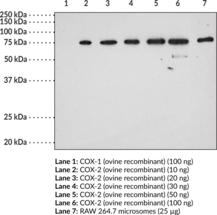
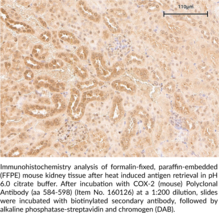
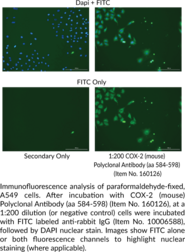
    Cyclooxygenase 2 (COX-2) is a bifunctional enzyme that exhibits both COX and peroxidase activities and catalyzes the first step in the biosynthesis of prostaglandins, thromboxanes, and prostacyclins.1,2 The COX component converts arachidonic acid to the hydroperoxy endoperoxide prostaglandin G2 (PGG2; Item No. 17010), and the peroxidase component reduces the endoperoxide to the corresponding alcohol PGH2 (Item No. 17020). COX2 expression is induced by a variety of stimuli, including phorbol esters, LPS, and cytokines and is responsible for the biosynthesis of PGs under acute inflammatory conditions.3,4 Thus, COX-2 has been the focus of attention for nonsteroidal anti-inflammatory drug (NSAID) development. Cayman's COX-2 (mouse) Polyclonal Antibody (aa 584-598) can be used for immunofluorescence (IF), immunohistochemistry (IHC), and Western blot (WB) applications. The antibody recognizes a unique C-terminal region of COX-2 that is not present in COX-1, specifically detecting COX-2 at 72 kDa from human, macaque monkey, mouse, ovine, and rat samples.

    WARNING This product is not for human or veterinary use.

    References & Product Citations
    Product Description References

    1. Nugteren, D.H., and Hazelhof, E. Isolation and properties of intermediates in prostaglandin biosynthesis. Biochim. Biophys. Acta 326(3), 448-461 (1973).

    2. Hamberg, M., and Samuelsson, B. Detection and isolation of an endoperoxide intermediate in prostaglandin biosynthesis. Proc. Natl. Acad. Sci. USA 70(3), 899-903 (1973).

    3. Kang, Y.-J., Mbonye, U.R., DeLong, C.J., et alRegulation of intracellular cyclooxygenase levels by gene transcription and protein degradation. Prog. Lipid Res. 46(2), 108-125 (2007).

    4. Blobaum, A.L., and Marnett, L.J. Structural and functional basis of cyclooxygenase inhibition. J. Med. Chem. 50(7), 1425-1441 (2007).

    Product Citations

    Ray, J.W., Sun, X., Cruz-Diaz, N., et alSex differences in middle cerebral artery reactivity and hemodynamics independent from changes in systemic arterial stiffness in Sprague-Dawley rats. Physiol. Rep. 13(7), e70250 (2025).

    Minhas, P.S., Latif-Hernandez, A., McReynolds, M.R., et alRestoring metabolism of myeloid cells reverses cognitive decline in ageing. Nature (2021).

    Roulis, M., Kaklamanos, A., Schernthanner, M., et alParacrine orchestration of intestinal tumorigenesis by a mesenchymal niche. Nature 580(7804), 524-529 (2020).

    Lee, S.M., Kim, N., Yoon, H., et alMicrobial changes and host response in F344 rat colon depending on sex and age following a high-fat diet. Front. Microbiol. 9, 2236 (2018).

    Dusaban, S.S., Chun, J., Rosen, H., et alSphingosine 1-phosphate receptor 3 and RhoA signaling mediate inflammatory gene expression in astrocytes. J. Neuroinflammation 14(1), 111 (2017).

    Gostomska-Pampuch, K., Ostrowska, A., Kuropka, P., et alProtective effects of levamisole, acetylsalicylic acid, and α-tocopherol against dioxin toxicity measured as the expression of AhR and COX-2 in a chicken embryo model. Histochem. Cell. Biol. 147(4), 523-536 (2017).

    Menicacci, B., Cipriani, C., Margheri, F., et alModulation of the senescence-associated inflammatory phenotype in human fibroblasts by olive phenols. Int. J. Mol. Sci. 18(11), E2275 (2017).

    Matsumoto, T., Kobayashi, S., Ando, M., et alAlteration of vascular responsiveness to uridine adenosine tetraphosphate in aortas Isolated from male diabetic otsuka long-evans tokushima fatty rats: The involvement of prostanoids. Int. J. Mol. Sci. 18(11), E2378 (2017).

    Hull, M.A., Cuthbert, R.J., Ko, C.W.S., et alParacrine cyclooxygenase-2 activity by macrophages drives colorectal adenoma progression in the Apc Min/+ mouse model of intestinal tumorigenesis. Sci. Rep. 7(1), 6074 (2017).

    Li, C., Srivastava, R.K., Weng, Z., et alMolecular mechanism underlying pathogenesis of lewisite-induced cutaneous blistering and inflammation: Chemical chaperones as potential novel antidotes. Am. J. Pathol. 186(10), 2637-2649 (2016).

    Esbona, K., Inman, D., Saha, S., et alCOX-2 modulates mammary tumor progression in response to collagen density. Breast Cancer Res. 18(1), 35 (2016).

    Blanco, F.F., Preet, R., Aguado, A., et alImpact of HuR inhibition by the small molecule MS-444 on colorectal cancer cell tumorigenesis. Oncotarget 7(45), 74043-74058 (2016).

    Siebert, A., Goren, I., Pfeilschifter, J., et alAnti-inflammatory effects of rosiglitazone in obesity-impaired wound healing depend on adipocyte differentiation. PLoS One 11(12), e0168562 (2016).

    Manzo, L.P., de-Faria, F.M., Dunder, R.J., et alRoyal Jelly and its dual role in TNBS colitis in mice. ScientificWorldJournal 2015, 956235 (2015).

    Apostoli, A.J., Roche, J.M., Schneider, M.M., et alOpposing roles for mammary epithelial-specific PPARγ signaling and activation during breast tumour progression. Mol. Cancer 14, 85 (2015).

    Apostoli, A.J., Skelhorne-Gross, G.E., Rubino, R.E., et alLoss of PPARcexpression in mammary secretory epithelial cellscreates a pro-breast tumorigenic environment. Int. J. Cancer 134(5), 1055-1066 (2014).

    Kim, C.S., Joo, S.Y., Lee, K.E., et alParicalcitol attenuates 4-hydroxy-2-hexenal-induced inflammation and epithelial-mesenchymal transition in human renal proximal tubular epithelial cells. PLoS One 8(5), e63186 (2013).

    de Faria, F.M., Luiz-Ferreira, A., Socca, E.A., et alEffects of rhizophora mangle on experimental colitis induced by TNBS in rats. Evid Based Complement. Med. 2012, 753971 (2012).

    Seta, F., Rahmani, M., Turner, P.V., et alPulmonary oxidative stress is increased in cyclooxygenase-2- knockdown mice with mild pulmonary hypertension induced by monocrotaline. PLoS One 6(8), e23439 (2011).

    Neeb, L., Hellen, P., Boehnke, C., et alIL-1β stimulates COX-2 dependent PGE2 synthesis and CGRP release in rat trigeminal ganglia cells. PLoS One 6(3), e17360 (2011).

    St-Louis, I., Singh, M., Brasseur, K., et alExpression of COX-1 and COX-2 in the endometrium of cyclic, pregnant and in a model of pseudopregnant rats and their regulation by sex steroids. Reprod. Biol. Endocrinol. 8, 103 (2010).

    Zagani, R., Hamzaoui, N., Cacheux, W., et alCyclooxygenase-2 inhibitors down-regulate osteopontin and Nr4A2-new therapeutic targets for colorectal cancers. Gastroenterology 137(4), 1358-1366 (2009).

    Lin, H.W., Jain, M.R., Li, H., et alCiliary neurotrophic factor (CNTF) plus soluble CNTF receptor α increases cyclooxygenase-2 expression, PGE2 release and interferon-γ-induced CD40 in murine microglia. J. Neuroinflammation 6, 6-7 (2009).

    Young, L.E., Sanduja, S., Bemis-Standoli, K., et alThe mRNA binding proteins HuR and tristetraprolin regulate cyclooxygenase 2 expression during colon carcinogenesis. Gastroenterology 136(5), 1669-1679 (2009).

    Jin, Y., Kotakadi, V.S., Ying, L., et alAmerican ginseng suppresses inflammation and DNA damage associated with mouse colitis. Carcinogenesis 29(12), 2351-2359 (2008).

    Udd, L., Katajisto, P., Rossi, D.J., et alSuppression of Peutz-Jeghers polyposis by inhibition of cyclooxygenase-2. Gastroenterology 127(4), 1030-1037 (2004).