
Technical Support & Resources
Visit our FAQ
Contact Us
Toll Free Phone (USA and Canada Only): (888) 526-5351
Direct Phone: (734) 975-3888
Technical Information
- FLT4-L
- FLT4 Ligand
- Vascular Endothelial Growth Factor C
Shipping & Storage Information
Recommended Products
Certificates of Analysis & Batch Specific Data
Provide batch numbers separated by commas to download or request available product inserts, QC sheets, certificates of analysis, data packs, and GC-MS data.
Kinase Resource Center
Discover Products & Resources for Kinase Research
- Kinase inhibitors, screening libraries, assay kits, & more
- Tools to study kinase signaling pathways:
- Growth factor signaling
- PI3K/Akt/mTOR
- MAPKs (ERK, p38, & JNK)
- JAK/STAT signaling
- Articles, resources, & advice
Product Description
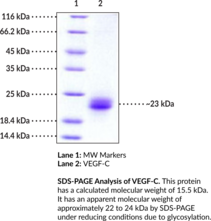
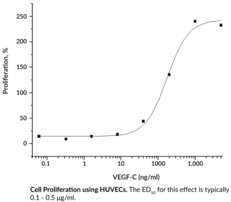
VEGF-C is a member of the PDGF/VEGF family of growth factors that promotes lymphangiogenesis.1 VEGF-C exists as a secreted homodimer composed of a central VEGF homology domain that contains the receptor binding region and is flanked by N- and C-terminal propeptides, which are proteolytically cleaved by furin and ADAMTS3 or plasmin to generate the mature, active protein.2,3 VEGF-C is produced by macrophages, fibroblasts, smooth muscle cells, and tumor cells.3 VEGFC expression is upregulated by stimulation with IL-1β, TNF-α (Item Nos. 32020 | 32069), PDGF, TGF-β, or EGF (Item Nos. 32057 | 32025) and downregulated by dexamethasone (Item No. 11015).4,3 Binding of VEGF-C to its receptors, VEGFR2 and VEGFR3, which are expressed by endothelial cells, stimulates the migration, proliferation, and survival of endothelial cells and increases vascular permeability.3 VEGF-C induces angiogenesis in chick embryo chorioallantoic membranes and stimulates proliferation and migration of porcine aortic endothelial cells in vitro.5 Genome-wide deletion of Vegfc in mice induces embryonic edema and defects in lymphatic vascular development and is perinatal lethal.6 Increased VEGF-C tumor levels are positively correlated with poor prognosis, decreased overall survival, and resistance to hormone therapy in patients with breast cancer.7 VEGFC SNPs have been found in patients with non-small cell lung cancer (NSCLC), as well as colorectal or prostate cancer. Cayman's VEGF-C (human, recombinant) protein can be used for binding and cell-based assay applications. This protein consists of 136 amino acids, has a calculated molecular weight of 15.5 kDa, and a predicted N-terminus of Thr103 after signal peptide cleavage. By SDS-PAGE, under reducing conditions, the apparent molecular mass of the protein is approximately 22 to 24 kDa due to glycosylation.
WARNING This product is not for human or veterinary use.
References & Product Citations
1. Biology of vascular endothelial growth factor C in the morphogenesis of lymphatic vessels. Front. Bioeng. Biotechnol. 6, 7 (2018).
2. Efficient activation of the lymphangiogenic growth factor VEGF-
3. Effect of inflammatory cytokines on the expression of the vascular endothelial growth factor‐C. Int. J. Exp. Path. 80(3), 109-112 (1999).
4. Comparison of VEGF, VEGF-
5. Vascular endothelial growth factor C induces angiogenesis in vivo. Proc. Natl. Acad. Sci. USA 95(24), 14389-14394 (1998).
6. Vascular endothelial growth factor C is required for sprouting of the first lymphatic vessels from embryonic veins. Nat. Immunol. 5(1), 74-80 (2004).
7. The role of vascular endothelial growth factor SNPs as predictive and prognostic markers for major solid tumors. Mol. Cancer Ther. 8(9), 2496-2508 (2009).
Contact Info
Cayman Chemical1180 East Ellsworth RoadAnn Arbor, Michigan 48108 USAToll Free: (800) 364-9897(USA and Canada only)Fax: (734) 971-3640


