
Technical Support & Resources
Information provided in the product description is from published literature. Due to the nature of scientific experimentation, your results (e.g., selectivity and effective concentrations) or specific application for this product may differ. If you have questions about how this product fits your application, please contact our technical support staff.
Visit our FAQ
Contact Us
Toll Free Phone (USA and Canada Only): (888) 526-5351
Direct Phone: (734) 975-3888
Product Categories
Product Type
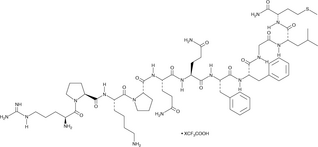
Substance P (1-7) (trifluoroacetate salt)
Item No. 43046

Technical Information
- Arg-Pro-Lys-Pro-Gln-Gln-Phe
- SP (1-7)
Shipping & Storage Information




Certificates of Analysis & Batch Specific Data
Provide batch numbers separated by commas to download or request available product inserts, QC sheets, certificates of analysis, data packs, and GC-MS data.
Product Description
Substance P (1-7) is a peptide fragment of the neuropeptide substance P (Item No. 24035).1 It is produced by proteolytic cleavage of substance P by neprilysin. Substance P (1-7) (10 nM) induces internalization of the neurokinin-1 (NK1) receptor in isolated rat striatal slices.2 It inhibits substance P-induced contralateral rotation in rats and substance P-induced substantia nigra dopamine release in anesthetized rats.3 Administration of substance P (1-7) into the nucleus tractus solitarius decreases mean arterial pressure and heart rate in anesthetized rats.1 Substance P (1-7) (1 nmol/animal) reduces withdrawal jumping in morphine-dependent mice when administered intrathecally.4 It increases the latency to tail-flick in the tail-flick test in streptozotocin-induced diabetic mice, an effect that can be reversed by naloxone or (+)-pentazocine but not naltrindole (Item No. 9000705), β-funaltrexamine (Item No. 39901), norbinaltorphimine, or BD 1047 (Item No. 22928).5 Substance P (1-7) (35 pmol/animal) increases the number of entries into and percentage of time spent in the open arms of the elevated plus maze in rats, indicating anxiolytic-like activity.6
WARNING This product is not for human or veterinary use.
References & Product Citations
1. The role of enzymatic processing in the biological actions of substance P. Peptides 10(4), 895-901 (1989).
2. N-
3. The substance P(1-
4. Substance P-
5. Substance P(1-
6. Opposite effects of substance P fragments C (anxiogenic) and N (anxiolytic) injected into dorsal periaqueductal gray. Eur. J. Pharmacol. 432(1), 43-51 (2001).
Contact Info
Cayman Chemical1180 East Ellsworth RoadAnn Arbor, Michigan 48108 USAToll Free: (800) 364-9897(USA and Canada only)Fax: (734) 971-3640


