
Technical Support & Resources
Information provided in the product description is from published literature. Due to the nature of scientific experimentation, your results (e.g., selectivity and effective concentrations) or specific application for this product may differ. If you have questions about how this product fits your application, please contact our technical support staff.
Visit our FAQ
Contact Us
Toll Free Phone (USA and Canada Only): (888) 526-5351
Direct Phone: (734) 975-3888
Product Categories
Technical Information
- Indian Saffron
- Turmeric yellow
Shipping & Storage Information
Recommended Products
Certificates of Analysis & Batch Specific Data
Provide batch numbers separated by commas to download or request available product inserts, QC sheets, certificates of analysis, data packs, and GC-MS data.

Visit Our Environmental Toxicology Resource Center
Explore additional resources to study natural toxins, pollutants including PFAS and 6-PPD-Q, and their biological effects.
ENVIRONMENTAL TOXICOLOGY TOOLS & SERVICESProduct Description
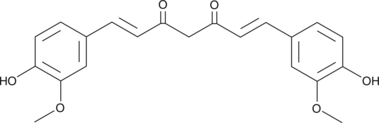
Curcumin is the major yellow pigment in turmeric and curry and has antioxidant, anti-inflammatory, and antitumor activities.1,2,3,4 It inhibits nitric oxide (NO) production (IC50 = 6 μM) and reduces inducible nitric oxide synthase (iNOS) activity in LPS-stimulated RAW 264.7 cells.1 Curcumin inhibits release of histamine and the inflammatory cytokines TNF-α, IL-1β, IL-6, and IL-8 from HMC-1 mast cells.2 In vivo, curcumin decreases serum levels of histamine and TNF-α, inhibits histopathological changes of nasal mucosa, and decreases the number of sneezes and nasal rubbing in a mouse model of ovalbumin-induced rhinitis. Curcumin (100 or 200 mg/kg) prevents ovalbumin-induced accumulation of 3-nitrotyrosine (3-NT), a marker of oxidative stress, in mouse heart. Topical administration of curcumin (1-10 μmol) reduces the number of tumors induced by phorbol 12-myristate 13-acetate (TPA; Item No. 10008014) in mouse skin.3 Dietary administration of curcumin reduces the number of tongue neoplasms and preneoplastic lesions induced by 4-nitroquinoline 1-oxide (4-NQO) in rats.4
WARNING This product is not for human or veterinary use.
References & Product Citations
1. Curcumin, an anti-
2. Anti-
3. Inhibitory effect of curcumin and some related dietary compounds on tumor promotion and arachidonic acid metabolism in mouse skin. Adv. Enzyme Regul. 31, 385-396 (1991).
4. Chemoprevention of 4-
Contact Info
Cayman Chemical1180 East Ellsworth RoadAnn Arbor, Michigan 48108 USAToll Free: (800) 364-9897(USA and Canada only)Fax: (734) 971-3640


