
Cell Cycle and DNA Damage
Brochures
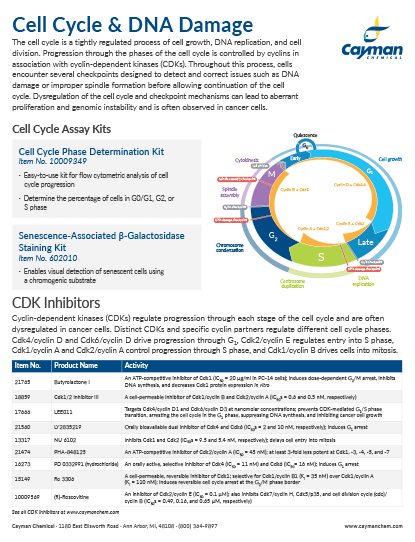
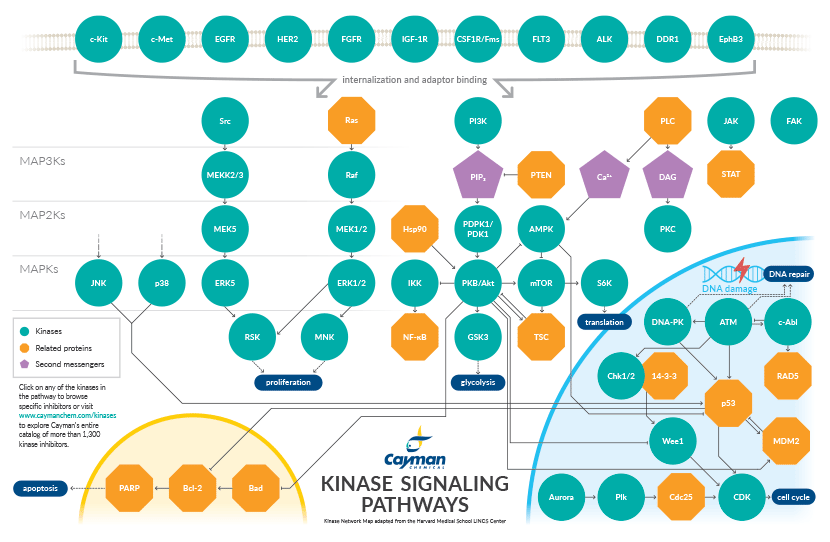
The cell cycle is a tightly regulated process of cell growth, DNA replication, and cell division. Progression through the phases of the cell cycle is controlled by cyclins in association with cyclin-dependent kinases (CDKs). Throughout this process, cells encounter several checkpoints designed to detect and correct issues such as DNA damage or improper spindle formation before allowing continuation of the cell cycle. Dysregulation of the cell cycle and checkpoint mechanisms can lead to aberrant proliferation and genomic instability and is often observed in cancer cells.
Kinase Inhibitors
Brochures
High-Throughput Flow Cytometric Screening of a Kinase Inhibitor Library for Apoptosis Induction
Application notes
Key Information
- Cayman’s multiparametric Early Apoptosis Detection Assay Kit used with Miltenyi Biotec’s MACSQuant® X Flow Cytometer creates a powerful, efficient, and exquisitely detailed screening tool.
- Using this approach to screen a library of kinase inhibitors for cytotoxicity, apoptosis inducers were distinguished from necrosis-causing or mitochondrial-uncoupling compounds.
- This simple approach can be adapted to many other probes for cellular function to help determine the effects of potential therapeutic compounds during the drug development process.
To cite this application note: Rumble, J.M., Hoffman, D.L. High-Throughput Flow Cytometric Screening of a Kinase Inhibitor Library for Apoptosis Induction. Application Note, Cayman Chemical (2020).
Screening a Kinase Inhibitor Library for Mitochondrial Dysfunction
Scientific posters
Mitochondrial toxicity from compound exposure can be pinpointed with coordinated OCR/ECAR analysis and mechanism of action assays.
Do you have a question or comment for the presenter? Let us know.
To cite this poster: Hoffman, D.L. Screening a kinase inhibitor library for mitochondrial dysfunction. Poster presented at: MichBio's 2019 Cutting Edge / Drug Discovery & Development in Michigan Symposium; November 12, 2019; Ann Arbor, MI.
Flow Cytometric Screening of a Kinase Inhibitor Library for Apoptosis Induction
Scientific posters
Multiparametric screening of kinase inhibitor cytotoxicity distinguishes multiple modes of cell death.
Do you have a question or comment for the presenter? Let us know.
To cite this poster: Rumble, J.M. and Hoffman, D.L. Flow cytometric screening of a kinase inhibitor library for apoptosis induction. Poster presented at: MichBio's 2019 Cutting Edge / Drug Discovery & Development in Michigan Symposium; November 12, 2019; Ann Arbor, MI.
A New, Efficient Synthesis of ω-NBD Sphingosine
Scientific posters
ω-NBD sphingosine is a biologically active derivative of sphingosine that is tagged with a fluorescent nitrobenzoxadiazole (NBD) group. Sphingosine (d18:1) (Cayman Item No. 10007907) is an important precursor to sphingosine-1-phosphate. The two enzymes that are responsible for this process are the sphingosine kinases SPHK1 and SPHK2. The fluorescently tagged ω-NBD sphingosine (Cayman Item No. 25348) allows researchers to monitor the activity of these kinase enzymes in real time. ω-NBD sphingosine has been previously described in literature, and the former method of synthesis was thirteen steps long. We have developed a more efficient method of synthesis that is only six steps long.
Do you have a question or comment for the presenter? Let us know.
To cite this poster: Hyder, S. and Uzieblo, A. A new, efficient synthesis of ω-NBD sphingosine. Poster presented at: Bioactive Lipids in Cancer, Inflammation, and Related Diseases 16th International Conference; October 20-23, 2019; St. Petersburg, FL.
Examining the FP receptor-triggered CREB activation in cell-based assays
Scientific posters
Autophagy and Apoptosis
Brochures
Heat Shock Proteins
Brochures
Contact Info
Cayman Chemical1180 East Ellsworth RoadAnn Arbor, Michigan 48108 USAToll Free: (800) 364-9897(USA and Canada only)Fax: (734) 971-3640


