
News & Announcements
Bile Acid-Gut Microbiome Axis
Article from 2021-09-27
The microbiome plays a major role in the biotransformation of nutrients and xenobiotics in the body, which can alter the pharmacology and/or toxicology of these chemicals. A clear example of this is how intestinal microbiota transform primary bile acids made in the liver into a diverse array of secondary bile acids that can be cycled back to the liver for additional modifications or excreted as waste. Cholic acid accounts for half of the primary bile acids synthesized by the liver in humans and mice, and chenodeoxycholic acid makes up the other half in humans, while in mice, chenodeoxycholic acid is converted to muricholic acid. In the liver, glycine or taurine can be conjugated to bile acids, preventing their reentry into host cells and enhancing their detergent properties. When bile acids transition to the large intestine, bacteria deconjugate them and further reactions form metabolites. These secondary bile acids have chemical and signaling properties that are different from primary bile acids. The hydrophobic secondary bile acids, deoxycholic acid and lithocholic acid, are generated through 7α-dehydroxylation and are most abundant in healthy human and rodent feces.
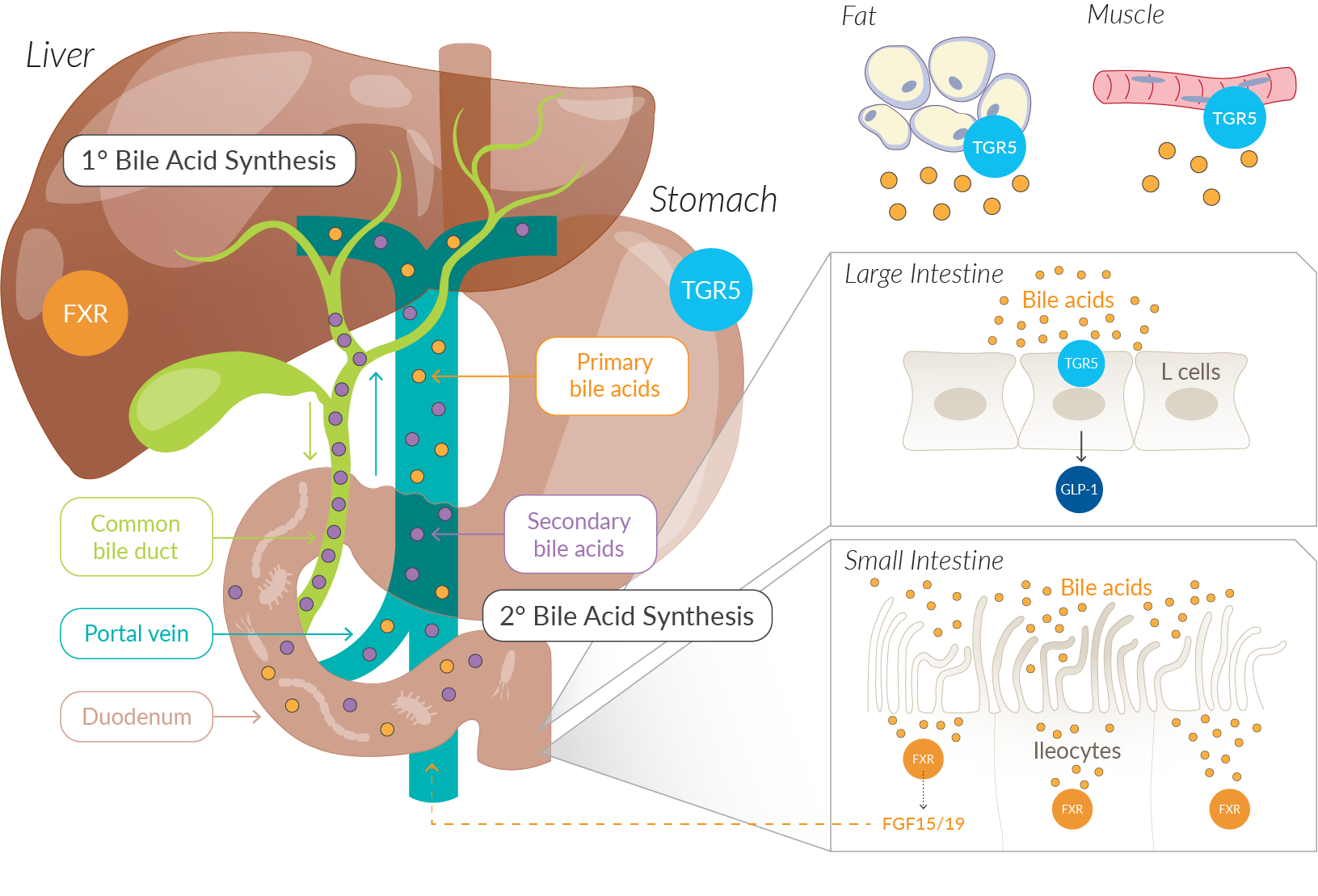
Bile acids provide an energy benefit to bacteria, regulate the microbiota population, aid in the absorption of fats and lipid-soluble vitamins, and/or act as agonists (or antagonists) at bile acid receptors (FXR and TGR5) to affect signaling pathways related to bile acid synthesis and energy metabolism regulation. Alterations in the bile acid pool are also associated with chronic diseases such as gallstones and certain liver and colon cancers. Ursodeoxycholic acid, a secondary bile acid and metabolite of lithocholic acid that inhibits the absorption of cholesterol in the intestine and its secretion into bile, is commonly used in the management and treatment of cholestatic liver disease.1 Bariatric surgery has been shown to reduce bile acids in the intestine, while increasing circulating bile acid levels. Cholic acid 7-sulfate, a primary bile acid generated through microbiome signaling, is being explored as a pharmaceutical alternative to bariatric surgery and a treatment for obesity and type 2 diabetes.2 It is a hydrophilic, high-affinity TGR5 agonist that leads to glucagon-like peptide 1 secretion. Additional nuclear receptors including the constitutive androgen receptors 1-3, pregnane X receptor, and aryl hydrocarbon receptor also help regulate to connection of the microbiome to the essential communication occurring in the gut-brain axis.
Cayman offers a comprehensive collection of primary and secondary bile acids including labeled standards and discovery mixtures for use in gut microbiome research applications. Cell-based assays for easy assessment of potential modulators of TGR5, FXR, and additional key nuclear receptors are also available to support basic research ongoing to understand the impact of the microbiome and to develop translational bile acid-based therapies.
Primary Bile Acids, Conjugates, Metabolites, and Derivatives
| Bile Acid | Species | Conjugates, Metabolites, and Derivatives Available from Cayman |
|---|---|---|
Human | Cholic Acid 7-sulfate | |
Human | Glycochenodeoxycholic Acid (sodium salt hydrate)* | |
Pigs and other mammals | ||
Mouse | ||
Mouse | Glycine-β-muricholic Acid |
*Also available: isotopically labeled internal standards
Secondary Bile Acids, Conjugates, Metabolites, and Derivatives
*Also available: isotopically labeled internal standards
MaxSpec® Discovery Mixtures
Cayman's Bile Acids MaxSpec® Discovery Mixture and Deuterated Bile Acids MaxSpec® Discovery Mixture contain a variety of primary and secondary bile acid standards, as well as glycine- and taurine-conjugated bile acids, prepared specifically for mass spectrometry and related applications where quantitative reproducibility is required.
Prepared gravimetrically and supplied in a deactivated glass ampule sealed under argon.
Guaranteed to meet identity, purity, stability, and concentration specifications.
Concentration verified by comparison to an independently prepared calibration standard and provided on the batch-specific certificate of analysis.
Ongoing stability testing performed to ensure the concentration remains accurate throughout the shelf life of the product.
View individual bile acid MaxSpec® standards
Reverse Transfection Cell-Based Assays for Evaluating Potential Modulators of Bile Acid Receptors
TGR5 (GP-BAR1) Reporter Assay Kit
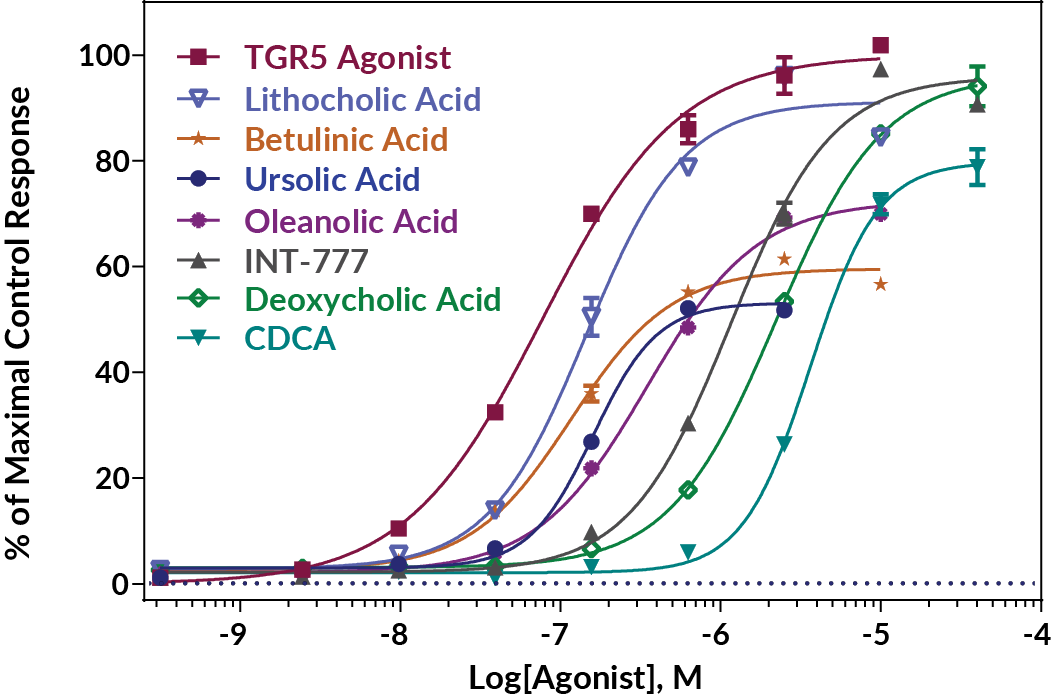
Validation of TGR5 reporter assay with different classes of agonists. View all TGR5 agonists available from Cayman.
Bile Acid Nuclear Receptor FXR (NR1H4) Reporter Assay Kit
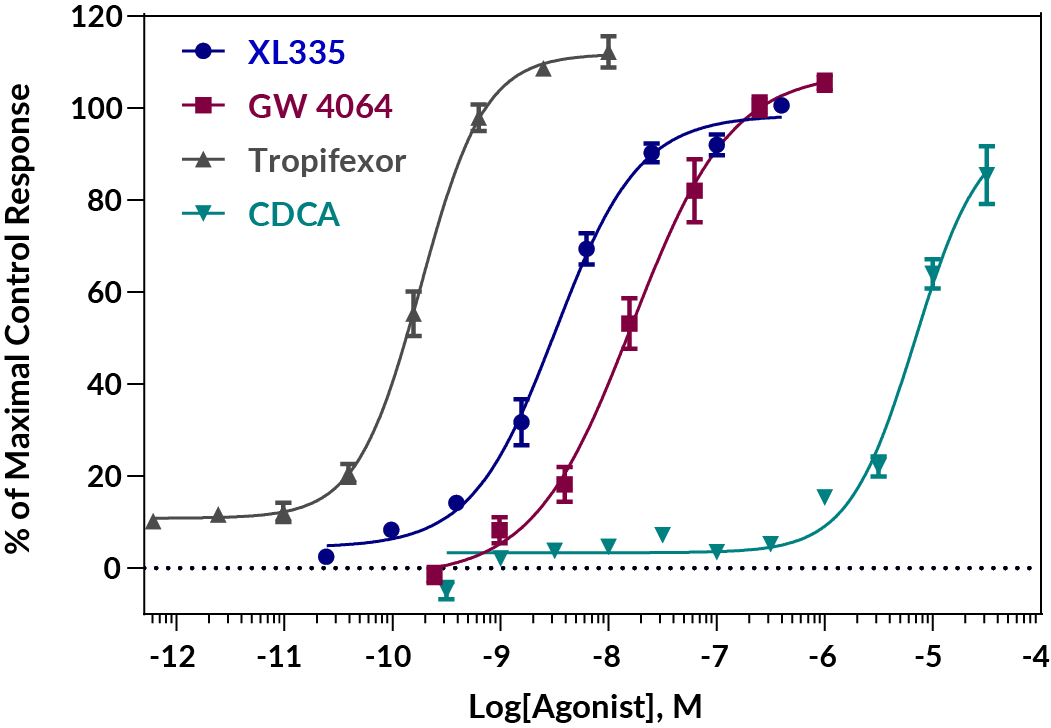
Validation of FXR reporter assay with different classes of agonists. View all FXR ligands available from Cayman.
About Reverse Transfection Technology
Cayman's TGR5 and FXR reporter assay kits use plates pre-coated with optimized transfection complexes for expressing the respective receptor along with a promotor-regulated SEAP reporter in user supplied cells. This unique system offers up to 3-fold increased transfection and >95% co-transfection efficiency (compared to traditional transfection methods) for well-to-well consistency and is ideal for rapid assay development and high-throughput screening.
No need to develop, maintain, or expand stable cell lines.
Avoid cell lineage variability.
Sufficient reagent provided to sample at multiple time points.
Additional Reporter Assay Systems
These reporter assay systems produced by Indigo Biosciences include non-human mammalian cells engineered to express a mouse or human nuclear receptor and cryopreserved to yield high cell viability post-thaw. Reporter cells include a luciferase reporter gene functionally linked to a nuclear receptor-responsive promotor.
Immediately dispense healthy, division-competent reporter cells into assay plates.
No need for intermediate spin-and-wash steps, viability determinations, or cell titer adjustments.
Optimized media provided for cell culture and test compound dilution.
Mouse Farnesoid X Receptor Reporter Assay System
Human Farnesoid X Receptor Reporter Assay System
Human Aryl Hydrocarbon Receptor Reporter Assay System
Rat Aryl Hydrocarbon Receptor Reporter Assay System
Zebrafish Aryl Hydrocarbon Receptor Reporter Assay System
Mouse Constitutive Androstane Receptor Reporter Assay System
Human Constitutive Androstane Receptor (isoform 1) Reporter Assay System
Human Constitutive Androstane Receptor, isoform 2 Reporter Assay System
Human Constitutive Androstane Receptor (isoform 3) Reporter Assay System
Mouse Pregnane X Receptor Reporter Assay System
Human Pregnane X Receptor Reporter Assay System
Human Vitamin D Receptor Reporter Assay System
View all Bile Acid & Microbiome products
References
1. Guarino, M.P.L., Cocca, S., Altomare, A., et al. Ursodeoxycholic acid therapy in gallbladder disease, a story not yet completed. World J. Gastroenterol. 19(31), 5029-5034 (2013).
2. Ridlon, J.M. Bariatric surgery stirs symbionts to counteract diabesity by CA(7)Sting a liver-generated bile acid into the mix. Cell Host Microbe 29(3), 320-322 (2021).
You May Also Be Interested In
Contact Info
Cayman Chemical1180 East Ellsworth RoadAnn Arbor, Michigan 48108 USAToll Free: (800) 364-9897(USA and Canada only)Fax: (734) 971-3640


