
Technical Support & Resources
Visit our FAQ
Contact Us
Toll Free Phone (USA and Canada Only): (888) 526-5351
Direct Phone: (734) 975-3888
Product Categories
Product Type
Application
Technical Information
- Activation-inducible Lymphocyte Immunomediatory Molecule
- AILIM
- CVID1
- Inducible T Cell Costimulator
Shipping & Storage Information
Recommended Products
Certificates of Analysis & Batch Specific Data
Provide batch numbers separated by commas to download or request available product inserts, QC sheets, certificates of analysis, data packs, and GC-MS data.
Kinase Resource Center
Discover Products & Resources for Kinase Research
- Kinase inhibitors, screening libraries, assay kits, & more
- Tools to study kinase signaling pathways:
- Growth factor signaling
- PI3K/Akt/mTOR
- MAPKs (ERK, p38, & JNK)
- JAK/STAT signaling
- Articles, resources, & advice
Product Description
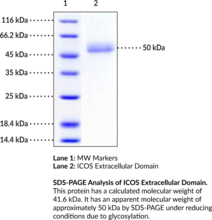
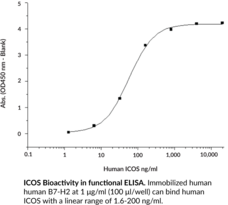
Inducible T cell co-stimulator (ICOS) is a glycoprotein and member of the CD28/B7 family of co-stimulatory receptors that promotes T cell activation.1 It exists as a membrane-bound disulfide-linked homodimer and contains a leader peptide, an extracellular domain that interacts with ICOS ligand (ICOSL), and a cytoplasmic tail that mediates association with PI3K and is critical for T cell activation.1,2 ICOS is expressed on activated CD4+ and CD8+ T cells following T cell receptor crosslinking and/or co-stimulation by CD28.1 ICOS co-stimulation of T cells induces production of IL-4, IL-5, IL-6, IFN-γ (Item Nos. 32008 | 32078), TNF-α (Item Nos. 32020 | 32069), and GM-CSF (Item Nos. 32044 | 32079), but not IL-2, and superinduces production of IL-10, as well as prevents T cell apoptosis.2 Human melanoma cells express ICOSL and promote the expansion of ICOS+ IL-10-secreting regulatory T cells, which is positively correlated with unfavorable clinical outcomes.3 Administration of an anti-ICOS monoclonal antibody ameliorates mucosal inflammation and damage in a mouse model of T helper cell-induced chronic colitis.4 Cayman's ICOS/CD278 Extracellular Domain (human, recombinant) protein can be used for ELISA. This protein is a disulfide-linked homodimer. The reduced monomer, comprised of ICOS (amino acids 21-141) fused to His-tagged human IgG1 Fc at its C-terminus, consists of 386 amino acids, has a calculated molecular weight of 41.6 kDa, and a predicted N-terminus of Glu21 after signal peptide cleavage. As a result of glycosylation, the monomer migrates at approximately 50 kDa by SDS-PAGE under reducing conditions.
WARNING This product is not for human or veterinary use.
References & Product Citations
1. ICOS Co-
2. Induction, binding specificity and function of human ICOS. Eur. J. Immunol. 30(12), 3707-3717 (2000).
3. Inducible co-
4. ICOS costimulation in inflammatory bowel disease. J. Gastroenterol. 37(Suppl 14), 78-81 (2002).
Contact Info
Cayman Chemical1180 East Ellsworth RoadAnn Arbor, Michigan 48108 USAToll Free: (800) 364-9897(USA and Canada only)Fax: (734) 971-3640


