
News & Announcements
Citrullination Research Tools
Citrullination Research Tools
Article from 2017-04-21
For a current list of Cayman's citrullination research tools, download our brochure.
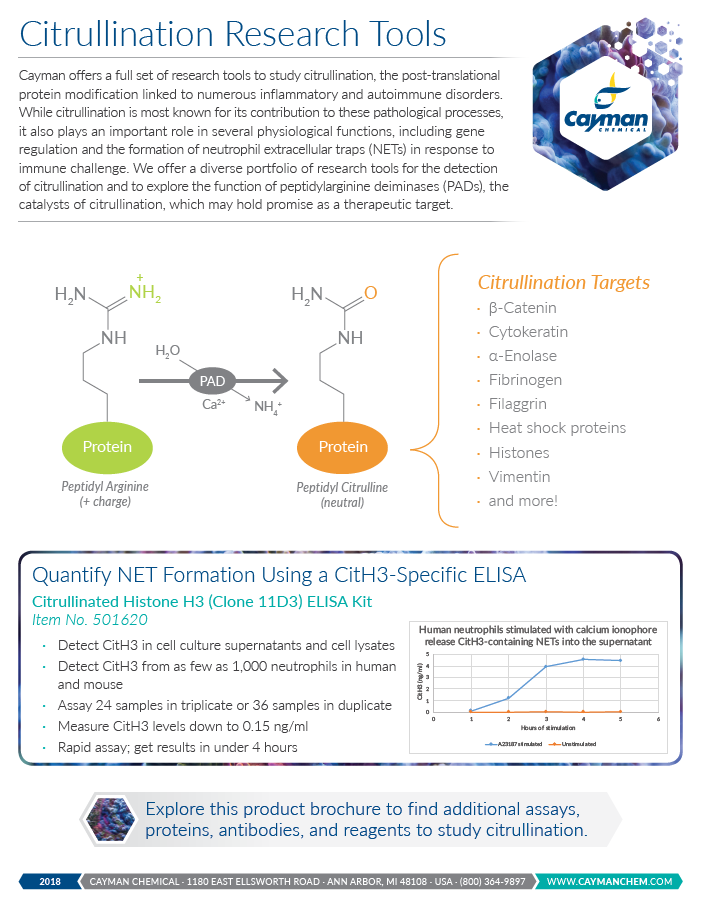
Citrullination is a post-translational modification in which positively charged arginine is deiminated to a neutrally charged citrulline. Protein arginine deiminases (PADs) catalyze this process, which ultimately alters a protein’s function. Citrullination has normal roles in gene regulation as well as pathological roles. Of the known PAD isotypes, PAD2 and PAD4 are the most studied due to their impact on inflammation, epigenetics, cancer, and autoimmune diseases. Known substrates that are targeted by PADs are listed in the graphic below.
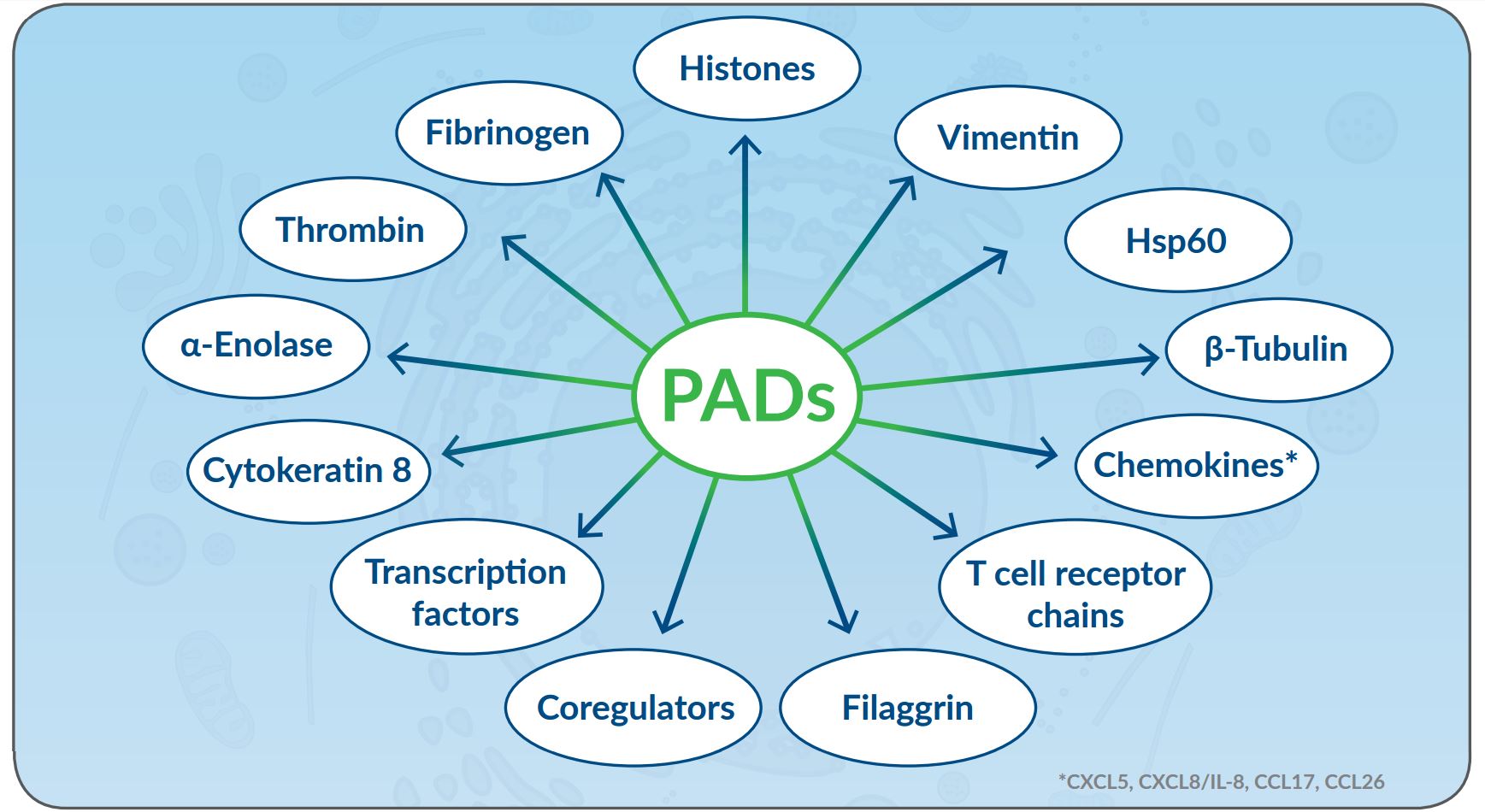
Citrullination Targets
Proteins and Purified Enzymes
| Item No. | Product Name | Description |
|---|---|---|
| 20582 | Citrullinated Core Histones (bovine) | A mixture of H1, H2A, H2B, H3, and H4 histones isolated from calf thymus and modified by PAD4 enzyme |
| 17926 | Citrullinated Histone H3 (human recombinant) | Purified protein expressed in E. coli |
| 18473 | Human Fibrinogen (PAD2 Citrullinated) | Native protein purified from human plasma and citrullinated with human recombinant PAD2 |
| 400076 | Human Fibrinogen (PAD4 Citrullinated) | Native protein purified from human plasma and citrullinated with human recombinant PAD4 |
| 10784 | PAD1 (human recombinant) | Active, N-terminal His-tagged enzyme expressed in E. coli |
| 10785 | PAD2 (human recombinant) | Active, N-terminal His-tagged enzyme expressed in insect cells |
| 10786 | PAD3 (human recombinant) | Active, N-terminal His-tagged enzyme expressed in E. coli |
| 10500 | PAD4 (human recombinant) | Active, N-terminal His-tagged enzyme expressed in E. coli |
| 13188 | Thrombin (human) | Sourced from human blood |
Antibodies to PADs and Their Common Substrates
Reagents for Studying Citrullinated Proteins
| Item No. | Product Name | Description |
|---|---|---|
| 17079 | BB-Cl-Amidine | Potent, stable pan-PAD inhibitor with increased cellular potency (EC50 = 8.8 μM in cells for PAD4) |
| 10599 | Cl-Amidine (trifluoroacetate salt) | Irreversible inhibitor of PAD1, PAD3, and PAD4 (IC50s = 0.8, 6.2, and 5.9 µM, respectively) |
| 10610 | F-Amidine (trifluoroacetate salt) | Irreversible inhibitor of PAD1, PAD3, and PAD4 (IC50s = 29.5, 350, and 21.6 µM, respectively) |
| 19933 | AP-III-a4 | Inhibits enolase (IC50 = 0.576 μM); inhibits cancer cell migration and invasion processes |
| 16172 | Citrulline-specific Probe | Fluorescent probe for citrulline-containing protein detection |
| 17489 | GSK199 (hydrochloride) | Selective inhibitor of PAD4 (IC50 = 200 nM) |
| 17488 | GSK484 (hydrochloride) | Selective inhibitor of PAD4 (IC50 = 50 nM) |
| 401272 | Human Fibrinogen Affinity Sorbent | Immobilized human fibrinogen for the removal of antibodies that bind unmodified fibrinogen |
| 11352 | Withaferin A | Targets metastatic cells that upregulate vimentin expression |
Assays for Studying PADs and Their Substrates
| Item No. | Product Name | Description |
|---|---|---|
| 501270 | Anti-Citrullinated Human Fibrinogen Assay Kit (mouse) | Measure antibodies specific for citrullinated human fibrinogen in mouse plasma or serum |
| 501450 | PAD2 (human) ELISA Kit | Detect human PAD2 in cell culture supernatants, cell lysates, plasma, and serum |
| 500930 | PAD4 Autoantibody ELISA Kit | Measure anti-PAD4 autoantibodies of any isotype (IgM, IgG, IgA) |
| 501460 | PAD4 (human) ELISA Kit | Detect human PAD4 in tissue culture medium, cell lysates, plasma, and serum |
Screening Assays for Identifying Inhibitors of PAD Activity
Cayman has developed a set of orthogonal assays to enable the screening of large libraries of compounds for next generation PAD inhibitors. These fluorescence-based assays monitor the activity of either PAD2 or PAD4 by one of two methods: 1) detecting the ammonia released by the deimination reaction or 2) exploiting the substrate specificity of trypsin to monitor the citrullination reaction. Which PAD inhibitor screening assay is right for you?
| Item No. | Product Name | Readout |
|---|---|---|
| 701390 | PAD2 Inhibitor Screening Assay Kit (AMC) | Fluorescence plate reader (ex 355-365 nm, em 445-455 nm) |
| 701400 | PAD2 Inhibitor Screening Assay Kit (Ammonia) | Fluorescence plate reader (ex 405-415 nm, em 470-480 nm) |
| 701320 | PAD4 Inhibitor Screening Assay Kit (AMC) | Fluorescence plate reader (ex 355-365 nm, em 445-455 nm) |
| 700560 | PAD4 Inhibitor Screening Assay Kit (Ammonia) | Fluorescence plate reader (ex 405-415 nm, em 470-480 nm) |
Tools to Investigate NETosis
PADs have been linked to inflammation through their role in catalyzing histone H3 hypercitrullination during neutrophil extracellular trap (NET) formation. Cayman has developed a collection of tools to study this form of pathogen-induced cell death.
| Item No. | Product Name | Description |
|---|---|---|
| 501410 | Myeloperoxidase (human) ELISA Kit | Detect human MPO in cell culture supernatants, plasma, and serum |
| 11189 | N-acetyl-Pro-Gly-Pro Peptide | A neutrophil chemoattractant |
| 601010 | NETosis Assay Kit | For the measurement of NET-derived neutrophil elastase |
| 14922 | Neutrophil Elastase Inhibitor | Selectively targets the binding domain of neutrophil elastase (IC50 = 7 nM) |
| 601070 | Neutrophil (mouse) Isolation Kit | Isolate mouse neutrophils from peritoneal lavage or bone marrow |
Carbamylated Antibody and Proteins
Carbamylation is a post-translational modification that results in the generation of homocitrulline via the non-enzymatic reaction of cyanate with lysine. Cayman developed a polyclonal antibody to detect carbamylated proteins and recombinant versions of key carbamylated proteins.
| Item No. | Product Name | Description |
|---|---|---|
| 22428 | Anti-Carbamylation (Homocitrulline) Polyclonal Antibody | Specifically detects carbamylated proteins of any type and from any species |
| 21075 | Carbamylated Bovine Serum Albumin | Albumin isolated from bovine plasma and modified with potassium cyanate |
| 21076 | Carbamylated Core Histones (bovine) | A mixture of H1, H2A, H2B, H3, and H4 histones isolated from calf thymus, modified with potassium cyanate |
| 21097 | Carbamylated Fetal Calf Serum | Fetal calf serum modified with potassium cyanate |
| 21370 | Carbamylated Human Fibrinogen | Fibrinogen purified from human plasma and modified with potassium cyanate |
Contact Info
Cayman Chemical1180 East Ellsworth RoadAnn Arbor, Michigan 48108 USAToll Free: (800) 364-9897(USA and Canada only)Fax: (734) 971-3640


