
News & Announcements
Targeting cGAS Activity in the STING Pathway: Assays for Drug Discovery
Article from 2022-09-22
Cyclic GMP-AMP (cGAMP) synthase (cGAS) is found in the cytosol of mammalian cells and acts as a DNA sensor, detecting foreign DNA from microbial pathogens as part of the innate immune response. When bound to DNA, cGAS produces the cyclic dinucleotide second messenger 2'3'-cGAMP from GTP and ATP. 2’3’-cGAMP then activates stimulator of interferon genes (STING), leading to activation of the type I IFN pathway.
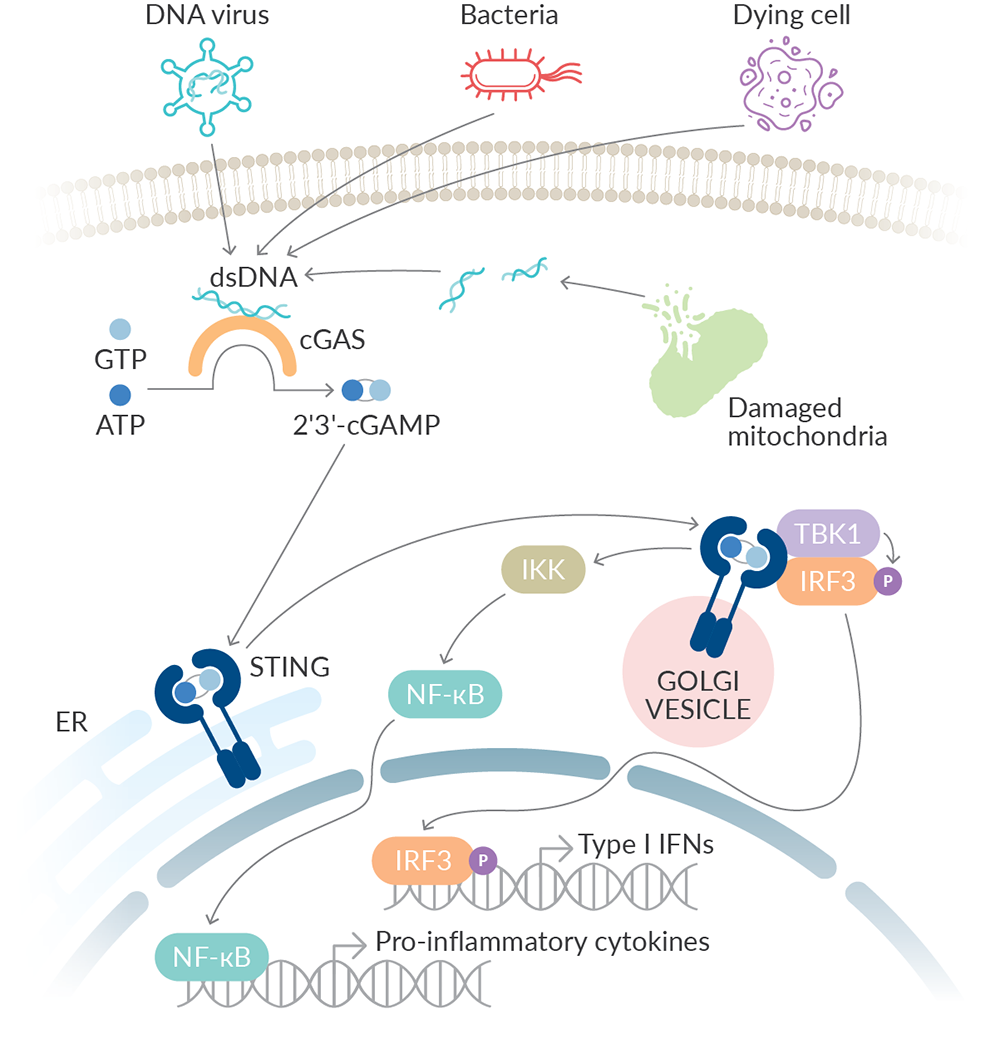
2'3'-cGAMP produced by cGAS is recognized by STING. Downstream signaling leads to production of type I IFNs and pro-inflammatory cytokines.
While activation of cGAS by pathogen-associated DNA and the production of 2'3'-cGAMP are important in host defense, they can also play a role in the development of autoimmune diseases that are characterized by increased expression of IFN-stimulated genes. Additionally, cGAS is activated in response to mitochondrial DNA leakage, which is associated with metastatic phenotypes and age-associated inflammation in cancer, and the accumulation of extrachromosomal telomere repeat DNA that results in IFN expression and inhibition of cell proliferation.
Inhibiting cGAS activity can suppress IFN-stimulated gene expression and decrease type I IFN production. This is of particular interest in searching for novel ways to treat autoimmune diseases. Conversely, activation of cGAS activity may have therapeutic utility in detecting tumor-derived DNA and promoting antitumor immune responses. Though the cGAS-STING pathway has several antitumor roles, persistent inflammation and chronic activation of STING can paradoxically promote tumor growth and metastasis, initiating negative feedback to downregulate immune responses. Thus, the protumor functions of the pathway should be considered in the design of any treatments. Cayman, in conjunction with the expert nucleotide scientists at Biolog Life Science Institute in Germany, has developed a set of assay kits to help discover novel compounds to further develop these immunotherapies and help optimize new therapeutics targeting the cGAS-STING pathway.
cGAS Inhibitor Screening Assay Kit
Novel modulators (inhibitors or stimulators) of human cGAS can be identified and characterized using Cayman's cGAS Inhibitor Screening Assay Kit. This easy-to-use platform is performed in two stages and can be completed in about three hours. First, a reaction is conducted wherein cGAS, DNA, ATP, and GTP are combined in the presence of experimental modulators. Any 2'3'-cGAMP produced by this reaction is then quantified via a highly sensitive competitive ELISA using a 2'3'-cGAMP-specific antiserum. By measuring the production of 2'3'-cGAMP, the activity of the cGAS enzyme can be determined.
cGAS Inhibitor Screening Assay workflow. cGAS, DNA, ATP, and GTP are mixed with experimental modulators in reaction tubes. Any 2’3’-cGAMP produced by the reaction is then measured by a competitive ELISA using a specific antiserum. Complete instructions on using this kit can be found in the kit booklet (PDF).
This kit conveniently packages an active cGAS enzyme, necessary substrates, and all the assay components needed, including optimized buffers and 96-well plate, to run the ELISA. The cGAS inhibitor CU-76 is also included as a positive control to ensure proper assay performance. The researcher only needs to provide the experimental cGAS modulators. The ELISA portion of the kit is robust and extremely sensitive with a standard curve range of 4.57-10,000 pM, a midpoint of approximately 300 pM (50% B/B0), a sensitivity (80% B/B0) of approximately 50 pM, and an LLOD of 5 pM. This powerful tool can be used to discover cGAS modulators and profile candidate compounds for inhibitor potency. Example data using this kit is shown below.
Example Z' data for the cGAS Inhibitor Screening Assay Kit from 36 replicates each for control and cGAS inhibitor (CU-76)-treated samples. Red dotted lines represent three standard deviations from the mean for each control value. Z' = 0.73. | Inhibition of human, recombinant cGAS by cGAS inhibitor CU-76 displaying an IC50 value of 108 nM. Data are plotted as the mean of multiple ELISA dilutions ± the standard deviation. Vehicle control (Veh.) represents 100% initial activity. |
Download the scientific poster to learn about the development and validation of our cGAS Inhibitor Screening Assay.
cGAS TR-FRET Inhibitor Screening Assay Kit
Our newest assay kit for identification and characterization of human cGAS modulators is the cGAS TR-FRET Inhibitor Screening Assay Kit. It uses a robust and easy-to-use time-resolved Förster resonance energy transfer (TR-FRET) platform and is performed as a homogenous assay that can be completed in just an hour and a half. This assay utilizes a mouse anti-rabbit monoclonal IgG directly labeled with a europium (Eu3+) chelate as a donor molecule and fluorescently labeled 2'3'-cGAMP as the acceptor molecule. In the presence of an anti-2'3'-cGAMP antibody, the donor and acceptor are brought into close proximity resulting in a FRET from the donor to the acceptor upon excitation of the Eu3+-conjugated IgG at 340 nm and an emission from the acceptor at 665 nm.
cGAS TR-FRET Inhibitor Screening Assay Kit scheme. Eu3+-labeled IgG and fluorescently labeled 2’3’-cGAMP are brought into close proximity by an anti-2’3’-cGAMP antibody. Excitation of Eu3+ at 340 nm results in FRET to the labeled 2’3’-cGAMP and an emission at 665 nm. When cGAS, DNA, ATP, and GTP are mixed with experimental modulators, any 2’3’-cGAMP produced by the reaction will displace the labeled 2’3’-cGAMP, reducing the FRET signal. Complete instructions for using this kit can be found in the kit booklet (PDF).
In the assay, production of 2’3’-cGAMP by cGAS in the presence of dsDNA, ATP, and GTP results in the displacement of fluorescently labeled 2’3’-cGAMP from the anti-2’3’-cGAMP antibody, c ausing a loss of TR-FRET signal, whereas inhibition of cGAS activity maintains the signal. As with the ELISA-based cGAS Inhibitor Screening Assay Kit, the researcher only needs to provide the experimental cGAS modulators. Included in the kit are the active human cGAS enzyme, all fluorescent components and substrates, optimized buffers, the cGAS inhibitor CU-76 to be used as a positive control, and a 96- or 384-well assay plate. This homogenous assay is ideal for high-throughput screening of large compound libraries for the identification of cGAS modulators. Example data using this kit is shown below.
Example performance data for the cGAS TR-FRET Inhibitor Screening Assay Kit from 48 replicates each for vehicle control and 100 μM cGAS TR-FRET Inhibitor (CU-76)-treated samples. The red lines correspond to three standard deviations from the mean for each control value. Z’ = 0.80. | Inhibition of recombinant human cGAS by cGAS TR-FRET Inhibitor (CU-76) displaying an IC50 value of 1,225 nM. Data are plotted as the mean of triplicate measurements ± the standard deviation. Vehicle control (Veh.) represents 100% initial activity. |
Choosing the Right cGAS Inhibitor Assay Kit
When choosing between Cayman's cGAS Inhibitor Screening Assay Kits, it is important to consider your specific project needs and available equipment. Below is a side-by-side comparison of key features of each kit that can help you choose the most appropriate one for your application.
| cGAS Inhibitor Screening Assay Kit (Item No. 701930) | cGAS TR-FRET Inhibitor Screening Assay Kit (Item No. 702120) | |
| Platform | ELISA | TR-FRET |
| High Sensitivity | Yes | No |
| Compatible with high-throughput screening? | No | Yes |
| Plate format | 96-well plate | 96- and 384-well plates |
| Sample numbers | 24 samples in triplicate | 30 samples in triplicate (96-well plate format) or 126 samples in triplicate (384-well plate format) |
| Steps | Multi-step assay, requires plate washing | Single plate, homogenous assay |
| Assay run time | 3 hours | 1.5 hours |
| Readout | Plate-based colorimetric readout (Abs. = 450 nm) | Plate-based, time-resolved fluorometric readout (Ex. = 340 nm; Em. = 615 and 665 nm) |
| Required instrumentation | Plate reader capable of measuring absorbance at 450 nm | TR-FRET-capable plate reader with appropriate filters |
Still unsure of which kit is best for your experiment? Contact our experts in Technical Support.
2'3'-cGAMP ELISA Kit
For researchers who want to detect 2'3'-cGAMP directly in their cell lysate samples, Cayman offers a stand-alone 2'3'-cGAMP ELISA Kit. This ELISA employs a different 2'3'-cGAMP-specific antiserum than used in the cGAS Inhibitor Screening Assay Kit, and exhibits a standard curve range of 9-148,000 pM, a midpoint of 1,350 pM (50% B/B0), a sensitivity (80% B/B0) of 126 pM, and an LLOD of 14 pM. However, the principle of the assay remains consistent with that of the ELISA portion of the cGAS Inhibitor Screening Assay Kit. In addition to the specific antiserum, the necessary tracers, standard, substrate, buffers, and 96-well plate needed to run the ELISA are included in the kit. This ELISA can be run overnight at your convenience or incubated for just two hours without compromising the sensitivity. By monitoring 2'3'-cGAMP levels in cells, this kit will help identify compounds that modulate cGAS activity in a biological setting.
Download the scientific poster to learn about the development and validation of our 2'3'-cGAMP ELISA.
Additional Tools to Study cGAS Activity
cGAS recombinant proteins, a monoclonal antibody, and a set of potent inhibitors are also available from Cayman to study this area of therapeutic interest.
cGAS (human, recombinant)
cGAS (161-522) (human recombinant)
cGAS Monoclonal Antibody (Clone 5G10)
cGAS Inhibitors:
CU-76
CU-32
G150
RU-521
PF-06928215
You May Also Be Interested In
 Cyclic Dinucleotides: Ubiquitous Cellular Messengers |  Helping Recruit Immune Cells to Cancer |
| | |
 cGAS/STING Activation in Neurodegenerative Diseases |  STING Signaling Pathway Brochure |
| | |
Contact Info
Cayman Chemical1180 East Ellsworth RoadAnn Arbor, Michigan 48108 USAToll Free: (800) 364-9897(USA and Canada only)Fax: (734) 971-3640


