
News & Announcements
Tools to Study SARS-CoV-2-Host Interactions
Article from 2020-04-06
Severe acute respiratory syndrome coronavirus 2 (SARS-CoV-2) is a positive-sense, single-stranded RNA virus that causes coronavirus disease 2019 (COVID-19). This virus shares 79.5% sequence identity with SARS-CoV. All coronaviruses consist of several key proteins, including a spike (S) protein, a membrane (M) glycoprotein, an envelope (E) protein, and a nucleocapsid (N) protein, to facilitate infection. The S protein mediates viral entry into host cells by binding to the host angiotensin-converting enzyme 2 (ACE2) receptor, which enables the fusion of viral and host membranes.
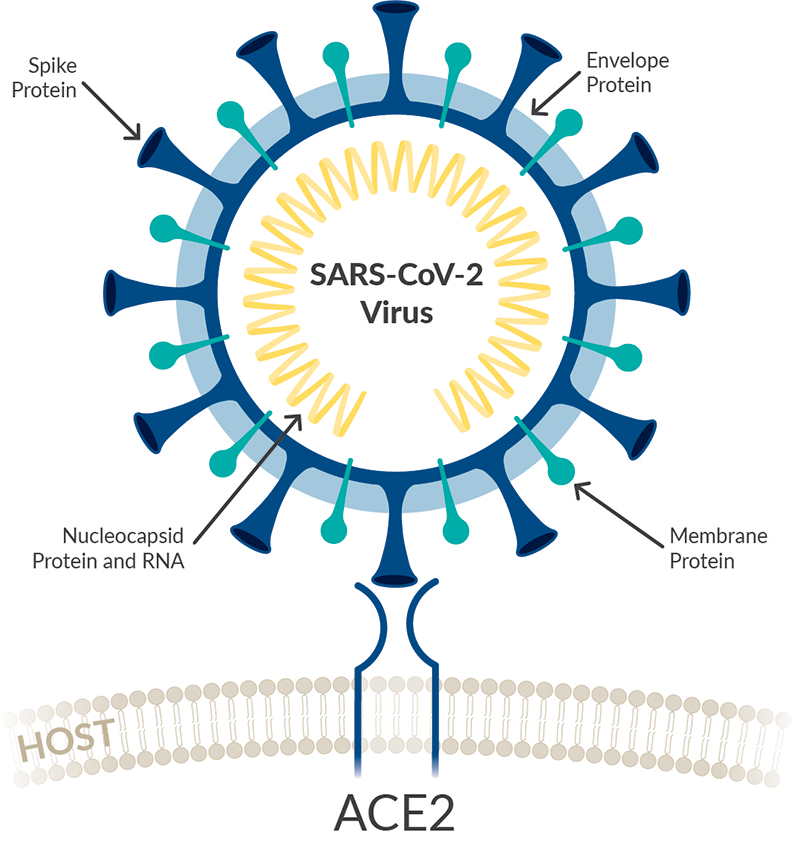
Coronaviruses, including SARS-CoV, SARS-CoV-2, Middle East respiratory syndrome coronavirus (MERS-CoV), and infectious bronchitis virus (IBV), fuse at the plasma membrane or use receptor-mediated endocytosis and fuse with endosomes, depending on the cell or tissue type. This virus-receptor interaction allows the viral genome to be delivered to the host cell cytoplasm for replication. The E protein facilitates assembly and release of the virus. The M protein provides structure to the virus and binds to the N protein, which binds to RNA helping to tether the viral genome to the replicase-transcriptase complex and package the encapsulated genome into viral particles. One focus for treating the infection is on identifying agents targeting these viral proteins and host cell receptors in order to minimize and block viral replication.
ACE2 Antibodies
ACE2 is a functional receptor that acts as an entry point into human lung cells for coronaviruses and plays a key role in both cross-species and human-to-human transmissions of the virus. A better understanding of the SARS-CoV-2-ACE2 interactions can lead to the development of anti-infective strategies such as ACE2 protein blockade or the development of neutralizing antibodies. Cayman offers the following ACE2 antibodies that are cross reactive to human tissues.
| Antibody | Host | Applications |
| ACE2 (human) Monoclonal Antibody (Clone AC18F) | Mouse | ELISA, flow cytometry, and Western blot |
| ACE2 (human) Monoclonal Antibody - Biotin (Clone AC18F) | Mouse | ELISA, flow cytometry, and Western blot |
| ACE2 (human) Monoclonal Antibody (Clone AC384) | Mouse | ELISA and Western blot |
| ACE2 (human) Monoclonal Antibody (Clone AC384; preservative free) | Mouse | ELISA (direct or indirect), Western blot (using ECL) |
| ACE2 Polyclonal Antibody | Rabbit | ELISA, Western blot |
ACE2 Inhibitor Screening
While ACE2 is known to bind to SARS-CoV-2 spike, it also plays a role in regulating blood pressure. Thus, while ACE2 inhibitors may be beneficial against coronavirus infection, they may dually increase angiotensin II-induced hypertension, susceptibility to atherosclerotic plaques, myocardial dysfunction, and insulin resistance, thereby exacerbating COVID-19 comorbidities. Cayman’s ACE2 Inhibitor Screening Assay Kit provides a robust and easy-to-use platform to be used as a counter-screen for potential drug candidates to ensure they do not interfere with the normal physiological functions of ACE2. The assay uses an ACE2-specific fluorogenic substrate, Mca-APK (Dnp). ACE2 cleaves this substrate generating free Mca, which is quantified using a fluorescence plate reader. The kit includes a potent, reversible ACE2 inhibitor MLN-4760 as a positive control.
SARS-CoV-2 Proteins
SARS-CoV-2 viral proteins and antibodies can be useful to understand the infectious strategies of the virus in order to identify possible treatment routes. SARS-CoV-2 surface glycoprotein, also known as the spike protein, is located on the outer envelope of the virion. It is comprised of an S1 and S2 subunit divided by a furin S-cleavage site not found in other SARS-CoVs. The S1 subunit contains the N-terminus and a receptor binding domain, and the S2 subunit contains a fusion peptide, two heptad repeats, and the C-terminal domain. Cayman’s SARS-CoV-2 Spike Glycoprotein (433-506) contains the SARS-CoV-2 Spike Glycoprotein Receptor Binding Motif and a disulfide bridge between Cys480 and Cys488. The spike glycoprotein receptor binding motif is contained within amino acids 438-506, whereas the SARS-CoV-2 Spike Glycoprotein Receptor Binding Domain represents amino acids 319-541 of the full-length SARS-CoV-2 spike protein. These binding domain proteins are available with human or rabbit IgG-Fc tags or a His-tag to enable simple detection or purification. The SARS-CoV-2 Nucleocapsid Protein packages the viral RNA into a helical ribonucleoprotein complex that is a template for viral replication. It is integral for viral self-assembly and is involved with regulation of the cell cycle.The SARS-CoV-2 main protease (Mpro), also known as 3C-like protease (3CLpro), cleaves non-structural proteins 5-16 (nsp5-16), which, together with the nsp1-4, form the SARS-CoV-2 replication and transcription complex, which is critical for the viral replication cycle. The SARS-CoV-2 Papain-like Protease is a non-structural protein that helps to form the replicase complex. It also reverses certain post-translational modifications from host proteins, helping to suppress the host innate immune response. The SARS-CoV-2 nsp9 is an RNA binding protein that is likely important for RNA binding and viral replication. The SARS-CoV-2 nsp16 Methyltransferase has a role in 5'-end capping of viral mRNAs, which facilitates increased translation of viral mRNAs and reduced innate immune recognition by the host cell. The SARS-CoV-2 nsp13 Helicase functions as both an RNA helicase and a nucleoside triphosphate hydrolase that may also help suppress the host immune response. Cayman’s SARS-CoV-2 proteins can be used as antigens or for Western blot, ELISA, protein-protein interaction studies, or other in vitro binding and in vivo functional assays.
SARS-CoV-2 Proteins
SARS-CoV-2 Spike Glycoprotein (433-506)
SARS-CoV-2 Spike Glycoprotein S1 Subunit
SARS-CoV-2 Spike Glycoprotein S2 Subunit
SARS-CoV-2 Spike Glycoprotein Receptor Binding Domain (human IgG1 Fc-tagged)
SARS-CoV-2 Spike Glycoprotein Receptor Binding Domain (rabbit IgG1 Fc-tagged)
SARS-CoV-2 Spike Glycoprotein Receptor Binding Domain (His-tagged)
SARS-CoV-2 Spike Glycoprotein Receptor Binding Motif
SARS-CoV-2 Nucleocapsid Protein
SARS-CoV-2 Papain-like Protease
SARS-CoV-2 nsp13 Helicase (E. coli expressed)
SARS-CoV-2 nsp16 Methyltransferase
SARS-CoV-2 Main Protease Inhibitor Screening
Novel inhibitors of SARS-CoV-2 Mpro can be identified using Cayman's SARS-CoV-2 Main Protease Inhibitor Screening Assay Kit. The assay uses a SARS-CoV-2 Mpro-specific fluorogenic substrate containing a cleavage site found between nsp4 and nsp5. SARS-CoV-2 Mpro cleaves this substrate separating an EDANS fluorophore from a Dabcyl quencher generating free EDANS, which can be easily quantified using a fluorescence plate reader. The SARS-CoV-2 Mpro inhibitor GC376 is included as a positive control. The SARS-CoV-2 Mpro inhibitors Mpro Inhibitor 11a and Mpro Inhibitor 11b are available separately. Covidyte™ EN450, Covidyte™ TF670, Covidyte™ ED450, and Covidyte™ IF670 are also available to be used as fluorogenic substrates for SARS-CoV and SARS-CoV-2 Mpro to quantify Mpro activity.
SARS-CoV/SARS-CoV-2 Antibodies
SARS-CoV, the causative agent of SARS, shares close homology with SARS-CoV-2 and both can bind to human ACE2. We offer antibodies that can bind both SARS-CoV and SARS-CoV-2 with high affinity to study receptor binding, membrane fusion, virus/host specificity, and vaccine design. Antibodies to a chimera of SARS-CoV and SARS-CoV-2 spike and nucleocapsid proteins as well as SARS-CoV S1 subunit and nucleocapsid proteins are available.
SARS-CoV/SARS-CoV-2 Antibodies
SARS-CoV/SARS-CoV-2 Spike Glycoprotein Chimeric Monoclonal Antibody
SARS-CoV Spike Glycoprotein S1 Subunit Monoclonal Antibody
SARS-CoV Spike Glycoprotein S1 Subunit Polyclonal Antibody
SARS-CoV/SARS-CoV-2 Nucleocapsid Protein Monoclonal Antibody (Clone 001)
SARS-CoV/SARS-CoV-2 Nucleocapsid Protein Monoclonal Antibody (Clone 005)
SARS-CoV/SARS-CoV-2 Nucleocapsid Protein Polyclonal Antibody
SARS-CoV Nucleocapsid Protein Polyclonal Antibody
SARS-CoV-2 Spike-ACE2 Interaction Assay Kit
The SARS-CoV-2-ACE2 interaction is a potential target for reducing viral infection. Recombinant human soluble ACE2 inhibits SARS-CoV-2 attachment to cells, and antibodies in convalescent plasma or those directly raised against the SARS-CoV2 spike glycoprotein reduce viral entry in vitro. The broad expression of ACE2 allows SARS-CoV-2 to disrupt function in a wide variety of cells and tissues, but the mechanism of SARS-CoV-2-ACE2 binding provides multiple targets that can potentially be exploited to reduce cellular infection and the severity of COVID-19.
Cayman’s SARS-CoV-2 Spike-ACE2 Interaction Inhibitor Screening Assay Kit provides a robust and easy-to-use platform for identifying novel inhibitors of the SARS-CoV-2 spike and ACE2 interaction. The assay uses a recombinant rabbit Fc-tagged SARS-CoV-2 spike S1 RBD that binds to a plate precoated with a mouse anti-rabbit antibody. A recombinant His-tagged ACE2 protein binds the spike RBD and the complex is detected with an HRP-conjugated anti-His antibody. This assay includes a control for competition of the SARS-CoV-2 spike RBD-ACE2 interaction.
As a companion kit, the SARS-CoV-2 Spike S1 RBD-ACE2 Binding Cellular Imaging Assay Kit provides a sensitive and unique imaging platform for identifying novel modulators of SARS-CoV-2 spike S1 RBD and ACE2 binding. This assay uses Cayman’s proprietary reverse transfection platform to express human ACE2 on the surface of cells for binding by a recombinant rabbit Fc-tagged SARS-CoV-2 spike S1 RBD protein. Binding of the spike S1 RBD to ACE2 is detected with a DyLight™ 550-conjugated anti-rabbit Fc antibody by fluorescence imaging. A positive control neutralizing antibody is included to inhibit the binding between the SARS-CoV-2 spike S1 RBD and ACE2.
Serological Testing & Validation
After SARS-CoV-2 infection, immunoglobulin antibodies such as IgA, IgM, and IgG appear in blood. The IgM antibodies serve as early indicators of infection, and the IgG antibodies indicate recent and past infection. IgA antibody is found in mucous membranes, mainly in the respiratory and digestive tracts. The secreted antibodies provide protection against future infections from viruses because they remain in the circulatory system for months to years after infection and will bind quickly and strongly to the pathogen to block cellular infiltration and replication. These antibodies are named neutralizing antibodies.
The SARS-CoV-2 Neutralizing Antibody Detection ELISA Kit enables semi-quantitative identification of neutralizing antibodies in human plasma or serum. It is designed to detect any circulating antibodies—independent of isotype—that block the interaction between the viral spike glycoprotein RBD with the ACE2 cell surface receptor and was validated using plasma from volunteers that tested positive in a PCR test for COVID-19. The competitive ELISA includes a SARS-CoV-2 neutralizing antibody as a standard that was carefully tested to ensure its interference with the ACE2 protein for binding sites on the SARS-CoV-2 spike S1 RBD.
Learn more about this assay by reading the application note:
Seropositivity Testing for SARS-CoV-2 Neutralizing Antibodies
The SARS-CoV-2 Human IgG (4-plex) ELISA is also available for qualitative detection of SARS-CoV-2 reactive IgG class antibodies in human serum and plasma. As a multiplex assay, this kit enables simultaneous detection of human antibodies to the SARS-CoV-2 S1 protein, SARS-CoV-2 S2 protein, a negative control (Sheep Fc), and a positive control (anti-human IgG). The presence of the positive and negative control in each well allows the user to have confidence the assay was performed in accordance with the instructions for use. The kit also includes a high and low control sample. The 96-well plate format of the kit allows for testing of up to 90 samples in less than two hours while using only 2 μl of sample, making it an efficient and cost-effective solution for population studies.
Serological SARS-CoV-2 ELISAs
SARS-CoV-2 Neutralizing Antibody Detection ELISA Kit
Q-Plex™ SARS-CoV-2 Human IgG (4-Plex)
Cayman's SARS-CoV-2 (human) Neutralizing Recombinant Antibody disrupts the S1-RBD-ACE2 interaction and can be used for ELISA, immunofluorescence, and Western blot applications. The antibody recognizes the SARS-CoV-2 spike glycoprotein at approximately 65 kDa.
A set of human serum that is positive or negative for SARS-CoV-2 neutralizing antibodies as well as serum collected pre-pandemic that is negative for SARS-CoV-2 neutralizing antibodies are available as controls for validation experiments.
SARS-CoV-2 Neutralizing Antibody Positive/Negative Controls
SARS-CoV-2 Neutralizing Antibody Human Plasma Control Set
SARS-CoV-2 Neutralizing Antibody Human Serum Control Set
SARS-CoV-2 Neutralizing Antibody-Positive Human Serum
SARS-CoV-2 Neutralizing Antibody-Negative Human Serum
SARS-CoV-2 Neutralizing Antibody-Negative Pre-pandemic Human Serum
You May Also Be Interested In
 |  |
| Using Existing Therapeutics Against SARS-CoV-2 | Uncovering the Role of BRD2 in COVID-19 |
Explore more Infectious Disease research tools
Contact Info
Cayman Chemical1180 East Ellsworth RoadAnn Arbor, Michigan 48108 USAToll Free: (800) 364-9897(USA and Canada only)Fax: (734) 971-3640


