
Lipids in Health & Disease
Dyslipidemias, Cardiovascular Disease, & Metabolic Disorders
Excess LDL cholesterol, low HDL cholesterol, and other lipid abnormalities are among the causal factors of coronary heart disease, giving rise to atherosclerosis and a gradual obstruction of vessels and diminishing blood flow. Excess lipid accumulation and disordered lipid metabolism are also related to the pathogenesis of obesity, insulin resistance, type 2 diabetes, metabolic syndrome, and NAFLD/NASH. PPARs mediate the effects of a variety of lipid ligands on gene transcription, targeting genes involved in lipid transport and metabolism, thereby making them targets for developing therapeutics for these diseases.
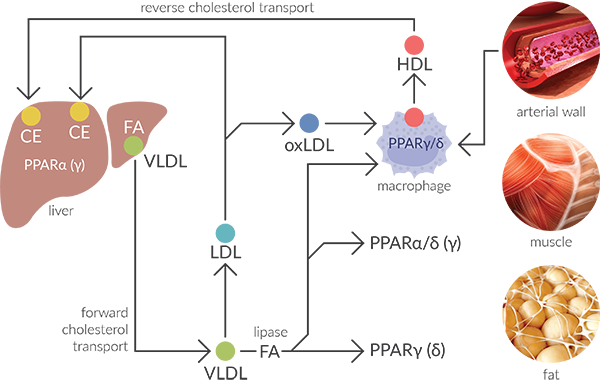
TARGETING PPARs: A GUIDE TO FUNCTION AND STRUCTURE
While PPARs display a high degree of homology at the protein level, each subtype exhibits distinct, noninterchangeable roles in energy metabolism that range from energy burning to energy storage.
DOWNLOAD THE GUIDELipids in Cancer
Lipids are major players in cancer development and growth through mechanisms such as increased lipid oxidation, acylation of proteins, disrupted lipid metabolism in autophagy, or dysregulated angiogenesis and proliferation signals mediated by lipids. Dietary PUFAs, especially ω-3, may have inhibitory effects on tumors. Changes in ganglioside composition are linked to the deregulation of cellular signals that control cell proliferation and migration. Gangliosides in malignant cells serve as detectable biomarkers and are promising targets for anticancer therapies such as anticancer antibodies, natural ganglioside vaccines, anti-ganglioside-specific CAR-T cells directed at particular tumor cells, and selective glycosphingolipid synthesis inhibitors. Targeting enzymes and receptors that are important for maintaining lipid homeostasis, metabolism, and signaling have also been shown to reduce cancer growth and metastasis.
Explore additional tools, resources, and services for cancer research
VISIT OUR CANCER RESOURCE CENTERPotential Roles of Lipids in COVID-19
The acid sphingomyelinase/ceramide system plays an important role in SARS-CoV-2 infections. Its activity on the cell surface results in membrane changes that mediate viral entry and may be a very promising target for preventing infections such as COVID-19. It has been suggested that PUFAs freed from plasmalogens and converted to modulators of the inflammatory response are characteristic of both the onset and the severity of COVID-19. Lipid droplets also have roles in infections, serving as assembly platforms for viral proteins. Pharmacological prevention of lipid droplet formation inhibits SARS-CoV-2 replication and reduces the production of mediators of a pro-inflammatory response. Lipid biomarkers for platelet activation and antiplatelet agents that prevent thrombosis have also become a focus in the development of therapeutics to combat the complications associated with the disease. Resolvins and EETs have additionally been examined for their ability to promote endogenous inflammation resolution mechanisms and enable a return to tissue homeostasis.
Learn more about resolving inflammation in COVID-19
READ THE ARTICLELipid Peroxidation & Ferroptosis
Reactive oxygen species (ROS) induce lipid peroxidation of polyunsaturated fatty acids (PUFAs). Such oxidation can stress the redox balance in biological systems and is involved in many pathologies including atherosclerosis, neurodegenerative diseases, and cancer. Ferroptosis is an iron-dependent form of programmed cell death driven by lipid peroxidation. It is associated with the oxidation of PUFAs, such as arachidonic and adrenic acyl chains, in phospholipids through enzymatic and non-enzymatic processes, which generates ferroptotic signals that navigate a cell towards programmed death. Cayman provides several convenient methods to detect the presence of lipid ROS, and our scientists are experts in building the tools needed to study how oxidized lipids are involved in the ferroptotic process.
LEARN MORE ABOUT VARIOUS FERROPTOSIS MEDIATORS FROM OUR FERROPTOSIS PATHWAY GUIDE AND ARTICLE.
READ THE PUBLICATION
CD8+ T cells regulate tumour ferroptosis during cancer immunotherapy
University of Michigan researchers, in collaboration with Cayman Chemical, found that increased oxidized lipids in tumor cells lead to ferroptosis and cancer cell death, as one of the effects of immunotherapy.
Lipid Storage Diseases
Lipid storage diseases are a group of inherited metabolic disorders in which harmful amounts of lipids accumulate in the lysosomes of various tissues and cells due to deficiencies of specific enzymes necessary for their proper metabolism. Over time, this excessive accumulation can cause permanent damage to the brain, peripheral nervous system, liver, spleen, and bone marrow. Several main sphingolipidoses affect the glycosphingolipid pathway: Farber's, Gaucher, Niemann-Pick, Krabbe, metachromatic leukodystrophy, Fabry, sialidosis, Tay-Sachs, Sandhoff, and GM1 gangliosidosis. Cayman offers many glycosphingolipids as well as specific enzyme inhibitors and LC-MS/MS enzyme activity assay workflows that are ideal for studies involving these sphingolipidoses.
LYSOSOMAL STORAGE DISORDERS
Explore the LC-MS/MS assay workflows and the wide range of glycosphingolipid standards associated with the ten main sphingolipidoses.
DOWNLOAD THE BROCHURESkin Barrier
The epidermal lipid matrix made up of cholesterol, free fatty acids, and very long-chain ceramides in the outermost layer of skin is crucial to the skin’s barrier function by preventing excessive water loss and blocking environmental compounds from permeating the epidermal and dermal layers where they would cause an immune response. Sebaceous lipids including triglycerides, wax esters, squalene, and free fatty acids also offer waterproofing, antioxidant, and antimicrobial functions important for the epidermal barrier. Variations in carbon chain lengths and double bonds can provide a wide variety of skin barrier ceramides. Cayman offers cis-6-hexadecenoic acid (sapienic acid) and esterified ω-hydroxy sphingosines (EOS) as research tools to help better understand the arrangement of lipids in the skin barrier.
Learn more about the role for ω-hydroxy VLCFA ceramides in the skin’s lipid matrix
READ THE ARTICLEContact Info
Cayman Chemical1180 East Ellsworth RoadAnn Arbor, Michigan 48108 USAToll Free: (800) 364-9897(USA and Canada only)Fax: (734) 971-3640


