
Filter by TypeClear Filters


Application notes (5)

Brochures (4)

Cayman Currents (2)

Guides (3)

Lab Wall Posters (1)

Scientific posters (1)

Webinars (6)

Filter by CategoryClear Filters


Forensic Chemistry & Toxicology (22)

Neuroscience (3)
Displaying 1 - 22 of 22 Results

Creating Custom Cannabis CRM Mixtures: Forty-seven Phytocannabinoids, One HPLC Method

Application notes


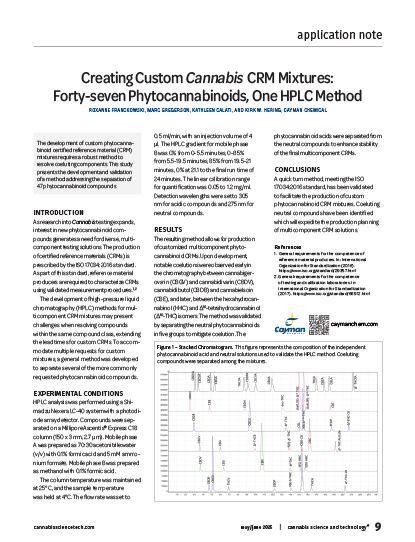
The development of custom phytocannabinoid certified reference material (CRM) mixtures requires a robust method to resolve coeluting components. This study presents the development and validation of a method addressing the separation of 47 phytocannabinoid compounds.

Highlights:

  • Chromatography was run on 47 phytocannabinoid compounds (12 acid and 35 neutral).
  • Co-eluting neutral compounds were identified and segregated for the acceptable validation of an HPLC method. 
  • This method supports Cayman’s quick turn production of custom phytocannabinoid CRMs.

To cite this application note: Franckowski, R., Gregerson, M., Calati, K., et al. Creating Custom Cannabis CRM Mixtures: Forty-seven Phytocannabinoids, One HPLC Method. Application Note, Cayman Chemical (2025).
Download Copy (PDF)
custom cannabis crm mixtures method

Semi-Synthetic Cannabinoids: An Emerging NPS Overview and Case Study on In-Vitro Metabolism

Webinars


Semi-synthetic cannabinoids (SSCs) represent an emerging class of Novel Psychoactive Substances (NPSs) that are often advertised and sold as legal. SSCs can be described as partially synthetic materials that are derived from natural components of the Cannabis Sativa L. plant, such as Cannabidiol (CBD). New studies on the in-vivo and in-vitro metabolism of SSC’s, such as Δ10-THC, Δ6a,10a-THC, and HHC, are emerging, which detail the similarities and differences seen to natural phytocannabinoid like Δ9-THC.


Alicyn Stothard and Jonathon Bassman, synthetic organic chemists at Cayman Chemical, discuss the overall landscape of newly emerging SSCs and their metabolism, along with a case study utilizing LC/MS-based identification of putative in-vitro metabolites for the SSC’s Δ10-THC and Δ6a,10a-THC.

Presented as part of the CFSRE's 2025 Current Trends in Forensic Toxicology Symposium.

Do you have a question or comment for the presenter? Let us know.

Metabolic Profiling of the Semi-synthetic Tetrahydrocannabinols (THCs), Δ10-THC and Δ6a,10a-THC, Using Human Liver Microsomes and LC/MS

Webinars


The pharmacology of several naturally occurring phytocannabinoid constituents of Cannabis sativa L., such as Δ9-THC, has previously been studied and well-documented in the scientific literature. However, since the deregulation of hemp in the 2018 USDA Farm Bill, new semi-synthetic structurally related isomers, analogs, and homologs have emerged, presenting new chemical entities with unknown metabolic profiles.

Listen as Nathan Layle, a synthetic organic chemist at Cayman Chemical, discusses the LC/MS-based identification of putative in vitro metabolites of the semi-synthetic tetrahydrocannabinols Δ10-THC and Δ6a,10a-THC.

Presented as part of the 77th Annual Scientific Conference of the American Academy of Forensic Sciences.

Do you have a question or comment for the presenter? Let us know.

​NPS Snapshot: Semi-synthetic Cannabinoids

Guides


Semi-synthetic cannabinoids rapidly emerged in the United States in response to legislative reforms that loosened Cannabis restrictions. Often marketed as “legal” alternatives to Δ9-THC, semi-synthetic cannabinoids have been widely sought after for both medicinal and recreational purposes. This NPS Snapshot summarizes the structures of the various semi-synthetic cannabinoids as well as key historical dates and known pharmacology.

To cite this NPS snapshot: Williams, J.B. and Hering, K.W. ​NPS snapshot: semi-synthetic cannabinoids. Cayman Chemical (April 2025).
Download Copy (PDF)

Creating Custom Cannabis CRM Mixtures: Forty-seven Phytocannabinoids, One HPLC Method

Scientific posters


Production of certified reference materials (CRMs) is prescribed by the conformity assessment standard ISO 17034:2016. Creating multi-component mixtures can present arduous challenges to ensure these criteria are met. 

This poster addresses the challenges of separating 47 phytocannabinoids for method validation and the considerations for the stability of the final CRM solutions. 

Do you have a question or comment for the presenter? Let us know.

To cite this poster: Franckowski, R., Gregerson, M., Calati, K., et al. Creating custom Cannabis CRM mixtures: Forty-seven phytocannabinoids, one HPLC method. Poster presented at: The AOAC International Annual Meeting; August 23-28, 2024. Baltimore, MD.


Download Copy (PDF)

Intoxicating Hemp and Synthetic Cannabinoids: Insights into Lab Testing

Webinars


Intoxicating hemp and synthetic cannabinoids have permeated the cannabis market, but there are not many regulatory requirements for production and product testing. The disparity in quality and safety between cannabinoid-containing products found in state-legal dispensaries and those available in gas stations or smoke shops is significant and concerning. Moreover, there's a general lack of awareness among lawmakers about the intricacies of laboratory testing and the distinctions between natural and synthetic cannabinoids.

Key Learning Outcomes: 
  • Learn more about various compounds like THC, THCa, THCP, THCjd, HHCP, and others. 
  • Understand the nuanced differences in testing requirements for products labeled as "hemp-derived" versus "Cannabis-derived." 
  • Examine the potential risks and public health and safety concerns associated with unregulated cannabinoid-containing products.
Hosted by the GMP Collective as part of the When Things Go Wrong series. 

Isomers, Homologs, and Analogues of THC - Challenges for Identification and Separation of New Psychoactive Substances

Webinars


Loopholes in the 2018 Farm Bill legislation have led to an increase of psychoactive THC products within the marketplace. Listen as Jeffrey B. Williams, Manager of Phytocannabinoid R&D at Cayman Chemical, discusses isomers, homologs, and analogues of tetrahydrocannabinol. Learn about the structural differences of new psychoactive products that are appearing showing up in Cannabis and Cannabis-based products, as well as associated challenges in identification and separation of these substances. 

Presented as part of the 2023 Current Trends in Forensic Toxicology Symposium

Do you have a question or comment for the presenter? Let us know.

GC Separation for Identification of iso-THC Contaminants and Accurate Quantification of Δ8 -THC and Δ9-THC in Cannabis Samples

Application notes


Key Features

  • Synthetic conversion of cannabidiol (CBD) to the tetrahydrocannabinols (THCs) Δ9-THC and Δ8 -THC produces measurable quantities of the iso-THC products Δ8-iso-THC and Δ4(8)-iso-THC.
  • Co-elution of THCs and iso-THCs makes C18 reversed phase-HPLC (RP-HPLC) methods unsuitable for the quantification of THCs. Quantities of THCs are distorted if the testing methods are unable to resolve the iso-THCs in analyzed samples.
  • Gas chromatography (GC) offers a reliable and robust method for quantification of Δ9-THC, Δ8-THC, Δ8-iso-THC, and Δ4(8)-iso-THC. Additionally, this method represents a method for identifying THC derived from CBD conversion.

To cite this application note: Williams, J.B., Liu, J., and Hering, K.W. GC separation for identification of iso-THC contaminants and accurate quantification of Δ8-THC and Δ9-THC in Cannabis samples. Application Note, Cayman Chemical (2023).

Download Copy (PDF)

​The Magic and Chemistry Behind Psychedelic Mushrooms

Webinars


The revival of research into psychedelics as medicine has given rise to increased interest in psilocybin-containing fungi. Psilocybin and its active metabolite psilocin are currently undergoing numerous clinical trials for various maladies such as depression, PTSD, addiction recovery, and smoking cessation among others. Given this renewed interest it is important to consider the chemistry behind these tryptamines as well as appropriate sample preparation, storage, and preferred handling conditions. Listen as Danielle St. Germaine, a scientist from Cayman’s Forensic Chemistry Division, discusses the biosynthesis pathways, analytical considerations and challenges, and handling and preparation recommendations for psilocybin and psilocin.

Presented during Analytical Cannabis’s Advances in Psilocybin Research webinar.

Do you have a question or comment for the presenter? Let us know.

​Phytocannabinoid Known Unknowns

Webinars


Learn about exciting developments in the world of Cannabis testing with Cayman scientist, Jeffrey Williams. In this webinar Jeffrey discusses details about degradation pathways and phytocannabinoids. 

Hosted by Emerald Scientific as part of their webinar series.

Do you have a question or comment for the presenter? Let us know.

​​Cayman Currents Issue 34: Phytocannabinoids: What Is on the Horizon?

Cayman Currents


As Δ9-THC remains a controlled substance in almost all countries, new avenues are opening for the other non-regulated Cannabis constituents. Much is still left to be uncovered in knowing how Cannabis stimulates the endocannabinoid system in the body and to substantiate its anecdotal and scientific merits as a potential therapeutic. Cayman continues to keep an eye on the horizon by supporting law enforcement agencies in the quick identification of illicit synthetic cannabinoids, legal Cannabis industry purveyors in the safe manufacture of their products, and basic science researchers in the pursuit of understanding the endocannabinoid system and how it is affected by Cannabis.

Articles:

Note: Since the printing of this issue, we have updated the article ​"International Regulation and Control of Hemp and Cannabinoids" and the phytocannabinoid reference table in our digital version.
Download Copy (PDF)

​Mycotoxin Analytical Standards

Brochures


We understand that identifying mold and mycotoxins, such as aflatoxins and ochratoxin A, that can naturally contaminate hemp and Cannabis during its cultivation, transportation, storage, and even processing, is crucial to the assurance of your quality and safety testing. Linked to kidney and liver damage, reproductive disorders, and immune suppression as well as some being identified as potent carcinogens, mycotoxins are a known risk within the food safety industry. Cayman’s Mycotoxin Mixture CRM and single-component standards have been designed with consumer safety in mind to help you carry out mycotoxin analysis as part of your essential testing program.
Download Copy (PDF)

Certified Reference Materials for the Cannabis Industry: Solving the Production Puzzle

Guides


​As more analytical laboratories involved in Cannabis testing fall under regulatory and/or accreditation requirements, they are expected to utilize CRMs when available. This article outlines several production steps Cayman considers when creating a CRM to address questions frequently heard from our customers about how compounds are selected to be made into CRMs and how long it takes to produce them. 

This article was first published in the July/August issue of Terpenes and Testing.

Download Copy (PDF)

​Comparison of CRM Concentrations Among Four Different Reference Material Producers

Application notes


​Key Features

  • ISO-certified CRMs from multiple manufacturers are employed by analytical facilities to identify Cannabis components and report potency values.
  • Reference material consistency across vendors is needed to ensure accuracy of reporting.
  • We compare the reported concentration of 11 individual cannabinoid CRMs from four different reference material producers.
  • No significant variability in CRM concentrations exists among products produced under the ISO 17034 standard, reaffirming the competence of manufacturers.

To cite this application note: Goodwin, S.K., Franckowski, R.E., and Edwardsen, J.T. ​Comparison of CRM Concentrations Among Four Different Reference Material Producers. Application Note, Cayman Chemical (2020).

Download Copy (PDF)

​Improved Potency Testing

Guides


​Want to streamline your Cannabis potency testing and cannabinoid profiling? Watch how different reference standard preparation methods stack up and see why testing labs are implementing Cayman’s pre-made, multi-component CRM mixtures into their workflows. Cayman offers a suite of CRM mixtures for mass spectrometry applications. The Phytocannabinoid 10 Mixture (CRM) featured in this video contains ten phytocannabinoids prevalent in Cannabis.

Access the data in our application note: CRM Mixtures Improve Quantitation Accuracy.

​Phytocannabinoid CRM Mixtures

Brochures


Traceable reference materials are essential for measurement accuracy in Cannabis product quality testing and profiling. Cayman provides a collection of pre-made, multi-component phytocannabinoid mixtures as well as fast turnaround of custom mixtures from our ISO 17034 labs to support quantitation workflows.

Features: 
  • Reduce time, consumable cost, and reproducibility errors associated with preparing standard curves from individual standards
  • Provides ISO 17034 traceability of measurement results
  • Intended for direct snap-and-inject analysis in HPLC-UV or LC- or GC-MS applications
Download Copy (PDF)

Analytical Data Confidence is Highest with Commercially Prepared CRM Mixtures

Application notes


High-quality reference materials with established metrological traceability are an essential element for measurement accuracy during routine analytical checks as well as for Cannabis product quality testing and profiling. We compare two different methods using certified reference materials (CRMs) to generate a standard for the quantitation of ten prevalent phytocannabinoids against a calibration curve to show that premade multicomponent CRM mixtures improve quantitation accuracy.

To cite this application note: Miller, M.G., Goodwin, S.K., and Franckowski, R.E. Analytical data confidence is highest with commercially prepared CRM mixtures. Cannabis Science and Technology 2(4), 2-3 (2019).
Download Copy (PDF)

CRM Mixtures Improve Quantitation Accuracy

Application notes


​Key Features:

  • High-quality reference materials with established metrological traceability are an essential element for measurement accuracy.
  • Reproducibility errors that arise during standard curve preparations using certified reference materials (CRMs) may stem from inherent variability around pipetting procedures.
  • We compare two different methods to generate a standard for the quantitation of ten prevalent phytocannabinoids against a calibration curve.
  • Pre-made, multi-component CRM mixtures save time and consumable cost in the preparation of standard curves and improve quantitation accuracy during routine analytical checks as well as Cannabis product quality testing and profiling.
To cite this application note: Miller, M.G., Goodwin, S.K., and Franckowski, R.E. CRM mixtures improve quantitation accuracy. Application Note, Cayman Chemical (2019).
Download Copy (PDF)

Cannabis Testing Standards

Brochures


As the Cannabis industry grows, various stakeholders are working towards standardization within the industry. To identify and quantitatively measure the components found in a Cannabis product, Cayman offers analytical reference standards and ISO 17034-produced Certified Reference Materials. Along with single-component standards for potency testing, terpene profiling, and analysis of contaminants, we specialize in the production of pre-made, multi-component mixtures that are designed to improve quantitation accuracy and streamline workflows.
Download Copy (PDF)

Phytocannabinoid Analytical Standards

Brochures


Almost 150 structurally and physiologically distinct cannabinoid compounds are unique to Cannabis, known collectively as phytocannabinoids. Cayman provides authentic reference standards for more than 120 unique phytocannabinoids for identification, detection, and quantification. Cayman also offers a suite of ISO 17034-produced multi-component CRM mixtures designed and engineered to the highest industry standards to streamline the quantitation of multiple phytocannabinoids.
Download Copy (PDF)

​Phytocannabinoid Guide: Biosynthesis, Naming, and Numbering

Lab Wall Posters


Updated Februrary 2024

More than 100 structurally and physiologically distinct cannabinoid compounds are unique to plants of the genus Cannabis, known collectively as phytocannabinoids. Here we present the biosynthesis and degradation pathways of phytocannabinoids derived from the olivetol, varinol, and orcinol series and explain the conventions that have been adopted for nomenclature and structure numbering systems.

To cite this poster: St. Germaine, D.M. ​and Williams, J.B. Phytocannabinoid Guide: Biosynthesis, Naming, and Numbering. February 2024.

​Cayman Currents Issue 26: Forensic Chemistry: Cannabinoid Degradants

Cayman Currents


Synthetic cannabinoids were originally designed and synthesized as molecular probes to characterize structure-activity relationships and to elucidate the biological basis and pharmacological properties of the chemical constituents in Cannabis.

Download Copy (PDF)
Displaying 1 - 22 of 22 Results

