
Creating Custom Cannabis CRM Mixtures: Forty-seven Phytocannabinoids, One HPLC Method
Scientific posters
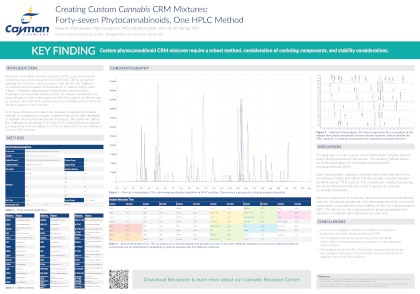
Production of certified reference materials (CRMs) is prescribed by the conformity assessment standard ISO 17034:2016. Creating multi-component mixtures can present arduous challenges to ensure these criteria are met.
Characterization of Hexahydrocannabinol Diastereomers by NMR, HPLC, GC-MS, and TLC
Scientific posters
This poster provides information that can aid in the correct identification and differentiation of the products resulting from hydrogenation of Δ8- and/or Δ9-THC
Do you have a question or comment for the presenter? Let us know.
To cite this poster: Stothard, A., Layle, N., Martin, M., et al. Characterization of Hexahydrocannabinol Diastereomers by NMR, HPLC, GC-MS, and TLC.
Synthesis, chemical characterization, and µ-opioid receptor activity assessment of the emerging group of “nitazene” 2-benzylbenzimidazole synthetic opioids
Scientific posters
Do you have a question or comment for the presenter? Let us know.
Respiratory Depressant Effects of Fentanyl Analogs
Scientific posters
Opioid-related fatalities involving synthetic narcotics have reached unprecedented levels. This study evaluated the respiratory depressant effects of seven fentanyl analogs that have either emerged in the recreational drug marketplace or been identified in toxicological analyses following fatal or non-fatal intoxications and for which their effects on ventilation had not been previously characterized. These results establish that the respiratory depressant effects of these fentanyl analogs are at least in part mediated by opioid receptors.
Do you have a question or comment for the presenter? Let us know.
To cite this poster: Varshneya, N.B., Hassanien, S.H., Holt, M.C., et al. Respiratory depressant effects of fentanyl analogs. Poster presented at: American Society for Pharmacology and Experimental Therapeutics Virtual Meeting; April 27-30, 2021.
Analytical Data Confidence is Highest with Commercially Prepared CRM Mixtures
Scientific posters
Conclusions
- Although making a mixture from individual components (Method A) generates results within tolerable limits, this data is not as accurate as data generated from a pre-made solution (Method B).
- CRMs provide a metrologically traceable standard that is reliable and accurate but can be compromised when mixing multiple standards together to create a mixture.
- Using a multi-component CRM solution, such as the Phytocannabinoid Mixture 10, will not only save time and cost—it will provide more reliable data than attempting to create a mixture from individual components.
Generation of Presumptive Metabolites of a Novel Synthetic Opioid Using Human Liver Microsomes and Subsequent Analysis by Orbitrap LC-MS/MS
Scientific posters
There is mounting evidence that 2-methyl AP-237, an acylpiperazine opioid, is being trafficked and detected in seized materials and drug screens. While compounds like U-47700 are the most prevalent synthetic opioids after fentanyl, new classes continue to emerge from published patents and journal articles. For this reason, we studied 2-methyl AP-237, a member of one of these new opioid classes, to explore what metabolites would arise from incubation with human liver microsomes (HLM). Analysis of these oxidative metabolites of 2-methyl AP-237 by LC-MS/MS can be used to inform what metabolites (and ultimately what corresponding masses) toxicologists may see in a blood or urine screen.
Do you have a question or comment for the presenter? Let us know.
To cite this poster: Layle, N., Hassanien, S., Holt, M.C., et al. Generation of presumptive metabolites of a novel synthetic opioid using human liver microsomes and subsequent analysis by Orbitrap LC-MS/MS. Poster presented at: Society of Forensic Toxicologists (SOFT) Annual Meeting 2019; October 13-18, 2019; San Antonio, TX.
Differentiation of Isobaric and Isomeric Fentanyl Analogs by Gas Chromatography-Mass Spectrometry (GC-MS)
Scientific posters
The structural similarities and isomeric nature of fentanyl analogs makes their differentiation a big challenge. The combination of mass spectrometry (MS) with gas chromatography (GC) is a promising way to solve the problem. In the present study, 60 fentanyl analogs, including structural and geometric isomers, were analyzed by GC-MS. An extracted ion chromatogram (EIC) function was used to select key fragments of the fentanyl analogs. Relative retention time (RRT) was used to minimize the impact of retention time variation. Oven temperature was determined to be critical to achieving successful separation. By slowing down the rate of the oven temperature program, complete chromatographic separation and baseline resolution of more than 1.5 was achieved. In this study, the effects of tuning type were also investigated. Tuning of the mass spectrometer affected the ratio of the characteristic fragment ions. However, isomers could not be differentiated by simply altering tuning type as they would likely have similar fragments with the same tuning method. (You can also download supplemental material for this poster.)
Do you have a question or comment for the presenter? Let us know.
To cite this poster: Liu, J. and Franckowski, R.E. Differentiation of isobaric and isomeric fentanyl analogs by gas chromatography-mass spectrometry (GC-MS). Poster presented at: AAFS 71st Annual Scientific Meeting; February 18-23, 2019; Baltimore, MD.
Developing Direct Analysis in Real Time Mass Spectral Libraries for the General Unknown Screening of Drugs
Scientific posters
- There is an ever increasing need for rapid and more specific drug screens to combat current and emerging drug abuse trends.
- In the past, synthetic cathinones and cannabinoids were heavily prevalent in the United States. The trend has since drastically shifted towards opioid abuse.
- Drug abuse trends are constantly shifting, creating difficulties and challenges for their detection.
- Here a DART-MS drug library has been created using a software program developed in-house. The data was acquired using a mobile single quadrupole mass spectrometry platform. This database can be used for the general unknown screening of a wide range of drug compounds.
Do you have a question or comment for the presenter? Let us know.
To cite this poster: Li, F., Tyler, A., Repaska, M., et al. Developing direct analysis in real time mass spectral libraries for the general unknown screening of drugs. Poster presented at: 66th ASMS Conference on Mass Spectrometry and Allied Topics; June 3-7, 2018; San Diego, CA.
Identification Of Fentanyl-Type Opioids Using GC-MS Fragmentation Data
Scientific posters
Do you have a question or comment for the presenter? Let us know.
The “K2” Epidemic: Preliminary Results of a Health Department’s Synthetic Cannabinoid Receptor Agonist (SCRA) Surveillance Project
Scientific posters
Do you have a question or comment for the presenter? Let us know.
Automated Ion Trap Library Screening Method for the Detection of Synthetic Cannabinoids in Commercial Herbal Incense Products
Scientific posters
Recently, Goda et al have identified synthetic cannabinoids in 44 of 46 herbal incense products. In an effort to determine the scope of this new designer drug phenomenon, our lab has prepared several synthetic cannabinoid standards and developed an automated method to screen for and positively identify these compounds in commercial herbal incense products.
Do you have a question or comment for the presenter? Let us know.
To cite this poster: Kennedy, P.D., Collin, W.R., and Buddenborg, T.P. Automated ion trap library screening method for the detection of synthetic cannabinoids in commercial herbal incense products. Poster presented at: 26th Annual Symposium of the International Cannabinoid Research Society (ICRS); June 26-July 1, 2016; Bukovina, Poland.
Development of a chiral LC-MS/MS approach for measuring metabolites of the synthetic cannabinoids JWH-018 and AM2201
Scientific posters
The Importance of Collaborations Between Private and Public Health Laboratories in Response to Designer Drugs of Abuse
Scientific posters
Do you have a question or comment for the presenter? Let us know.